When Mountains Move
They rode until the horses’ breath looked like torn silk and the stars began to pale, and still the dragon kept the distance it preferred—near enough to own the horizon, far enough to flatter hope. It slid from ridge to ridge without hurrying, a continent that had decided to follow a rumor. By the time they found a shelf of basalt with one thin line of scrub for shelter, both knew what the land already knew: there would be no camp without a reckoning.
“Here,” the gunslinger said, not because the place was good, but because it was true. The shelf offered a narrow throat where a charge would have to funnel, a tumbled scarp above for high ground, and to the east a field of glass that would turn any misstep into a lesson. He checked the cylinder, thumbed the star-iron rounds he’d poured in the House of Knots and Keys, and felt the quiet rightness of their making. Hope loosened her sling and set the phoenix book where her hand could find it without thinking. Neither spoke of calling.
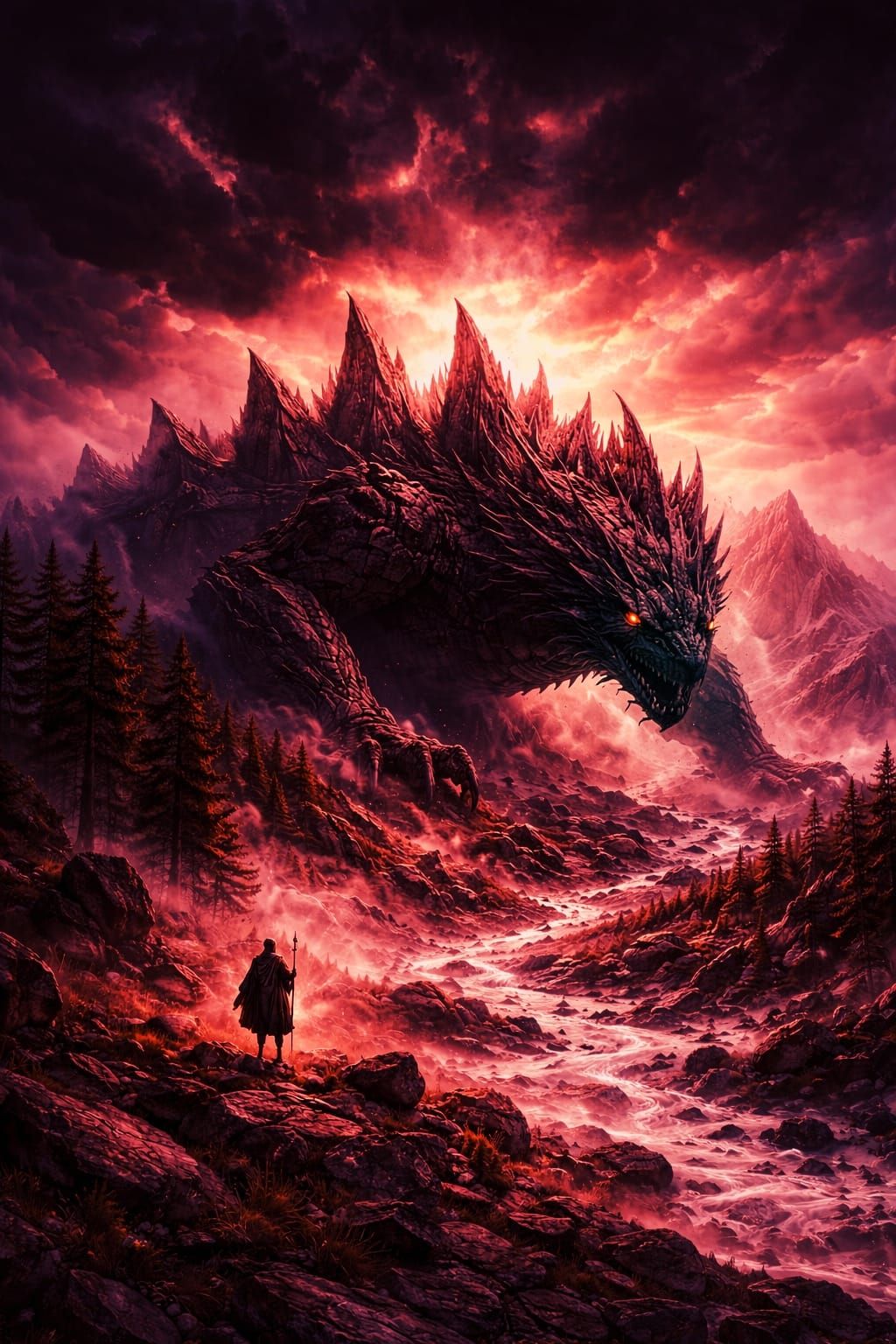
The dragon came the way storm comes to a mountain—first as pressure, then as intention. It gathered itself along the ridge opposite and turned its head, and the night turned with it. No roar: only weight, thinking aloud. Its scales weren’t scales; they were absences arranged, a script written in void.
When it uncoiled, the basalt under their boots hummed as if remembering the ocean.
The gunslinger started the work of small truths. He put a meteor-forged round far out to its left where shadow had thickened into claw, and watched blue-gold starfire bite and hold; the dragon’s foot found its own outline and earned a limp. He walked a line of shots along the jaw when it leaned in to taste their heat, and the starlight cut like an accountant—clean, exact, unimpressed. Where copper lived in the land, those rounds would have turned bindings to breath; here they scalded the dark enough to make it flinch.
Flinching buys time. He spent it.
Hope moved the ground’s memory with both hands. She spoke seams into the glass field—left-handed words that asked it to remember sand—, and for a breath the dragon’s flank sank to the shoulder. It learned fast. It lifted, faster. A sweep of its tail redrafted the basalt and sketched a map of pain across the shelf. They separated without discussing it—he to the scarp, she to the throat—make the dragon choose. It refused to choose. It came for both in one motion, the way hunger always does when it thinks it has finally been forgiven.
Steel, light, gravity; the hour narrowed to a blade. He fired—common rounds were just thunder and the blessed were bright, deliberate teeth. The dragon adapted with a mathematician’s malice, turning each answer into a new sort of question. Its breath was not fire but subtraction; wherever it passed, stars blinked out and did not hurry back.
Twice, the gunslinger felt the world tilt under him like a plate and heard his own name fall toward a hole. Twice, he found rock where one expects rock to be and set his boots on it.
“Not enough,” he said, not to her, not to the bird he would not ask for, but to the night, which did not argue.
The dragon changed weight, found the angle that was theirs and no longer theirs, and came on.
It revealed its actual size not by its length but by how the land was recalculated around it. What they had taken for a ridge was a shoulder; what they had trusted as sky was the shallow of a wing unfurling. Scales weren’t scales at all—more like facets of missing light, planes of polished absence that caught the stars and made them hesitate before deciding to continue being stars. Its hide rippled like a book closing and opening to a page nobody owned.
Along the spine, plates of night stood up like the teeth of a house key; between them, narrow seams of blue-cold glimmer ran—not illumination, exactly, but a hint of where illumination had once lived. Every movement redrafted the basalt underfoot; stones settled with the soft clatter of cutlery in a distant room.
The head came forward with a mathematician’s malice, angles that solved themselves as they appeared. Eyes were not eyes—wells where reflection went to be weighed; when moonlight entered, it came back as a ledger mark against the world. The mouth didn’t gape; it unfolded, a hinge of silence lined with knives as thin as papercuts and as long as regrets. Breathing made no steam in the cool air; instead, each exhalation shaved a sliver off the night and carried it away. Where breath touched the stars, they dimmed the way a memory does when told poorly.
Its foreclaws were draftsman’s tools, articulations so precise the ground seemed grateful to be scored by them. Each talon held the suggestion of calligraphy—strokes begun and not apologized for. The tail measured distances like a surveyor, tasting the air in arcs, knocking small boulders into new truths with the absentminded authority of weather. Wings? If they were wings, they were the negative of wind: pressure changes, sudden hollows, the feeling you get when a door closes three rooms away. Ragged edges of not-quite-feather, not-quite-membrane, they flexed and the plateau remembered oceans; they stilled, and the glass fields remembered how to be sand.
Closer, the smell arrived—not sulfur or smoke but cooled copper and the faintest bite of ozone, the scent of a storm deciding against accountability. Sound followed late and wrong: a choir of anvils swallowed, a bell struck under a blanket, the groan of old timbers in a ship that has never seen water. Even its shadow had a shadow; where it fell, the night seemed to double itself and yet lose definition, as if lines that kept the world in place had been rubbed with a thumb.
Intelligence showed in the small efficiencies: the way it kept the limp light had earned from a star-iron round hidden, shifting its weight to make sympathy into a trap; the way it mapped their escape lines and erased them with posture alone; the way it set its jaw as if biting down on a problem it had every intention of swallowing whole. It was not hungry in the simple sense. It was interested—the worst kind of interest, the kind that arrives with time to spare and no intention of leaving empty-handed.
Hope’s hand had been steady on the book for an hour’s worth of choices. It went still in a different way now. The phoenix does not arrive to rescue; it arrives to answer. She lifted her face toward the belt star that didn’t blink and laughed—a small stitch pulled tight, a bird changing its mind in flight—and spoke the word the House had given permission to use, the one she had no business knowing and had always known anyway.
Light stood up inside the book and stepped out into the air. Not a burst. A decision.
The phoenix rose, taking the shape of a mountain made from all the stars men ever called home. Blue-gold ran in its feathers like veins in living stone; its eye was an ethic, not a color. It took one breath, and the dark around them forgot its manners. Then it moved.
As if one mountain overtook another in stars and firelight, it crossed the hollow between ridge and shelf and met the dragon as peers. The hue of blue-gold in its breastbone—clean as water, old as iron—pierced the dragon’s heart and rippled outward; the void-skin split along the blow, ripping like glass shattered across marble. For a beat, they were sculpture: light and absence frozen in a lesson no hand could carve. Then the phoenix fed.
“Devours” is the word people use when they mean changes entirely. It did not chew. It did not tear. It held the dragon in its pinions and taught it a different grammar—fire without hunger, heat with purpose. Shadow sloughed from the dragon in plates and fell as ash that burned cold. The canyon wind found a voice it had not used for a century and spoke. Stars, displaced by the dragon’s breath, hurried back into their sockets.
When it was done, what remained of the dragon sifted down the scarp like dark snow and melted into the glass field without steam. The ridge exhaled, and the basalt under their boots stopped remembering oceans and remembered being rock again. The gunslinger lowered the barrel by inches; he had not known he was holding it in the air.
Hope closed the book. It was hot as a living thing, and it did not burn her. She looked older by a half-hour. The phoenix hung a moment longer, as if asking the land whether the lesson had taken, then thinned into a seam of heat that folded back on itself and went where it goes when it is not needed.
Silence stood up around them, and then something else stood up within it.
The shriek came over the plateau like a fault-line taught to sing. Not fear. Not pain. Want. Anger. Vengeance. It did not need ears; it arrived in bone and book and barrel, in the seams of the glass and the hollow of the throat. The molten thread in a far canyon surged and fell in the same instant, undecided. Every half-taught bell in the iron city below tried to ring a third note and failed, and then tried again, and failed more beautifully.
“The land knows,” the gunslinger said.
“He knows,” Hope said, and her voice—paper and unbreaking—made the night choose honesty. The dragon demon had felt the bird arrive and go to work. He had not felt fear. He had felt possession threatened.
Wind changed taste. The copper laughter that had been keeping pace from the edges of their path came closer and lost its patience. Far off, something older than the city’s furnaces stood and asked for a different set of tools.
He reloaded by habit, not because he thought bullets had much to say to what was coming, but because one should not meet a greater threat with an empty hand. The meteor’s cartridges sat like prayers that hadn’t been finished yet. Hope touched the book and felt the bird’s after-warmth, the way a candle feels the room it just taught to see.
“We can’t use it again so soon,” she said, and the book agreed along her fingers.
“No,” he said. “But does he know that?”
They did not make a fire. The ridge had learned to be a ridge again, but shadow had learned something more important: where they slept, what they loved, what they would pay to keep the light telling the truth twice. Below them, the iron city practiced half-bells, and the hyena laughter moved with intent. Above them, the hunter in the sky refused to blink.
They put their backs to the basalt and waited for the hour to choose them. The shriek receded into a threat made of time. Somewhere in the dark, what called itself all demons set a table and counted chairs. The land, now alerted, rearranged its furniture.
A greater thing was headed toward them, unhurried the way hunger is when it owns the road.