Chapter I - Volume IV: Hope’s Beginning
———
They first noticed on a wind day.
The sign over Mercy’s bar banged the wall and banged it again. The alley smelled of yeast and wet rope. A baby cried in the upstairs window and would not stop. Across the street two men had their coats off and were working up to a fight. Inside the ribbon shop the door latch stuck and the spools had thrown a snarl. The room held its breath the way a dog does before it bites.
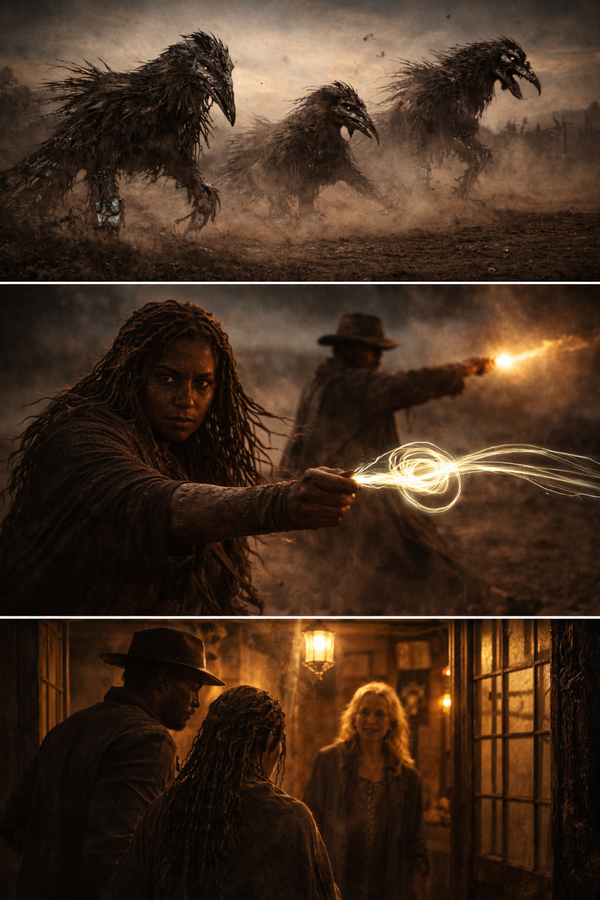
Hope came in with a basket of lemons and a school slate. She set both down and stood there, thin, dark, quiet. Growing up, before and after the sorceress had healed her, Hope had always been a thin girl with quick hands.
The sorceress watched her with the look she used for hard pages. Mercy wiped the bar and did not say anything. He had learned not to crowd a moment.
“Hand me that blue,” the sorceress said.
Hope reached. The snarl let go. The spool rolled light into her palm, the ribbon smooth and straight like it had chosen to behave. She tied a small loop the way a mother ties a child’s mitten string. The door latch slid home and stayed there. The upstairs baby hiccupped and then rested. Outside, one of the men laughed at himself, put his coat back on, and said he had work. The sign hit the wall twice more and then swung easy, like a thing reminded.
Mercy set down his rag. “Do that again,” he said.
“Do what?” Hope said.
“Nothing,” Mercy said. “Stand there. Breathe.”
Hope did not know what he wanted, so she did nothing. She breathed. A glass at the bar that had been hunting for the edge settled on its base. The bell rope by the door, frayed from years of one-note living, twitched and found its second. A chair that squeaked every time a man moved forgot to complain.
The sorceress looked at Mercy. Her voice, when she used it, was like paper turning. “You see it,” she said.
“I see something,” Mercy said.
They did not call it magic. They did not call it anything. But after that they started watching how rooms behaved when Hope was in them. A knot that never held began to hold. A hinge that bit stopped biting. People talked softer and heard more. Mercy kept count without writing it down. The sorceress tried to teach the girl a few hard tricks and found she didn’t need tricks; she needed doors told what they were.
Years later, yet still years before the gunslinger ever set foot on Wire Avenue…
The sickness left her the way a hard winter leaves a field. It did not take everything, but it took enough that the world looked new and a little mean. When she sat up for the first time without swaying, the sorceress watched her like you watch a candle in wind. Mercy watched her like you watch a door you keep expecting to open the wrong way.
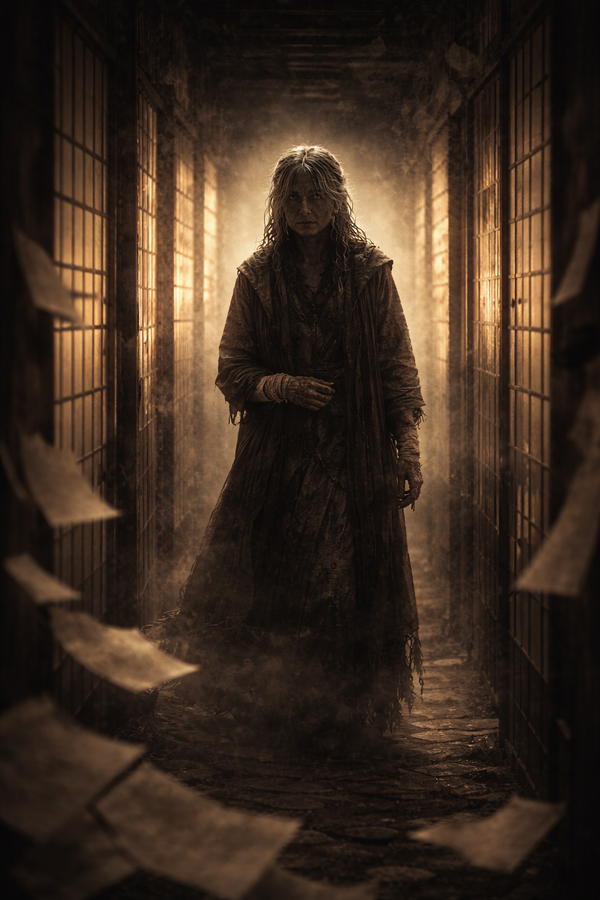
The sorceress would lay two fingers at Hope’s throat sometimes, not to feel fever, but to listen. Her fingers were cool. Her eyes were tired. Her voice had always sounded like pages turning, even before the bad things. That day it sounded like a book you can’t close.
“What?” Hope said once. She was fifteen and tired of being handled like a cup.
The sorceress drew her hand back and looked at it, as if the hand had been in water and come out changed. “You pull the room,” she said. “You don’t know you’re doing it.”
“I don’t pull anything,” Hope said.
Mercy had been wiping the counter with the same clean towel for too long. He stopped. “She does,” he said. “She pulled me into saying please yesterday. I didn’t even mean to.”
Hope looked at him, and he shrugged like it was no big thing, like it hadn’t scared him. His face was open, the way a good dog’s face is open. But his eyes had that quick worry in them.
The sorceress nodded toward the chair Hope sat in. It was an old chair, kept alive by repairs that weren’t pretty. “Do you hear it?” she asked.
Hope listened. The chair was quiet. Not quiet like dead wood. Quiet like something that had decided to behave.
“Yesterday,” Mercy said, “that chair squealed every time I sat down. Like it wanted to argue.” He glanced at the chair and then at Hope. “Now it don’t.”
Hope wanted to tell them they were both crazy. She wanted to tell them she was just a girl who had been sick and wanted the road and wanted the world to stop touching her like she might break.
The sorceress leaned in. “There’s an old friend,” she said. “Across the river. A few days’ travel. She owes me nothing, which is why I trust her.” She paused, and her eyes flickered toward Mercy, just once, the way guilt flickers before it gets trained. “She teaches children who can’t afford to be careless with what follows them.”
“I’m not a child,” Hope said.
“No,” the sorceress said. “You’re a door that keeps opening.”
Mercy cleared his throat, like he was about to tell a joke and couldn’t. “We’re not sending you away,” he said. “We’re sending you to learn how to come back.”
Hope wanted the road. She had wanted it before she got sick, when the town still felt like a hand on her shoulder. She wanted it worse now, because the town had become a place with watchers in it—Mercy watching her, the sorceress watching her, and something else watching from the edges, interested in what could be taken from a girl who didn’t know what she had.
That morning the air smelled like wet paper and rain. Mercy stood in the ribbon-shop door and put a coil of blue ribbon in Hope’s hand.
“For tying what you can’t lift,” he said.
He gave her an envelope that was heavy. “Papers,” he said. “For my friend. So I don’t worry so much.” He smiled. He worried and did not hide it.
The sorceress touched Hope’s cheek with two fingers. “Learn to mend without cutting,” she said.
Hope didn’t know what that meant. She nodded anyway, because she could feel something in the words, like a rule being set down gently.
She left at dawn with a small satchel and the ribbon tied around her wrist. She walked out past the roofs she knew and the bell that rang once and stopped like it was ashamed to finish its thought.
The road taught her towns by their quiet. Some quiet meant rest. Some quiet meant held breath. She learned to tell the difference by the way her stomach tightened.
In a tavern with a bad floor, chairs complained when anyone moved. The bar leaned. Men kept their hats on and their voices low. A boy at the next table made a face at a bitter drink and tried to swallow it like he had something to prove.
Hope let out a small laugh without thinking.
It wasn’t mean. It wasn’t for the room. It was just human, the way a cough is human.
The chair under her went still. Another chair quit. The bar eased like a back that had learned to breathe again.
Hope froze with her mouth still half-open, because she felt it—the little shift, the way the room rearranged itself around the sound. Like the air had been waiting for permission.
She tied Mercy’s ribbon around a stretcher under the table. The knot came easy. She rubbed oil into a dry joint like she’d watched Mercy do a hundred times. “You’re a chair,” she said under her breath. “Hold and be quiet.”
No one thanked her. The room felt better anyway, and that scared her more than gratitude would have.
In the next town the bell rang once and quit. The bellfounder had hands that knew metal the way fishermen know water. He let her climb the small tower. The ladder shook under her feet and she kept going because stopping made her feel watched.
She set her cheek to the bronze and took one breath and then another. She let out that same small laugh, softer now, like she was trying not to wake somebody.
The clapper moved.
“Again,” the bellfounder said.
She did it again. The bell answered itself. Not louder—right. Down below, you could feel it. In kitchens people touched their doorframes and smiled without saying why, like their bodies had remembered a promise their minds had forgotten.
“It isn’t louder,” Hope told him from the ladder.
“It’s answered,” he said, and he kissed the bell like you kiss a child’s forehead after a nightmare.
Downriver the market foamed at dusk and sugared by morning. People bought jars and said they slept. The copper taps along the plank looked busy and wrong, like they were listening to something they shouldn’t. A child stood on a crate and frowned, honest and confused.
Hope laughed again, careful this time, like she was holding a match near hay.
Frost walked the rims. The syrup cleared. It was like a window then.
The bartender stared at it like he’d seen his own thoughts.
“What did you do?” he said.
“Named what it’s for,” Hope said. She surprised herself by how sure her voice was. She shook a little salt into a glass. “Salt the froth before it hardens. Greet your first customer like you mean it. Ring the second note. Keep your copper clean.”
The bartender set both hands on the bar and leaned toward her. He was old enough to have stopped being impressed by tricks. That was why his eyes had more fear in them than wonder.
“Where you headed?” he asked.
Hope pointed downriver with her chin. “Across the river,” she said. “To a town over. To stay with a woman named Lark.”
The bartender’s mouth tightened. He glanced at the taps, then at her wrist, then away as if the room itself might be listening. “You don’t go across that river alone,” he said.
“I’m going,” Hope said.
He nodded once like he’d heard that before, from boys who didn’t come back. “Then hear this,” he said. “There are men at the landing. They ain’t ferrymen. They watch girls cross like it’s entertainment. They’ll smile at you and make you feel rude for not smiling back.”
Hope didn’t speak.
“And there’s something in the water,” he went on. He didn’t raise his voice. He didn’t need to. The whole room got quieter, like the chairs remembered to shut up. “Not a fish. Not a log. It’s wrong. When the cable hums, it hums back. I’ve heard it from the bank at night when the wind’s dead. Like a mouth under a blanket.”
Hope felt the cold lift up her spine and settle behind her ears.
“Keep your eyes up,” the bartender said. “Keep your hands to yourself. Don’t joke on that boat. Don’t bargain on that boat. If you got any prayers, don’t say ’em like you’re asking. Say ’em like you’re naming.”
He slid a small pinch of salt across the bar to her on the flat of his hand. “For your pocket,” he said. “Not for taste.”
Hope took it. “Thank you,” she said.
He nodded like a man who had done what he could. “And if you see the ferryman,” he said, “don’t look at his eyes too long. They ain’t eyes the way yours are. They don’t blink. They just… keep.”
She walked out of that town with the salt in her pocket and the ribbon tight on her wrist. The sky looked clean but the air tasted like rain that hadn’t fallen yet.
The open country came after that. The grass lay short from wind. It smelled clean and sharp, the way cold metal smells clean. She walked until her legs found the rhythm of going on without asking permission.
On the fourth day she saw the river.
It was wide and black and thick. It didn’t run so much as flex. Mist lay on it in a low sheet that hid the far bank until it wanted to show it. The air near it had the penny taste, like the world had bitten its own tongue.
The ferry cable sang sharp and wrong.
The boat shivered at the landing like it wanted to be anywhere else.
Three men stood by the slip with their hands in their pockets and their eyes on her wrist. They didn’t call out. Their watching was the hand. Their smiles were the glove.
Hope kept walking anyway.
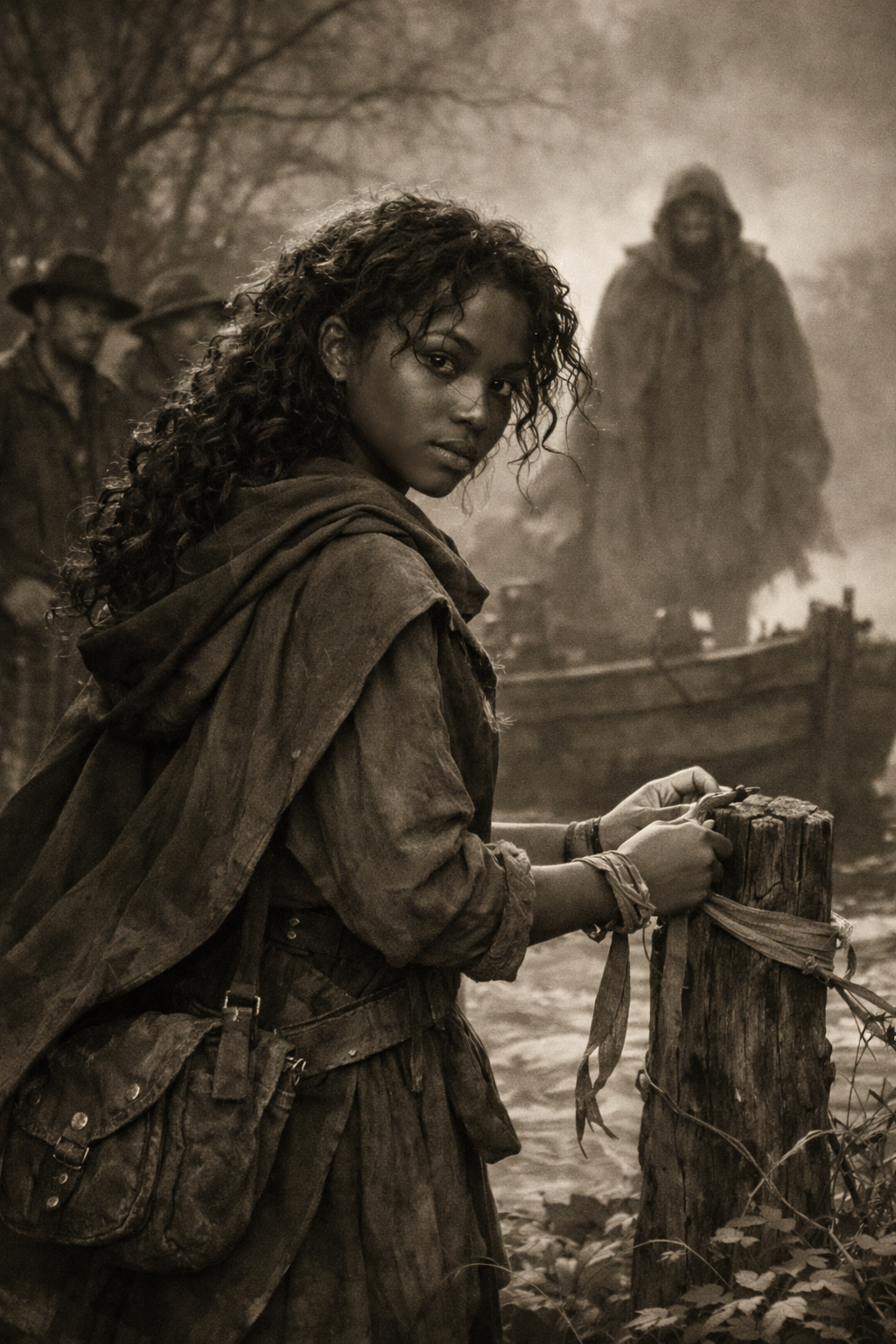
The ferryman stood up from nowhere, as if the mist had decided to make a shape and see if it could hold it. He wore a long cloak of dark cloth that had been torn and mended and torn again. It hung in strips at the hem. A hood shadowed his face so you saw the edge of it before you saw anything inside. The cloth looked wet but did not drip. It looked heavy but moved like smoke when he shifted.
His hands came out from the sleeves slow. The hands were long and clean the way old bones are clean.
He lifted his chin.
Where his eyes should have been there were two dull circles that caught the light the way coins catch it when you find one at the bottom of a cup. They didn’t shine. They didn’t look. They were simply there, set in the dark, patient as metal.
“Cross,” he said.
Hope stepped in.
The planks had ribs you could feel through the sole of your boot. She put one hand on the blue ribbon and felt the knot like an anchor.
One of the three men stepped closer. “We’ll ride too,” he said, like it was a decision he’d already made for her.
Hope didn’t answer him. She looked at the boat.
“Tell it what it is,” she said, because the bartender’s warning sat in her head like a nail.
“What?” the ferryman said. His mouth barely moved.
“The boat,” Hope said.
With a sound like an old hinge giving up, the ferryman laid his palm on the thwart. The skin of his hand did not crease. “You hold,” he told the wood. “You carry.”
The river listened like a dog you don’t trust.
Hope let out the small laugh.
The cable dropped to a true note. The boat steadied, just enough for her to feel it and not enough to feel safe.
The men hesitated. The one closest to the edge glanced at the water, and for a second the smile left his face.
They pushed off anyway. Hope did not see their feet move. One moment they were on the slip and the next they were on the boat, as if the mist had slid them.
The pole went down into the black without resistance. No wake formed. Water rose and lay back down. The current made a sound like someone speaking under a blanket. Names. Not hers. Names that felt used up.
Midstream the wind came cold from the bottom. It smelled like pennies and wet rope. The hood on the ferryman never moved.
Hope felt a handprint form in the dew on the gunwale beside her knee. The fingers were long. The thumb was on the wrong side.
“Don’t look down,” the ferryman said.
“I wasn’t,” Hope said.
“Good,” he said.
The hum climbed into her teeth. It made her want to laugh the wrong way, sharp and clever. It made her want to bargain. It made her want to say yes to anything that would end the crossing.
She thought of Mercy’s hands. She thought of the sorceress’s paper voice. She thought of Lark’s town as if it were a lamp.
She held still.
She breathed. One breath for arrival. One breath for staying.
Something moved under them—slow, huge, turning once like it was deciding which name to use. The boat rose and settled. One of the men made a small sound and swallowed it.
The ferryman’s coin eyes never blinked.
“Payment on the far side,” he said.
The far bank came out of the mist like a truth you didn’t want. The boat bumped the landing. The wood there was gray and slick like tongue.
The men stepped off fast, their bravado gone thin. They didn’t look at Hope now. They looked anywhere else.
A woman stood waiting with her hands in her apron pockets like she was trying not to show she’d been worried. She was tall and spare, with gray in her hair that looked earned. Her face was kind but not soft.
She didn’t look at the ferryman. She looked at Hope’s wrist.
“You made it,” she said.
Hope held up the envelope. “Mercy,” she said.
The woman took it, read the first line, and nodded once. “I’m Lark,” she said. “Come on. Before the river remembers you.”
Hope followed her into a town that smelled of baked bread and clean sawdust. There were no loud banners. There was a bell that rang twice without anybody bragging about it.
Lark’s house was plain. Everything inside had a job. The door closed like it meant to keep out weather, not people.
That was Lark’s first lesson. “Things like to know what they are,” she said. “People too.”
Hope stayed months.
She learned to place the laugh like you place a hand. She learned to wait without giving up. She learned to count until her body stopped arguing with fear. She learned to ask before she mended. She learned that courtesy could be a fence.
She also learned what not to do. Once she laughed wrong—sharp, embarrassed—and the room snapped back at her. A kettle rattled. A nail lifted out of the floor and dropped again like a warning. Lark didn’t scold her. She just made her sit in the doorway until her breathing stopped trying to run away.
“Don’t cut,” Lark said. “You can mend hard things, but you can’t do it angry.”
On the morning Lark said it was time to go home, she didn’t say it like a dismissal. She said it like a handoff.
“You’ve got enough to get yourself killed properly now,” Lark said, which was her way of blessing.
Hope laughed once, and it wasn’t small. It was real.
“I’ll be careful,” Hope said.
“No,” Lark said. “You’ll be deliberate.”
Hope walked back toward the river with the blue ribbon on her wrist and a new knot inside her that held steadier than fear.
At the landing, the same three men were there.
They stood where they’d stood before, but Hope could see the difference now. They were waiting for the river to do their work for them. Men like that always want the dark to be the one holding the knife.
The ferry cable sang sharp and wrong. The mist lay low.
The ferryman rose from it again, hooded, tattered, the torn hem licking at his boots like smoke. The two coin-circles sat in his face patient as metal.
“Cross,” he said.
The men moved with her. Not close. Close enough.
Hope did not step onto the boat yet.
She stood on the slip where the wood was slick and smiled at them, not kind, not cruel. Just plain.
Then she put her palm flat over her ribs.
One breath for arrival.
One breath for staying.
She felt her heartbeat answer itself. The second note in her body sat down and behaved.
She looked at the ferryman. “Tell it,” she said.
He didn’t move.
“Tell it,” Hope said again, and this time her voice had the weight of a rule.
The ferryman laid his hand on the thwart. “You hold,” he told the wood. “You carry.”
Hope’s laugh came then—soft, exact, placed like a lantern in a dark stairwell. It wasn’t for the men. It was for the crossing.
The boat stopped trembling.
The cable dropped to a true note.
The mist thinned just a little, as if the river didn’t like being told what to do but would tolerate it when asked properly.
The tallest man stepped forward anyway. He put his boot on the slip plank like he owned it.
Hope didn’t back up. She slid the blue ribbon off her wrist and held it between her hands.
“For tying what you can’t lift,” Mercy had said.
She looped the ribbon around the post and then around the ferryman’s cleat. She made a knot Lark had taught her—plain, honest, a knot that knew its job.
“This crossing is for passage,” Hope said. “Not for taking.”
The river flexed. The hum rose, curious.
The man grinned and reached for her.
Hope waited.
Then she laughed—small and exact.
The plank remembered it was a plank, not a tongue. It tipped the way boards tip when the world decides weight is a teacher.
The man’s boot slid. His knee hit the edge. His hands found air. He fell into the black without a splash that sounded right.
The water closed over him like a mouth closing on a coin.
The second man lunged—habit, greed, stupidity. He went in too.
The third man stepped back fast, his face gone pale and thin.
Hope looked at him and felt the sharp laugh try to rise. She didn’t let it.
“Go,” she said.
He ran.
The ferryman’s coin eyes stayed still. He did not thank her. He did not approve. He simply kept the crossing.
Hope stepped into the boat and sat down. She kept her hand on the ribbon knot like it was a promise.
“Hold,” she told the wood. “Carry.”
They pushed off. Midstream the cold wind came up again and tried to find her throat.
Hope did not look down.
She breathed. One. Two.
Under the boat something turned once, slow, like it was disappointed it didn’t get to eat. The hum tested her and found the second note armed.
The cable sang low and true all the way.
When Hope stepped onto the near bank, the ground felt honest. The air tasted like rain and not pennies. She did not look back.
She walked home with her knees still a little hollow, but her spine straight.
The county line came up like a remembered sentence. The sky above it was softer. Two towns on the way rang their bells twice without waiting to be told. In the third, a chair in a tavern stopped squeaking before she even sat down, like it had heard about her and decided to behave.
Wire Avenue lay ahead. Mercy stood in the bar door with a clean towel over his shoulder, like he hadn’t slept.
“Learn anything?” he said.
Hope smiled. The laugh rose and settled inside her like a small bird finding its perch and staying.
“Enough to come back,” she said. “Enough to go again.”
Inside, the sorceress pricked her finger sewing and laughed at herself, soft and real, and the sound did not cut. Outside, the street let out a breath and did not keep count.