South on the Plain, Second Note
I’ll tell you what we saw, because the road likes things said plain.
First was a city that eats attention and calls it duty. Towers in mirrors. Streets like chrome. A big counter hung over the main drag, ticking “audience” in numbers you could choke on. The steward wanted us on a stage. Hope kept walking. Children practiced the performance of their names while the chalkboard went hungry. We learned this: applause is a tax when a king collects it. The Phoenix on her shoulder broke into a thousand cold shards on every polished surface and gave no heat back. I kept my hat low and my face simple. Sometimes the only prayer is to be uninteresting.
Second was a market that keeps books on your throat. Doors opened by contract. Hinges held clauses. Favors ran on cords around wrists, color-coded like leashes. A minister in gray tried to roll us into his scroll and bill our breath. I put a bright round through a pact-hinge, feather and star singing high like a hawk. The copper went to filings. Iron stayed honest. A boy learned that a name doesn’t owe a door. A professor of rules wrote wages in a window where any neighbor could check the math and told the bell-ringer to hit the second note. He did. It sounded like a town remembering manners.
We turned south for Wire Avenue with both cities riding behind our ribs.
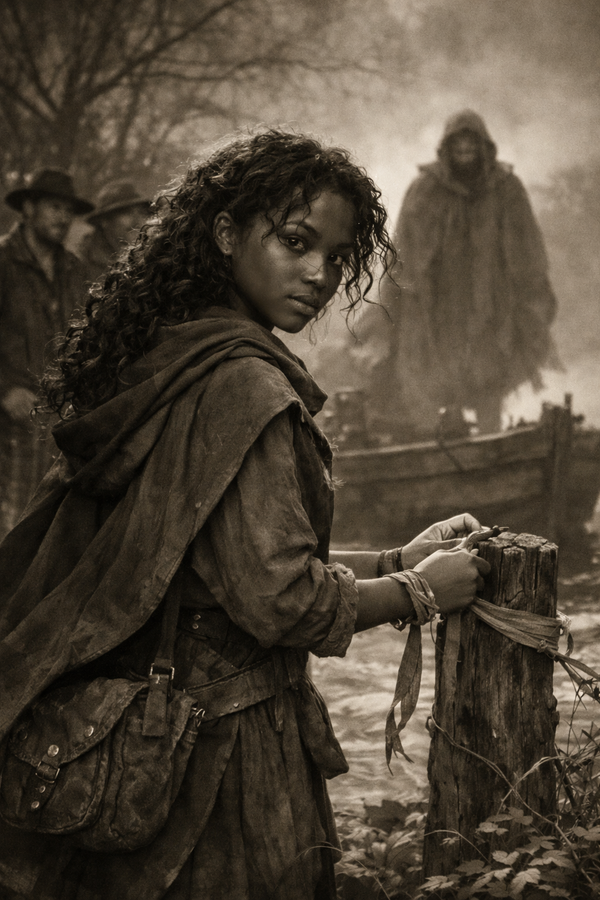
Afternoon leaned long. The horses found the old, clean gait you get when a trail knows your weight from years back. Dust rose and hung. The sky was high and, for once, not trying to be a screen. Hope had the Phoenix asleep, a coal under cloth. Her hand rested near the latch on the book. She was quiet. She’s quiet when she’s thinking and when she’s listening; the trick is knowing which.
That’s when I saw them.
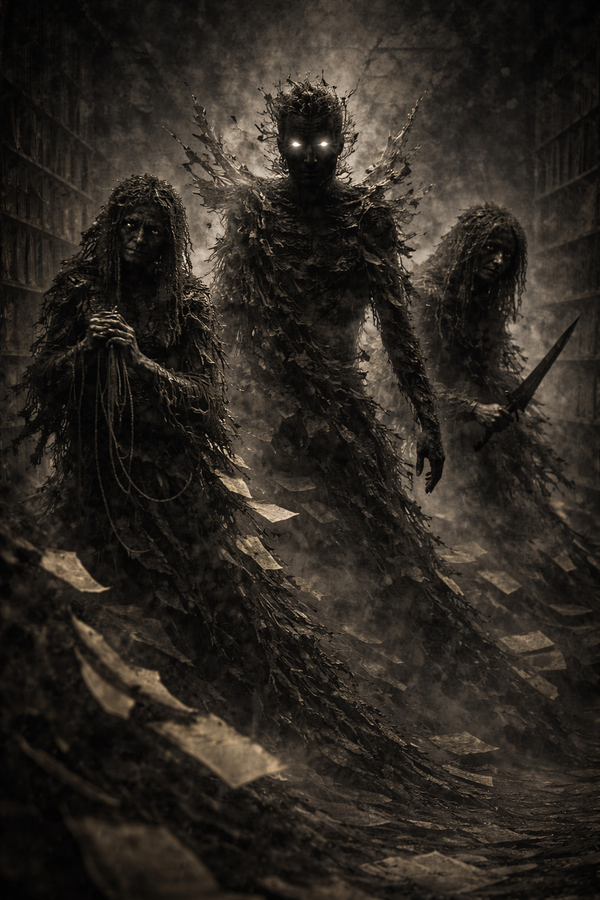
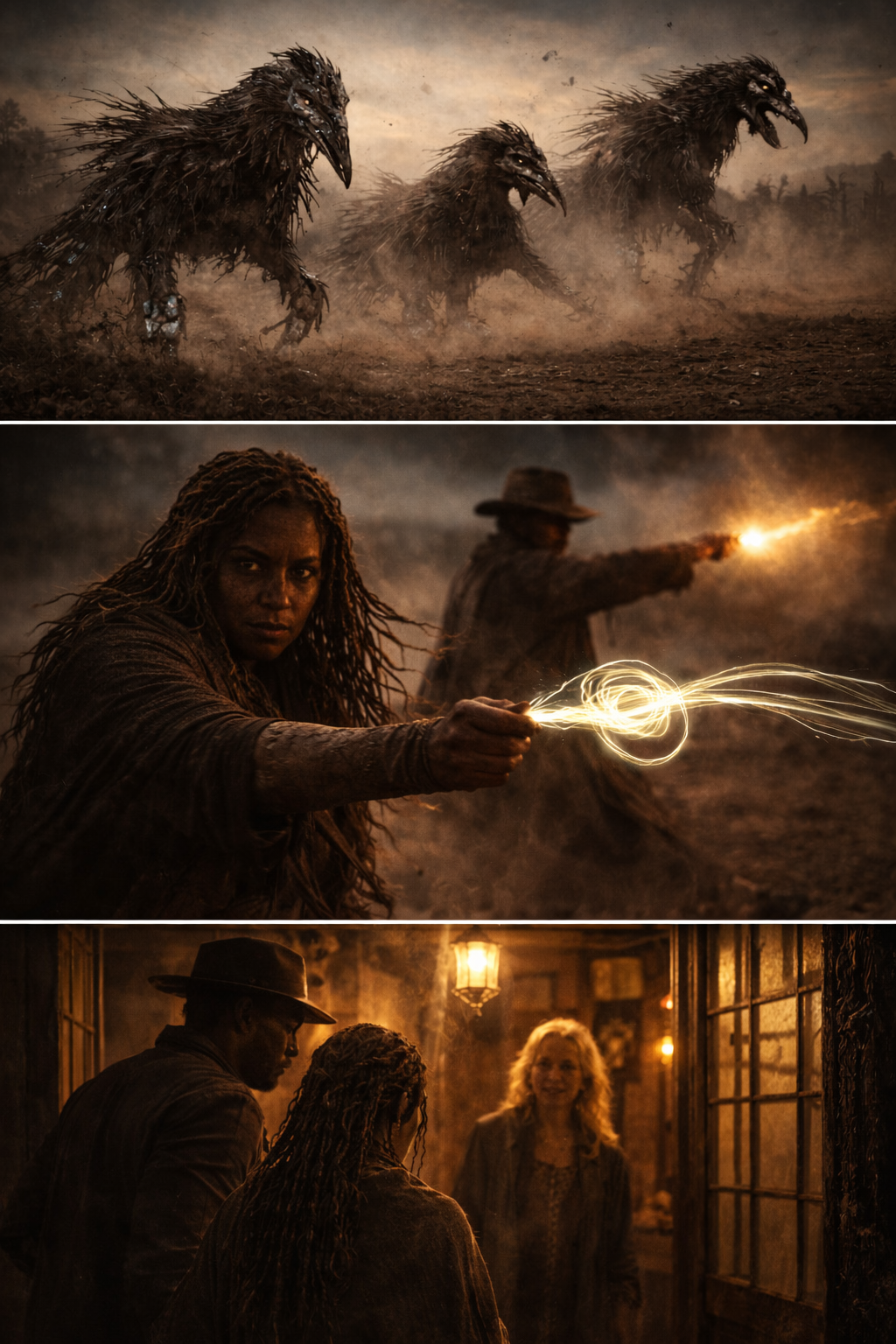
First it was the wrong kind of shadow on the fence line. Then a lift of dust where there was no wind. Then the shape of something that wanted to be a bird but didn’t have the decency to follow through. They paced us at a long angle, black against stubble. Double the size of an ostrich, bodies low and mean, wings like broken umbrellas that still remembered rain. Long shin bones like a runner’s. Beaks that were not beaks. Hooks, really. Knife-curved. Scales where feathers should sit. The sound they made, I’ll give it to you straight: wind through a bottle and teeth tapping glass.
“Company,” I said.
“I know,” Hope said, which is a thing she says when she’s already counted them and decided how much sky there is for mistakes.
There were six. Two peeled off. Four kept the flank. They didn’t crowd. They were patient the way hunger gets when it thinks it is smart. I smelled copper the way you smell a battery when a child puts it on their tongue and laughs because pain can be funny if nobody explains it.
“Hunters,” Hope said. “Not big. Fast.”
“They’ll try to cut us from ourselves,” I said. “Take the book or a name.”
“They can try,” she said, and the way she said it made me feel like a man walking under a roof that won’t fall.
They came in low from the right, the way coyotes would if coyotes had wings and a union. The lead one showed its hook and a bit of ribbon tied to its leg—a strip of mirror-tile stitched there like a favor. Courtesy of what we’d left behind.
I slid my hand down to the cylinder without waking it. Bright rounds, feather-and-star. A couple of the new ones we’d made in the House of Light, meteor dust hammered to cry like a hawk when they go. You can argue theology about whether a bullet can be blessed. I won’t. These are. They don’t just puncture; they tell the bad metal to remember it was never allowed.
“On my count,” I said.
“Count,” she said.
“One.”
The first hunter leapt, wings flared, all hook and joy. It wanted my shoulder. It wanted the book. It wanted a story that belonged to someone else. I put a round across its angle and heard the hawk-cry thread the air, thin and sure. The hook unmade, bright. The leg that carried the mirror-tile went out under it like a bad argument. It tumbled and did not get up. If you want to feel sorry for a thing like that, do it later.
“Two.”
The second came straight for Hope because some things are dumb enough to aim high. She didn’t reach for the Phoenix. She bent moonlight the way she does, quick and clean, and tied a knot in it like a woman tying back her hair to work. It caught the hunter across the eyes and turned its rush into a step the wrong way. It crashed in grass and scraped the earth like a match that chose not to light. I put a round where the pact-metal ran along its wing bone and that was that for number two.
The four at the flank opened up then. They liked the sound of their own hooks. One spat a spray that looked like dandruff and felt like fine print. It stuck to the side of my face and tried to run a clause down to my mouth. I wiped it with my sleeve and tasted penny-copper. It wanted me to say I agree without saying it. I didn’t. I said “hell” instead, and the word held.
“Three,” I said, though we’d gone past counting.
We turned it into a circle because that’s what you do when you’re outnumbered and don’t want to be out-throated. Hope rode inside my angle, close enough I could hear her breath. You can tell a lot from a person’s breath in a fight. Hers stays on the beat. I sighted quick and clean and let the rounds do the thinking. Hawk-cries. Filings. Hooks dropping like bad decisions. One of them got in close and I saw its eye. There wasn’t much there. Not hate. Not hunger. A job. That made it worse. I hit the brass ring at its ankle where a favor had been knotted and watched the whole leg remember dust in a hurry.
One of them jumped high, reckless, and came down behind Hope, wings trying to fold her in. She laughed—not at it, not even at me, just a small sound that belonged to both of us—and the air learned a better posture. It missed. The small sounds do that. They don’t change the world. They remind it. I turned my horse and broke that one’s argument at the hinge.
It took time. It took the part of your back that lives for next Tuesday. It took three reloads and the old, bad ache in the right wrist where a dragon’s breath had boiled skin once. When it was done, the field was quiet the way a room is quiet when it’s considering whether it wants you in it. Six lesser bodies. Black hooks cooling in stubble. A ribbon with a mirror square still shining on a leg that was no longer a leg.
Hope swung down. She is careful after it’s over. She went to each fallen thing and put her hand near, not on, and waited. Not for it. For herself. The Phoenix lifted the cloth and looked, and then settled again. No blaze. Not for this.
I picked up the ribbon with the mirror square and held it to the light. It threw back sky and a piece of my hat brim. The tile hummed, still trying to send. I put it in my pocket and felt the metal think there. You don’t keep trophies. You keep evidence.
“They’re doubling their bets,” I said.
“Yes,” she said. “Mirror on top. String on the legs. Blade in the hooks.”
“Anything we didn’t know?” I said.
“They’re closer,” she said. “Or hungrier.”
We rode on.
Evening peeled down. The road fell into the kind of quiet that asks for names. Wire Avenue came up the way home does when you’ve been trying not to count. First the old telegraph poles with the glass insulators like candy. Then the low fence. Then the row of light where Mercy keeps the porch lamp burning because lamps are not billboards; lamps are a way of saying you belong without making a speech.
The bell over the ribbon shop answered itself, once and then twice. I didn’t know I was waiting for it until I heard it. Mercy came to the door with a towel over his shoulder and a face that says he’d been more worried than he wanted to teach us about. He hugged Hope and put a hand out to me and left it there until I took it. He smelled like soap and coffee and the floor after a rain. If that doesn’t settle a man, nothing will.
“Trouble?” he asked, like asking if we’d brought something that might need salt.
“On the wing,” I said. “Closer than we’d like.”
He nodded once. He looks like the kind of man a town tells the truth to because he’ll measure it fair. He stepped aside. We went in.
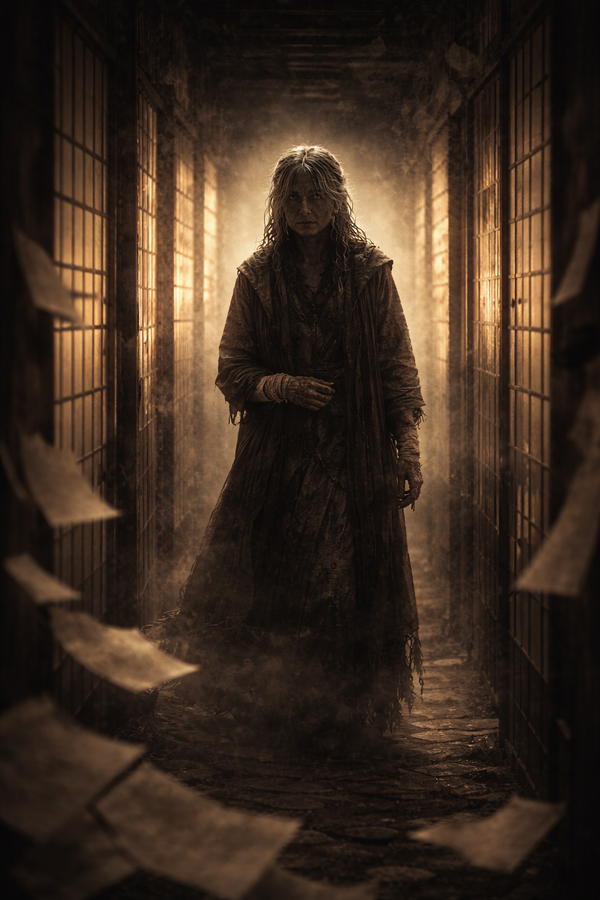
She was there. Her voice is paper turning. Her hands remember stitches. The light in that room is always a little kinder than it needs to be. She looked at Hope first and there was a thing between them that didn’t ask for my name. That’s fine. I’m not greedy.
Then she looked at me. She looked the way a person looks at a photograph in bad light and then moves the lamp without thinking. It was not dramatic. It was exact. She pressed her fingers to her throat like a woman remembering how to breathe and the bell over the door trembled without ringing.
“You,” she said, and the sound was pages and breath. “You’re the boy from the town I fled.”
Hope went very still beside me. I felt the floor under my boots decide it was a floor, not a stage. I did not say anything smart. There’s a time for that. This wasn’t it.
“Say it plain,” I said, because plain is how you mend.
“I am the woman your parents hid,” she said. “I am the reason they were hated when no one could remember why. I left because they made me leave and live. You were a boy with smoke in your hair and a door that creaked. You stood on the stoop with your hands in fists so you wouldn’t cry. I have been trying to find you since before I forgot my own name.”
The Phoenix on Hope’s shoulder lifted its head then, and the coal glowed a little brighter, the way a candle does when a window opens on purpose. The bell dared a second tremble and then answered itself—twice, clear.
So that’s how we stood: one man who’d been a boy, one woman who’d been a sorceress forgetting, one sister who laughs the room back into its job, and Mercy with a towel and a plan. Outside, the road took our dust and kept it. Somewhere behind us the little dragons cooled in stubble. Somewhere ahead the Demon braided his hungers and called it law. We were home enough to start.