Volume 3: The Night of Two Beginnings
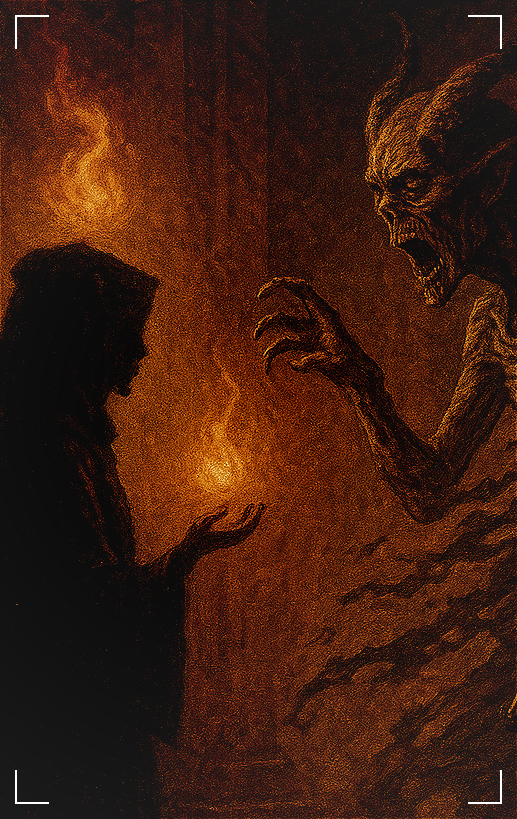
The bell tried to be brave and managed once. One clear coin of sound dropped into the dark, then nothing. Wind came up from the fields with the taste of pennies and the smell of a name being erased. In the west the sky went wrong—stars bending around a moving absence—and men who had never prayed counted to twelve in their heads and found only one.
The dragon arrived as a decision the land could not appeal. It crossed the ridge without shadow, because what follows a void is not shade but less. Its breath wasn’t fire at first; it was subtraction. Then the subtraction learned hunger, and the town learned what molten rock remembers when it calls itself river.
On a small porch the boy who would be the gunslinger stepped out because his mother had said, “Inside,” and sometimes the only way kids learn to obey a command is to go where they can see the reason for it. The night put a hand on his chest and pushed. Heat walked over the roofs in bare feet; shingles went to light and then to ash. He swallowed a taste like iron and nicked tongues.
His father had left the cedar box under the bed and a rule in the air: We’re done with shootings here. We know where the father went; even then the wires in the fence hummed his name and the crossroads had already counted him. The boy opened the box anyway—not for the pistol it no longer held, but for the jacket his father had folded there, the one with the map inked into its lining. He pulled it on. Against the base plate of a tool he did not yet own, scratched with a nail, a sentence waited: When you wake, go east.
He did not yet sleep. The world tried to put him down; he refused out of ignorance. The first roof fell on the house three doors over. The second roof fell on his. His mother shoved him through the pantry and out the back where the fence line ran—a line of copper wire his father had strung when the harvest learned to depend on him. The wire sang a low note now, and the song sounded like debt.
He went under as the kitchen swallowed itself; he came up with a new skin of soot and a blistering truth: there are fires you outrun only by being quicker than your name. He reached the ditch where the town’s runoff remembered rain and fell to his knees. Behind him the house lifted into a shape no carpenter had taught it and slid into orange.
Across town, the girl who would be the sorceress woke to the sound of her mother’s breath turning from sleeping to working. The window glowed at the edges with a color no dawn had the right to own. Her mother lifted her from the bed and wrapped a shawl around both of them so the girl would learn what a heart feels like when it is practicing not to break.
“We go to meet it,” the mother said, though her feet had already chosen between two duties. We know where the father went; his absence had a shape and a cost. She thought of him, of the way his hand knew the weight of a gun and the weight of a promise, of the cedared silence where metal did not live anymore. She thought of a book that had slept in the shop like a door that had learned manners. She thought of the laugh that called a bird, and of the rule that said birds bind darkness with warriors, not instead of them.
She ran the alley that knew her and came out on the square just as the void put a claw through the mill roof and taught the wheel to spin without water. Men left off shouting and watched their mouths stop belonging to them. The dragon dipped once and the tannery learned to be glass.
The mother set the girl on the steps of the ribbon shop and laid her palm to the cedar over the lintel. Mpatapo and Epa—knot and law—she drew with two quick motions, not on wood but in the light that leaned there. The windows of the shop flared with a lattice you couldn’t buy: pure moon held in place by meaning. Fawohodie—freedom—she set as a crown, and Sankofa she turned back over the door, fetching what must return. In the middle, where a heart should be, she set Gye Nyame to spin—except for God—which is a way of telling a building what not to pretend.
“Stay,” she told the girl, because sometimes the only way to keep a child is to ask the world to help.
Then she went to stop a thing no person stops alone.
She laughed once, small and clean, and the air elbowed itself. Heat stood up and put on feathers. The phoenix arrived without spectacle, blue-gold under the skin of the dark, and turned its face toward the ridge where subtraction wore a body. The mother did not tell it to eat. She asked it to hold.
“Bind,” she said, and the bird obeyed, stepping into the dragon’s breath the way light steps into a cave. For a breath the void learned manners. The mill stood longer than it deserved. The square stayed a square, not a theorem.
She climbed the church steps and put both hands on the bell rope. It had the good sense to chime once and then doubt itself. “Twice,” she said through her teeth. It choked halfway and she forgave it because forgiveness is a kind of knot that keeps pages from tearing and because the bell had not been built for this.
She saw, as only people who know how to read a night can see, that she was late by a degree a book can’t fix. Without the man who had put the pistol in the cedar box and the promise in the air, without the way he made decisions small and exact, without his starlight taught to bite—she would not break the back of the thing that had come. She could bind. She could teach the hour to pass without eating everything.
She could not end it.
She could keep a child.
So she did her work like a surgeon who has seen a wound too large for stitches: she saved what she could save. In the shop the windows of light held. In the square the heat behaved where it touched her laugh. In the ditch on the edge of town a boy coughed up smoke and stood because the air had developed the habit of permission.
The dragon noticed. It changed weight. It reached the way storms reach when they have found a name worth ruining. The phoenix met it shoulder to shoulder and for a moment the world learned what stalemate looks like: a night that will not fall, a fire that will not spread, a child breathing inside a circle made of rules and light.
Journeys have costs. The dragon, bored of being polite to physics, tore a strip of roof from the church and threw it like a plate. It struck the bell so hard the second note turned inside out. The spire shuddered. The phoenix held. The mother stumbled on the top step and saw, with the speed only dread owns, the calculus of what happens next if she stays.
She went to the door she had made of air and meaning. Inside, the girl had not cried because the lattice did not leave room for that kind of sound. The mother knelt and put her forehead to her daughter’s as if the two of them were a book closing over an argument.
“I’ll be in the rules,” she said, which is a way mothers lie that is also a way they tell the truth.
She stood and turned once more to the square. The bird still held. The void still pulled. The boy in the ditch had decided against dying. The house at the edge of town had learned ash. The father was where cords cross.
She laughed again—smaller, a stitch pulled tight—and the phoenix took that thread and wove it into its own breath. The dragon reared, angry that something it could not chew had the nerve to exist. The mother put both hands to the doorframe and spoke the bare minimum a house needs to remember its work.
Then the beam came down. Not light. Roof. Street. Decision. The church turned into a story about itself. The ribbon shop remembered wood. The window of Mpatapo cracked like ice in spring and then remade itself because the shape had learned how.
By morning, the town’s map had more white spaces than names. The ditch was mud. The boy wore a jacket too big and a sentence scratched where a tool would someday ride. He was nobody yet; he had a direction. The girl sat under a crown of freedom and did not cough because a door had decided to stay door until the world remembered what it owed.
The bell, ashamed of its cowardice, tried once more and managed once. People counted to twelve and got one again. That’s how you know a place survived a lesson: it starts over with smaller numbers.
This was the night a map stitched itself into a boy’s lining and a lattice stitched itself into a girl’s bones. It was the hour two beginnings found each other without seeing. It was the night a bird learned another way to hold, and a woman taught a door to keep a child, and the world, stingy as always, paid for both with a mother’s life.
When the wind came back from the fields it tasted less of copper and more of ash. The boy walked east because he had been told to when he woke. The girl walked into a path she would one day bind. And far off, where four roads make a hinge, a debt checked its pockets and waited to be named again.