Volume 2: Under the Belt Star
Rumor rides faster in thin air.
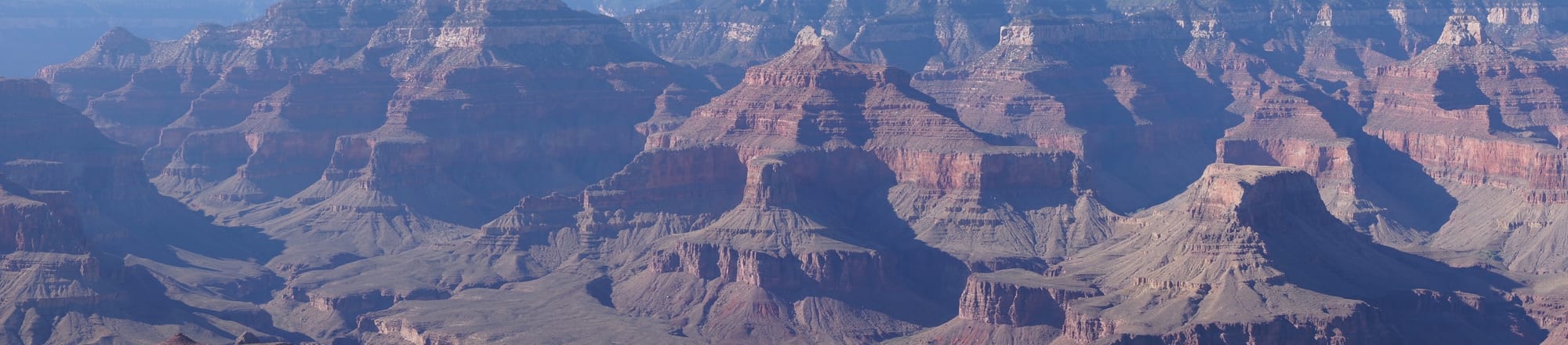
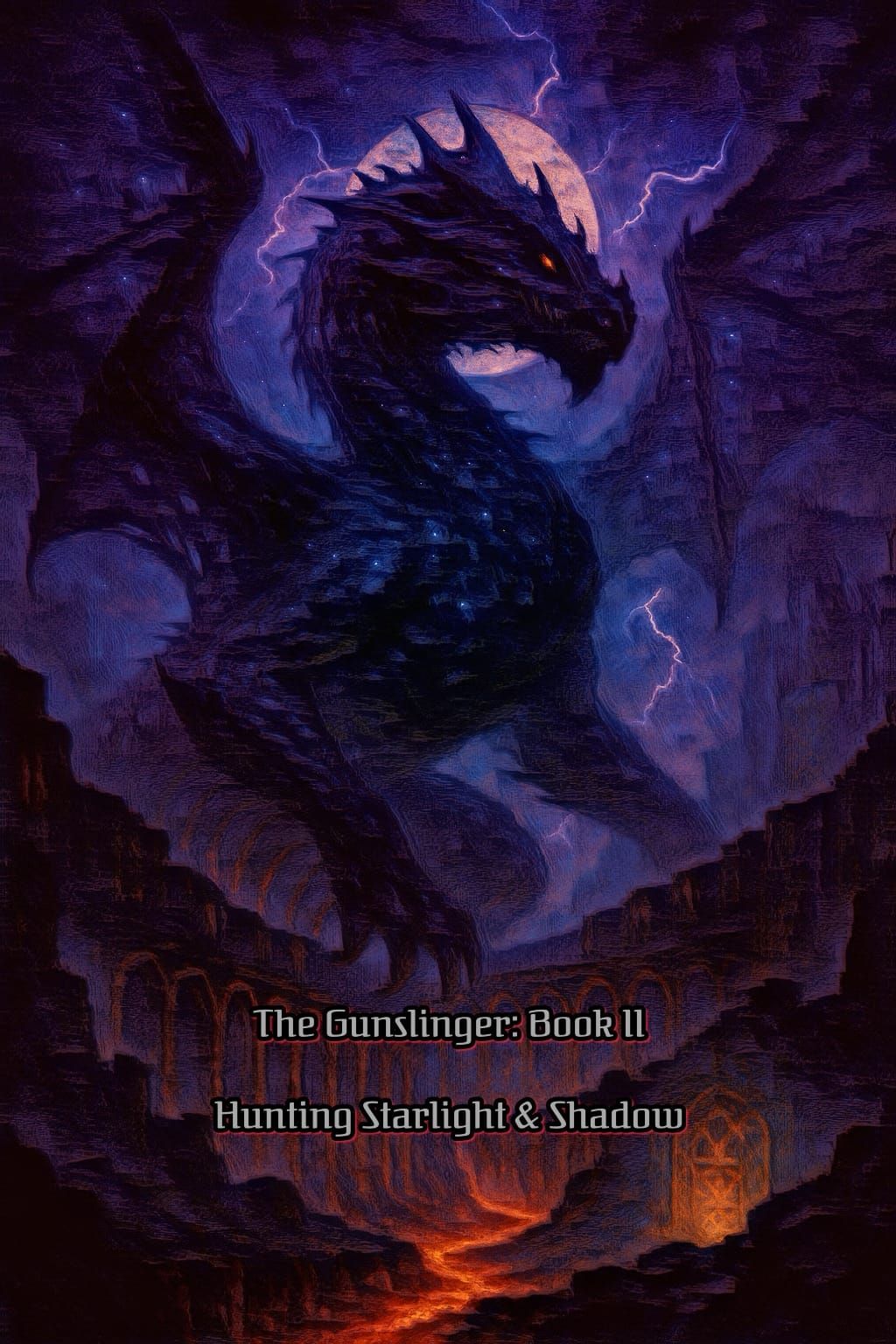
It reached them at a waystation where tea cooled too quickly and maps curled themselves shut: a dragon had been seen above a town built on a high mountain, a place for books and bells and professors who measured truth with calculated lathes and laughter. It said the creature did not descend, only circled, as if waiting for a lesson to end.
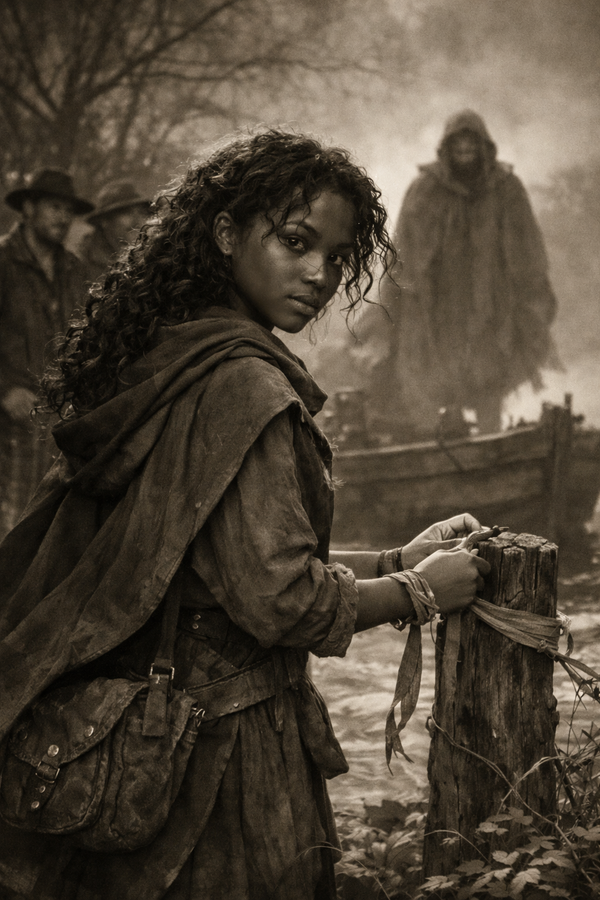
They camped on a shoulder of granite where the wind braided itself into ropes around the pines. Night came on like a tide you could see through. The stars arrived not as pinpricks but as declarations—constellations standing up out of the black with their old names intact. Hope lay on her back and traced the lines as if taking attendance.
“Follow the hunter,” she said.
“Them or us?” he asked, because some days it was hard to tell.
She lifted a hand. Orion burned there, a cathedral of three at his belt, shoulders bright as vows. The middle star—steady and terrible—hung exactly where the trail between the switchbacks would take them by morning. The air was clean enough that the Milky Way looked like someone had spilled salt across a slate. He slept poorly, as gunslingers do when the sky is honest. She slept little, studying a path ahead.
They traveled before dawn when the ground still kept night’s cool in its seams. The bell from the mountain town prized the silence loose. It rang strong, true, and twice—no choking, no stutter—two clean coins dropped into the morning. The sound carried down ridges and up arroyos, found them in the juniper shadows and took their measure. The gunslinger felt his shoulders let down a fraction.
“Someone up there tells the hour without lying,” he said.
“Those bells are strong. Someone up there believes in telling,” Hope answered.
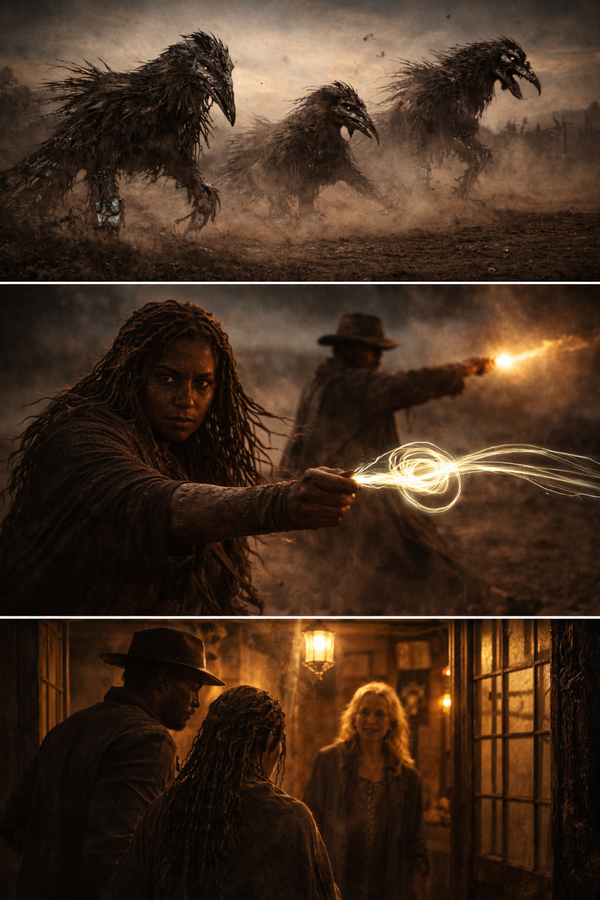
By afternoon they began to smell copper. Not the flat stink that comes of torn pipe, not the kitchen tang of old kettles. This was a scent that found the back of the tongue, sly and patient, like hyenas pacing the unseen edges of the trail, laughing low to themselves between bushes and books. The smell would vanish when the bell spoke, then creep back in the hollows between notes.
“When it smells like this,” he said, “we are watched.”
“Or expected,” Hope said, and made her way as if both were true.
They entered the town just as the sun slid behind the mountain’s ear and the middle star of the hunter’s belt pulled itself up the sky’s ladder to hang directly above the square. Students moved in shoals with their books held like shields. A pair of janitors argued gently about electricity while sweeping the same stoop back and forth. A signpost pointed in too many directions to be useful. They asked a porter about dragons; the porter laughed, the laugh of a man who will not admit he believes his own stories, and pointed them uphill.
The library did not try to be shy. It sat like an oath on a terrace of carved stone, golden gilding along its cornice and a great door banded in good iron and better intention. Light did not merely spill from its windows; it took its time, revealing the dust in the air as if reading aloud. Guards stood at the steps with the posture of men who have been told to expect nothing and everything. One nodded them through when he saw the look in the gunslinger’s eyes—the look that old weapons give men who carry new ones.
Inside, the library smelled of beeswax and paper and rain kept in bowls. It was the kind of place where an argument about stars could last a week and no one would call the law. And yet: beneath the varnish of scholarship ran a different current, a frequency that made human minds stumble for a beat.
At first it was only a hum under the floorboards, the sort that nervous men mistake for their own hearts. Then it was a pressure at the temples, a tide that rose and dropped like breath in a sleeping room. Shelves stood like soldiers, stacks ran like canals, ladders leaned into dimness the way men lean into trouble when they’ve decided to do it anyway.
“Do you hear that?” he asked at last.
“I hear what it does to you,” Hope said. “Keep walking.”
They searched until searching had the shape of a litany. Circling past astronomy—star atlases bound in blue cloth that still smelled of ink. Past metallurgy—plates of copper leaf that made his tongue think of pennies and lies. Past theology and its careful cages. The noises sharpened as they climbed: not noise by the physicist’s measure, but the sort of sound that makes the mind take a knee—wind the ear can’t locate, bell-metal in the bones, a not-quite-laugh that came from the rafters and nowhere at all.
They found the book in a room that pretended not to be special. Hope felt called to it.
It stood on a reading stand as if it had simply waited its turn, though the light around it behaved like a more obedient species of lightning. The binding was neither leather nor buckram but something the eye forgave without naming. The gilt on its edges wasn’t gold; it was the shine you see on the inside of thunderheads when you’re far enough from the storm to feel safe and near enough to be wrong.
He reached for it. The air warned his hand back. Hope stepped closer and let the light crowd her to make its case.
“I know what this is,” she said.
“Where have you ever seen anything like it before?” he asked, already a little tired of the part of himself that always demanded explanation.
She laughed. It wasn’t the loud laugh she saved for breaking spells in public. It was small and clean, like a stitch pulled tight, like a bird changing its mind in flight. The laugh went into the book the way warm breath goes into winter glass.
“In me,” she said.
The covers sighed and parted. Heat leaned out—not the brute heat of forge or dragon, but the ethical heat of a promise that means to keep itself. Light gathered, stood up and put on feathers.
The phoenix arrived without hurry, as if it had been in the next room all along, listening for its name. Each plume held a story about fire and none of them contradicted the others. It bowed, not to the library or its keepers, but to the people who had walked there on purpose.
“Welcome,” it said, as only fire says—without sound at all and yet entirely heard. “You have work yet.”
“The demon?” he asked, as a man asks about weather he suspects will be personal.
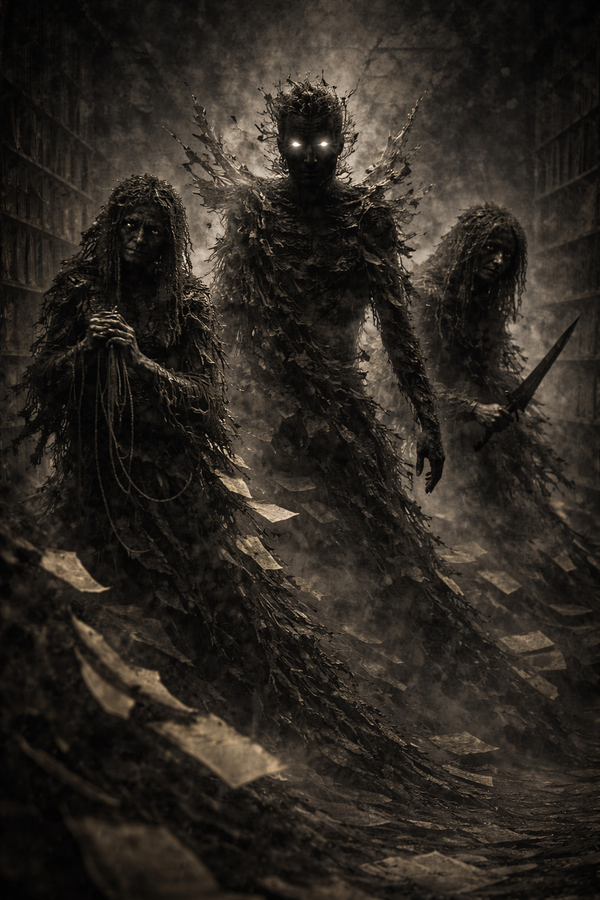
“Not done,” the phoenix answered. “Unleashed from Wire Avenue, he learned to live in the parts people don’t confess. In shadow, a thing grows teeth it was denied in light. He has courted elder cousins—dragons whose names were sung before bells were hung. They smell you. The copper along your trail laughs for them. You will move, or be moved.”
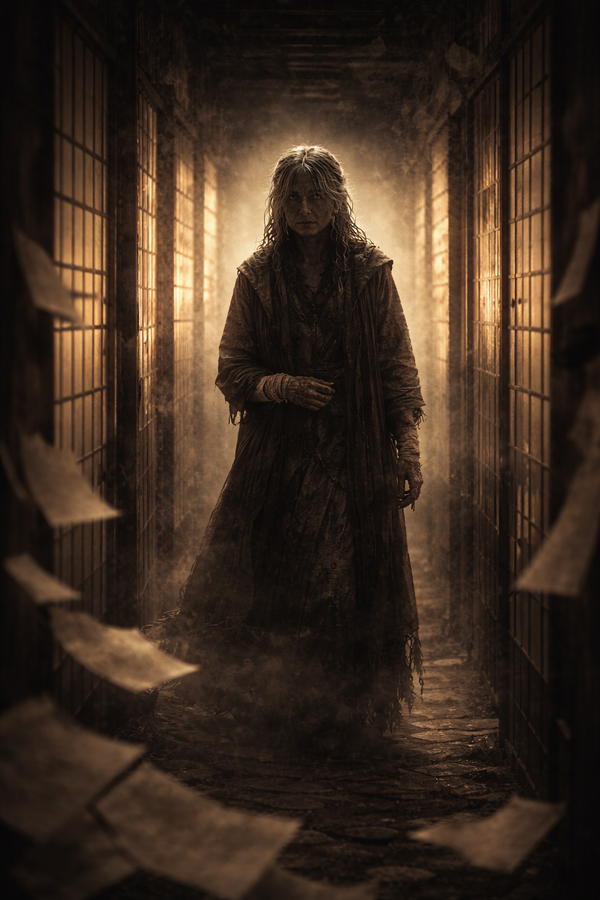
An old librarian who had been pretending to dust the same folio for twenty minutes cleared his throat. He wore skepticism like a waistcoat—a good habit that had kept poorer men from worse mistakes. His eyes gave himself away.
“You should know,” he said, adjusting his glasses as if they had opinions, “that the academics here do not trouble themselves with birds that speak or books that open to laughter. They measure things that can be weighed, and there is virtue in that. But this place—” he made a small square in the air with his finger, as if framing a photograph “—was built on a crossing none of them will put on a map. From time to time, for those who can call what you have called, it behaves like a station. Doors, shall we say, align. Tracks meet. You catch the next rail, if you’re quick enough to board.”
“And if we’re not?” the gunslinger asked.
The librarian looked down at his boots and polished unpolished leather on his trouser cuff. “Then it is only a very fine building with good light at the tables. Which is to say: you will board, some day, if not today. Whatever you do, do so with pace. Our light fades with time and we’ve held the hour as long as we can. Shadows have made camp here like rumor and while I fear they’ve been waiting for you—I won’t mind if they leave with you.”
He wished them luck as if the word could be counted and cashed. “Boa Me Na Me Mmoa Wo.”
Hope understood, he was a man of letters and had learned from the past, a language Hope knew well.
“When the bell rings twice,” he added, softer, “go. If it rings a third time—” He stopped, reconsidered, and shook his head. “It won’t.”
Hope closed her fingers under the book as if easing a child down from a high step. The binding softened for her and then remembered its duty. She laid it in a carry-sling that the librarian produced from nowhere in particular. The phoenix stepped into the brightness between her hands and vanished the way cleaned pain does—present, then not, leaving you certain of its return.
“It will come when I call,” Hope said, mostly to herself.
“And when you laugh?” the librarian asked.
“That too,” she said, and the corner of her mouth gave itself away.
Hope and the gunslinger walked out with the hush people give churches when they haven’t decided what they believe. The guards looked relieved to see them, which suggested they’d known more than their orders. Outside, the night had pushed the mountain back into silhouette. Orion’s belt hung at arm’s length, the center star directly above the library’s pediment like a tack holding the world’s map in place.
The bell rang twice. The sound ran into the hills and returned with friends. Somewhere in the darkness, copper hid its teeth and waited. Somewhere on a farther ridge, something large reconsidered the shape of its shadow.
“Tracks,” the librarian had said. The gunslinger heard them now, not underfoot but inside the hour—a timetable older than timetables. He checked the cylinder and left the blessed rounds where they were, heavy as choices. Hope rested a hand on the book’s spine, and he could almost feel the heat of a bird that had not yet been born into flame.
“Where to?” he asked.
Hope lifted her face to the hunter in the sky and then to the clean, honest bell that had the good manners to tell the truth.
“Follow the middle star,” she said. “If we’re being stalked, we might as well choose the ground.”
“And if we’re expected?”
“Then we won’t be late,” she said, and laughed quietly, and in some other room of the world a feather moved.
They set out as the hour changed color. The town fell behind them like a closed book that would open when asked nicely. Ahead, the trail took the angle of a blade. The bell did not ring a third time.
The copper smell kept pace, patient as hyenas and twice as certain. The phoenix would come when Hope called. The dragons, older and stronger for their waiting, moved like weather that had finally decided on a direction. Between the stars and the bell and the book she carried, they stepped into the dark as if it had been laid out for them on purpose.
Perhaps it had.