Chapter II: The Sorceress

The first thing she learned to move was wind.
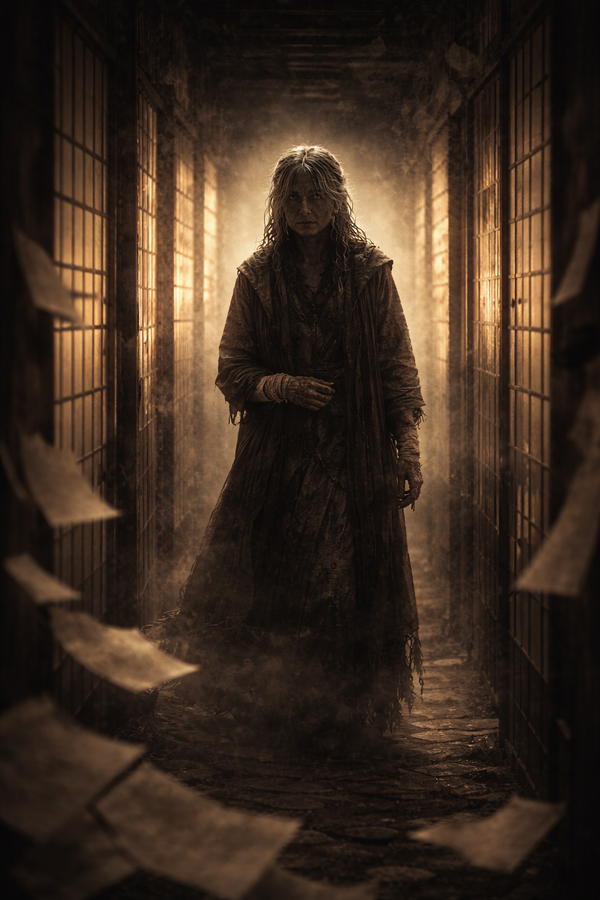
She climbed the water tower at dawn, skirt clutched in one hand, a spool of copper wire in the other, and listened while the telephone lines hummed to each other across the flats. The insulators were green glass, bubbled like old bottles, and each held a little mouthful of morning. She braided lengths of her hair into the copper and fastened them under the caps. The wire took her hair the way a river takes a reed: without fuss, but forever. When she finished, the wind changed key; the singing turned sly.
The town was small enough to keep in a pocket and large enough to vanish in. The depot to the west. The slaughterhouse to the south. The church with the whitewashed bell that didn’t fit the tower. She had arranged that too—swapped the clapper for one a fraction too long so every hour the bell choked on the second note. One chime only; a throat cleared; time jogged in place.
She wasn’t always a sorceress. Once she mended things with her hands the usual way. But power keeps books you don’t mean to open. The first time she pulled a fever out of a child and buried it in a jar of sugar, the air took her name down in its ledger. Word traveled, as it always does out here—by wire and wind and the thin road of rumor—and with it came a story about a man who hunted unnatural things. A sharpshooter, people whispered. A gunslinger whose pistol knew where to go before his hands did.
“He follows a scent,” Mercy had told her, polishing a glass he never managed to dry. “Not blood. Not powder. Closer to church smoke. He can smell when somebody’s bent the world.”
She had smiled then the way folded paper smiles. “Then we’ll give him another smell,” she’d said.
Mercy’s real name was older and had at least three saints in it. He’d come west to forget, but forgetting here was a commodity and she had already bought most of it. He owed her: for a sister whose lungs once sounded like rain on a tin roof, for a scar above his brow she had turned into a reminder rather than a sentence. A debt is a thread. She tied it to her spool.
Night found her on Wire Ave with a pail of red sand—iron-rich dust taken from the cut below the rails—and a pocket full of square nails scavenged from a collapsed corral. She drew a circle at the intersection, tamped it with the flat of her palm, and pressed the nails in at the cardinal points. The copper wire from the tower ran here, under the street and up the telephone poles, and into her circle like veins. She pricked her thumb and let three drops fall: one for rules, one for return, one for regret. Each hissed softly when it struck the line where dust met wire.
“Come,” she said into the quiet.
Not loud. You don’t need loud when you call the kind of thing that is always listening.
He came walking as if from a door nobody could see. Black suit. No dust on him yet. A smile you could use as a mirror if you wanted to see nothing at all. The demon looked around as if considering a piece of property.
“Own much of this?” he asked.
“Enough to make promises,” she said. “Enough to make you keep them.”
He dipped his head, courtly. “Say them.”
“Not inside the buildings,” she said, and felt the wires note it down. “Not the bar on the corner. Not Mercy. Not the woman with the paper voice.”
“Ah,” he said. “You.”
“Only in the street,” she said. “Where the town can watch. You show yourself to the gunslinger when he arrives. You goad him in that manner of yours. When he draws and you die, you are to gather again at the corner where Wire meets the east road. When you gather, you will not remember the pain. You will not forgive it either. You will be eager.”
“And the fee?” the demon asked, as polite as the end of a prayer.
“Memory,” she said. The word was small, but it had weight. “Not mine.”
The demon’s eyes brightened like a coal does when you breathe on it. “Whose?”
“The man’s,” she said. “The one with the pistol. Each time you fall, you take his knowing of faces. Leave him the city and its paths—leave him the bones of maps and tricks of ladders and how to tie a good knot. Strip the people. He will know the bell but not who rings it. He will know how to walk home and forget who waits there.”
The demon pressed two fingers to the copper line. It sang up the pole and down the block and out along the wires to the water tower and beyond. “Cruel,” he said, and she heard admiration dressed as judgment.
“Necessary,” she said.
“And you?” he asked. “What is it you don’t want him to know?”
She did not answer. She didn’t have to. It hung between them: that there are powers you can smell like rain and powers you can’t smell at all, not if your nose is pointed at blood. She needed him busy. Busy people don’t notice the way the light bends when you say certain words. Busy men don’t notice what you keep in the dark.
“One more,” he said, as if they were bartering over lace. “Name the thing I cannot touch.”
“The sky,” she said.
He laughed, delighted. “How pious.”
“How practical,” she said. “He’ll need a place to look that isn’t you.”
He put his hand, pale and neat, into the red sand and came away with nothing on him. “There must be a first time,” he said. “When does our music start?”
“When he steps onto Wire Ave,” she said, “and asks me if he knows me.”
The demon glanced down the street as if he could already see the man’s hat, the cut of his coat, the way his shoulders told the truth about how tired he was. “We should arrange a greeting then,” he said.
They did. Mercy was brought to the circle at dawn and bound with a small geas that felt like a polite hand at the back. He would not lie when asked a direct question. He would not volunteer what would spoil the spell. He would wipe the floor. He would keep the oranges and the bottle under the counter for ritual and comfort. In return, none of the harm would curl inward toward him or the sister with the quiet lungs. He swallowed the geas without water and it sat inside him like a warm stone.
“And if there’s a crack,” Mercy asked her when the demon had stepped out to admire the poles, “some place a ray gets in—what then?”
“Then let it in,” she said, and the paper in her voice rustled. “A crack makes the pot sing.”
They went to the church and she fixed the bell wrong by a finger’s width. They went to the tracks and she salted a stretch with handfuls of iron filings so the earth would notice whenever someone came or went with a pistol on his hip. She buried a length of copper below the middle of Wire Ave and looped it twice around an old nail. She whispered four words into the pole nearest Mercy’s window and turned the grain of the wood a shade darker. When wind worried the wires, the street kept time.
By the time the boots appeared at the far end of the avenue, the town was a loom and she sat at it, hands quiet on her lap, as if she had never learned to weave anything at all.
He came like a memory you’ve had all your life but can’t place. Hat caked in the town’s dust, though he’d never been here before. Red sand already working at his cuffs, as if the place were painting him to match. His pistol rode easy in his hand like a dog that doesn’t care for anyone else. He smelled the air and his face changed in the way a face changes when it recognizes a graveyard it hasn’t visited yet.
He walked to the bar door without looking at her. Men like that don’t look at the thing that matters until they have to; it keeps it safe. Mercy glanced at her as the gunslinger pushed in and she gave him a look that said: the thread is pulled, don’t tug too hard.
“Late,” Mercy told the man, as arranged. The bottle came up. The glass sweated. The world edged itself into place.
She stood in the doorway with the town behind her, all those small lives she had wrapped in the old cloth of her spell. Some would say she did it to hide what she was. Some would say she did it to keep the demon fed on something that wasn’t children. Both could be true. Power is rarely for just one thing.
The demon waited at a back table, enjoying a drink that did not diminish. He did not look at her either; that was part of their arrangement. They would never acknowledge each other in the man’s hearing. She was to be flavorless. Paper. Dust. She would be the thing his eyes slid off of because his mind had something brighter to stare at.
He sat. Mercy poured. The demon lifted his chin.
The wires outside tightened until they sang like a blade tasting air. Above the water tower, a hawk noticed the distance and stopped moving for a long time.
The demon said his line with honey. “Welcome home.”
The man’s hand hovered near his hip. He felt the hollow the demon carried around him and—there—his mouth made a little shape as if to bite a word he wasn’t ready to say. He turned his head, finally, toward the doorway where she stood.
“Do I know you?” he asked.
Her smile was the soft crackle of old paper and she shook her head no in a way that said yes and also said not yet.
“Folks come and go,” she said. “Some come back.”
She held her breath as he took his place in the street. That was the other part of the fee, the part she did not confess: every time the demon fell, a piece of forgetfulness would wash through the town too, like thin milk, and smooth the edges off the faces and the edges off the days, and if she was careful, she could drink some of that softness for herself. It was a dangerous drink. It kept the smell of her power down. It also kept the taste of her own past faint, which is how you wake up one day and can’t remember the name of the first child you saved or the first mistake you made.
She watched him find his stance—knees sweet, breath inside the breath—as if his bones were older than his skin. She watched the demon not move his hands at all. She watched Mercy close his eyes until the street told him to open them.
They drew.
The demon’s mouth opened like a slick door. The bullet went where it always went. The dust refused him. The bell cleared its throat once and only once. The wires, relieved, dropped a note.
And then came the wash, a tide rolling down Wire Ave, through the door, around Mercy’s boots, into the glass, through the woman in the doorway. It curled around the man like a mother and wiped a line of thought from his face. He blinked. He was lighter by a handful of names. He was free of them and poorer for it.
She felt the spell settle back into its grooves, humming, hungry but fed. The demon was already collecting himself at the corner, curious as a dog. The town exhaled. The sky above the water tower steadied into hammered metal.
She had kept him busy. She had kept herself hidden. She had—she told herself—protected them all for one more circuit of the wire.
Mercy came to the door with a rag in his hand. He waited beside her like a brother at a funeral. “You could tell him,” he said, not looking at her. “There are other ways to keep a man from a door than posting a devil in front of it.”
“If I tell him,” she said, “he looks at me the way he looks at that. And once he looks, I’m a mountain in his eye, not a paper. Mountains get climbed. Paper burns.”
Mercy shifted the rag from one hand to the other. “You can’t drink forgetting forever,” he said.
“No,” she said, and thought of the sugar jar, the old clapper, the copper under the street. “But you can sip it for a long time if you know how to hold your breath.”
Out in the middle of Wire Ave, the man raised his chin and looked up. Just a flick of a gaze, stealing a bite of sky. She felt the tiny crack Mercy had wished for, a thin ray probing the glaze of her spell. She did not patch it. A crack makes the pot sing.
He lowered his eyes and, right on cue, turned and came toward her again, hat tipped as if to a stranger in a place he almost remembered.
He stopped. “Do I know you?” he asked.
She smiled the way she had taught herself to smile, and the wires above them carried the sound of her voice away to the tower and back again, folding it thin enough to pass for weather.
“Better than most,” she almost said, but that was Mercy’s line and it would make the world snag. Instead she said the truest safe thing she knew: “You always do.”