The Sheriff’s Last Watch
Towns across every book within the shadowlands have similar stories. Not all end well.
Times final scale balances how many stories end with the heroes walking away and those recording their last fight.
This town’s hero wore a star now, not a crest—six points of tin over a vest gone shiny at the shoulders.
He kept the armor on a peg over the hearth, not to brag but to remember its weight. The plates were nicked where teeth had tried; the gorget was splashed with a heat that never scrubbed out. It was a knight’s suit turned into a story, and in this town stories sang if they found themselves on a wall.
He’d become acting sheriff because no one else wanted the job and because he did not know how to stop being useful.
His raven lived on the porch beam above the rocking chair. The bird had a soldier’s discipline and a thief’s humor. It would hop between his boots and tip its head toward the dusk as if the light itself were a suspect. When he raised two fingers, the bird lifted and went, black on black, out over the livery, along the ridge, past the bell whose rope had polished a groove in the tower’s plank.
“Go on, Kettle,” he said. The bird knew its name and the job behind it.
The town was a plain sentence of fronts and porches and a street you could sweep in an hour if no one argued. His wife kept the house to a clean that didn’t scold. His boy had his grandfather’s eyes and a slingshot that never hit what it was aimed at and a mean success with bottles no one wanted. The sheriff checked doors with two good knuckles, nodded to the bar-keep, to the teacher, to old Mrs. Gray who believed in a second bell even when the ringer was sick. He wore his hat low because hats do some of the work thinking won’t.
Night set down like a plate you’d better not spill. The raven came back once with dust on its breast and once with a burr in its wing and once with nothing but the smell of river on it, which meant the bridge was fine and the pump was not swearing. The sheriff rubbed the bird’s neck and sent it out again when the stars were up proper and the lamps along Main had settled to their business.
He was at his desk when the bird returned wrong.
It didn’t land. It hit the door as if a hand had thrown it. Claws scraped the jamb. The raven skittered across the floorboards, wings open, beak gaping without sound. Its eyes were coins where the mint had slipped. It looked everywhere at once, and then it found him.
“All right,” he said, and stood.
Copper had begun to hum low—so low you could pretend it was wind in the wire if you wanted the lie. The sound crawled through nails and hinges, along the belt buckles of tired men, into the bell’s throat. He felt it in a tooth that never quite forgave a winter years ago. He felt it in the star on his chest.
“Where?” he asked the bird.
The raven leaped to the windowsill, beat its wings once, twice—a westward pulse—and then turned its head to the street and screamed. The sound had ought to have brought a crowd; it brought only curtains.
He buckled his sword out of habit and because habits are the little bridges between this moment and the next. He had not raised the blade in a season. It did not complain. His wife came to the doorway and did not ask anything, because she had married a man who carried storms in on his boots and let them drip dry on the mat. She touched his arm. He put his hand over hers and then let go because you must.
“I’ll ring,” he said.
“You’ll come back,” she said.
He wanted to say yes. He said, “Keep the boy below. Shut the cellar from inside. If the first bell comes, wait for the second.”
She nodded. There was no second question.
On the porch he breathed once the way a man breathes before he lifts. The air tasted like pennies. The raven launched from the beam and became a black underline beneath the stars. The copper hum climbed—from a rattle through wire to a voice underfoot to a pressure that made the lamp glass sigh.
Then the dog at the end of the street lay down and set its head on its paws and refused this world.
He heard claws before he saw it.
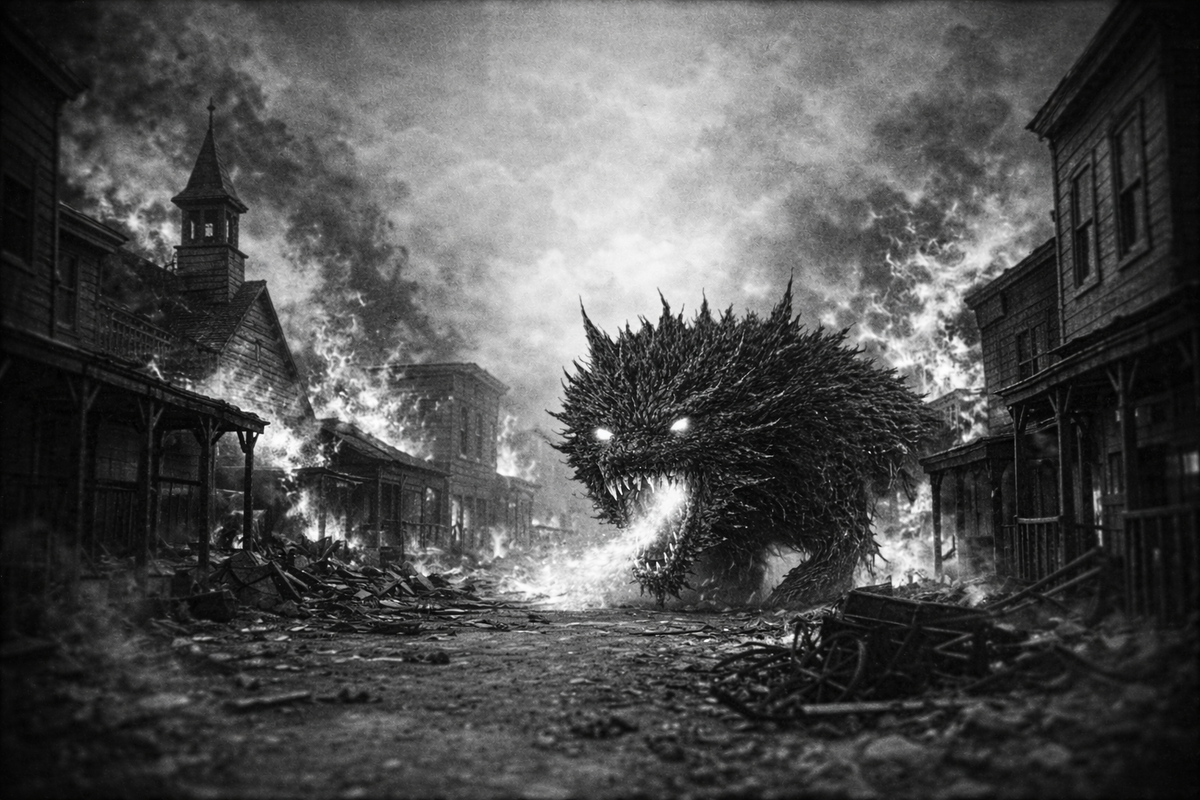
The wolf-dragon came in between buildings like it owned both; the porches shrank. House-high and thick as a cellar wall. Its mane was an orchard of iron thorns. Eyes like coals someone had blown on too long. The mouth was a door full of knives; behind the knives was a wind that made you feel like a letter that wouldn’t post. When it stepped, boards remembered they had been trees and wanted to be anywhere else.
He had fought bigger. He had fought older. He had not fought one with a face that wanted to remember you.
“You,” he said, and the word was not brave, it was accurate.
The dragon lowered its head and the copper deepened, a choir you couldn’t like. The star on his vest grew hot. Far off, the bell rope jerked as if a boy had yanked it out of a bad dream. The bell struck once and stopped. The second note died unborn in the copper’s throat.
Men came into the street because men do. They brought rifles and mouths and the hope of being useful. He lifted a hand, flat, and they stopped because he was the kind of man people obey when the hour is short. “Cellar,” he said. “Lanterns out. Keep water and doors.” He did not say pray. The copper was listening.
The raven arrowed at the dragon’s eye. The beast turned its head like a tired king and blew a breath that whitened the air. The sound the bird made was a joke that forgot its punchline. It fell like a hat. He didn’t look where.
He stepped into the street.
The dragon came on. Not fast. Not slow. The speed of something that knows the room is already its. Flames licked along the seams of its jaw like a habit. Fire dripped from its mouth as if it were bored with the idea of swallowing. The sheriff drew the sword and felt his hands remember the lesson his father had taught his arms when he was all knees and pride. He set his feet. He found the angle.
The first pass he made was at the foreleg, where scales thinned where they had to bend. The blade bit and shrieked. Heat walked up his arms. The cut opened like an eye and then closed, quick, as if it had been embarrassed to exist. Copper sang approval. The dragon laughed down its throat.
“Fine,” he said.
He went to work.
He moved like a man doing a job no one else wanted. Short steps, no waste, the edge where it counts. The dragon swung its head and the heat rolled past and made porch posts into torches. The paint on the saloon door peeled like bad news opening itself. He felt the town begin to burn as a fact, not an idea. He kept going.
He reached for the bell with his voice. “Twice!” he yelled, and you could hear the boy on the rope yank like a prayer. The bell struck once, proud and lonely, and the copper swallowed its echo.
The dragon’s breath found the street. The world went white with a blue inside it. Then there were embers where shelves had been, and glass ran down sills like tears that didn’t want to be caught. Wagons folded into their wheels. The sheriff walked through it because some men have nowhere else to walk when a thing like this chooses their address. His hat burned and he let it. The star on his chest flared and went black and he did not notice.
He reached the neck. He had always been good at necks. He drove the blade where plates meet, where the hinge hides. The sword bit through something that frowned but parted. The dragon shuddered—as if he had rung a note it disliked—and then its jaw fell open like a gate and the fire came honest.
He remembered the old country then, the first dragon, the one he’d beaten because he’d had a ridge and a wind and a name no one had taxed yet. He had beaten that one and lived because the hour had wanted him. He saw in the corner of now that this hour did not.
The fire took the boardwalks like a rumor that found good company. The livery bucked and fell. The schoolhouse coughed once and learned to be smoke. He smelled soap and coffee and his child’s hair and he put his body between the beast and the cellar door because that is where bodies belong when you are the thing you’ve told yourself you are.
The dragon lifted him with its breath as if he were a note it could choose. He felt the copper in the nails, in the badge, in the bell tongue, in the wire that stitched the town to itself. He felt the Demon’s hum as a ledger closing with a pleased thumb.
He threw the sword because sometimes all you have left is straight. It turned once and bit to the hilt in the membrane just behind the jaw. The dragon flinched. It was a small victory. It was the size of a man’s hand. The beast shook and the sword came out wreathed in light and fell somewhere that would not help anyone again.
He saw his wife in the window, hands on the boy’s shoulders, mouth making the shape of his name without calling it, because calling is how a thing finds you. He nodded. She nodded. It was a marriage vow, late and exact.
“Do it,” he said to the air, and the air obeyed the bigger voice.
When the breath came, it did not come like a line, it came like a room deciding to be smaller. He had a thought he’d had before: hold the door. He stood where a door had been and did that, with his body, and then with nothing.
What came after was what you see in the picture people will make of a night like this when there are no words left: a street learning to be ash; fire walking out of mouths; a wagon wheel canted like a question no one answers; and the beast, house-high, owning what it meant to own.
Someone rang the bell once, a brave lie. The second note did not come.
By morning there would be black teeth where porches had been and a smell that learned your lungs and wouldn’t leave. By noon there would be stories. By evening there would be a road leaving town and a boy who would become a man who’d learn to keep his face plain. But now it was night and the sheriff lay where a door had kept an oath long enough for love to get below. The raven, singed and wrong but still a bird, pulled itself to a beam that did not fall and watched, as ravens do, the way a witness watches: without mercy, without forgetting.
The copper hum eased down to a purr. The dragon lifted its head, listening for anything that might still be called alive that could be made into afterwards. It heard none worth the trouble. It stepped through flame as if it were a memory it had forgiven. Then it turned toward the dark where other towns kept their porches and went.
The street did not ask for help. The night did not promise anything. Somewhere far from here a bell practiced its second note and got it right.
But not here.