The Last Syllabus before the Second Bell
It wasn’t fire. It was arrival—pages taking the shape of air, spines finding gravity.
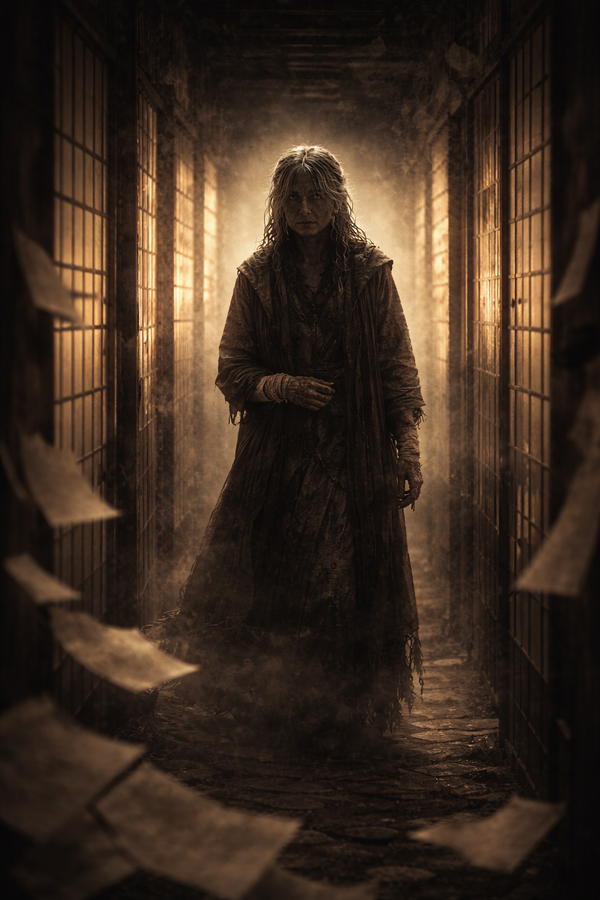
Books appeared the way rain decides on roofs: all at once, and as if roofs had always been deserving. They thumped onto benches, slid into neat towers on the floor, leaned themselves under windows where Mpatapo and Epa threw their rectangles of moon. Beeswax, coal-dust, and old ink came with them like the breath of a friend. Hope and the gunslinger did not ask from where. They knew. The librarian’s last professional courtesy had been to spend what remained of his enchantments smuggling his catalog to the one house the dark could not cross.
“Arsenal,” Hope said, touching a cloth cover as if checking a pulse.
She worked fast, arranging the sudden inheritance by the grammar of need. On Bells and the Ethics of Their Second Note. Rail Schedules Between Realms (Revised). Moonlight as Material. Counter-Weights & Will. Copper: Agreements and Annulments. A Short Ledger of Riddles That Refuse to Bind. Doorwork. Thin pamphlets on gravity that read like hymns. A folio of diagrams where constellations were treated as scaffolding instead of superstition. A plain-paper notebook with only one sentence: Teach light to stay and it tells the truth twice.
She did not have the phoenix. She had the book-space where it had slept, and she had work that could be done when birds are elsewhere.
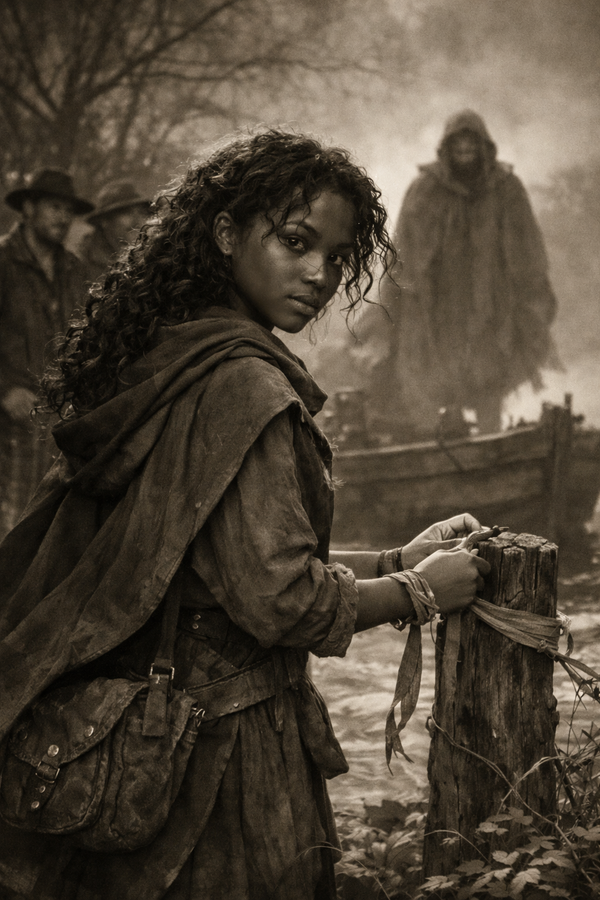
Hope opened Moonlight as Material and Counter-Weights & Will side by side and set her palms under the lattice windows. The House obliged, thickening the beam to the tempering glow she knew. She breathed into it—not power, but permission—and felt the light accept new chores. From Doorwork she took a braid: three-thread plaits of Fawohodie (freedom), Mpatapo (reconciliation), Epa (law) woven into lunar cord. From the folio of constellations she copied a small lens—a Sankofa curve that gathers what must return—and set it floating in the beam like a clear coin.
The light bent. Not away from itself, but toward use. She drew it into skeins and nets: a veil to make gravity share; a mirror to turn subtraction back on its author; a narrow ladder that could be rolled and unrolled across a mouth in the ground when a horse needed more than faith. Each held only because the House believed in patterns and she remembered how to ask.
Behind her, the gunslinger inventoried the quiet violence they had made. Belts coiled bright as decisions. He fed cylinders, eased hammers down to honest rests, weighed the new rounds in his palm and learned their promise by touch. The featherwork in the paste had taught them a cleaner note; the star-iron had taught them to refuse panic; the House had taught them to keep their manners. He packed a gross and a dozen where fingers would not have to think.
“Read me one thing,” he said without looking up.
Hope touched the thin pamphlet on riddles and obliged: “If asked for silence by a mouth that hunts, answer with work.”
“Good book,” he said, and buckled one more belt around the truth of his waist.
When she had braided what could be braided and taught the beam to remember its chores without her hands, Hope closed the last cover. She tied a soft harness of moon-cord over her shoulders and stowed the smallest nets inside her coat where warmth wouldn’t argue. She tucked Rail Schedules into the empty sling as if to remind absence it still had a job. She set On Bells on the threshold so the House could keep reading while they were gone.
They stood a moment and listened. Outside, mountains held their addresses. Inside, the meteor’s absence hummed like approval. The lattice windows shone with patient law. The pile of books looked like courage that had decided to become logistics.
The first bell rang.
Clean and honest, a coin dropped into the hour. No stutter. No swallowed note. The sound ran out across the ridge and into the canyons and came back with its spine straighter.
He lifted his hat the width of gratitude to a room that knew how to be a room. She palmed the doorframe—Fawohodie warm under her skin—and felt the House say go the way a good teacher says show me.
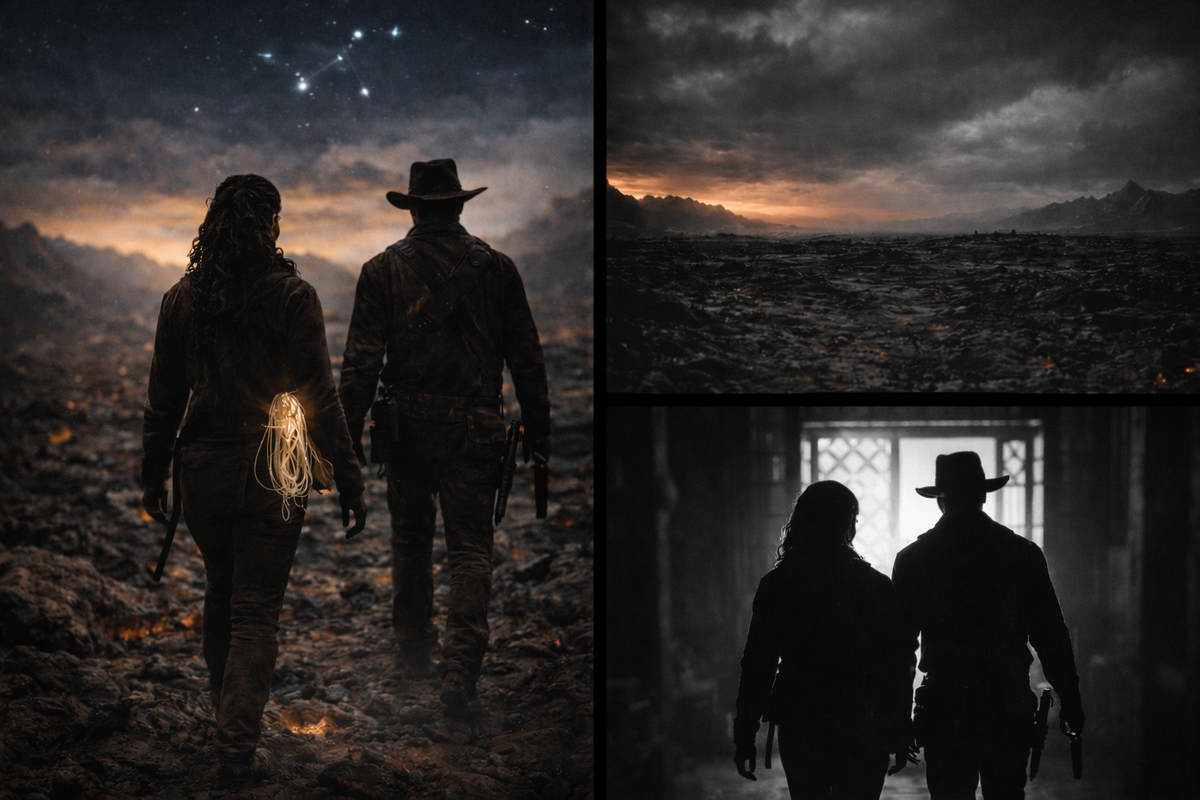
They crossed the sill together, not looking back, because some houses stay in your bones without needing your eyes. The door closed with a sound like a knot tightening in the right place. Above them, Orion’s middle star refused to blink. Below, the plateau remembered the path that molten rock had taken when it called itself river.
“Second bell,” he said.
“Second bell,” she agreed, and gathered the moon-cord into her fist.
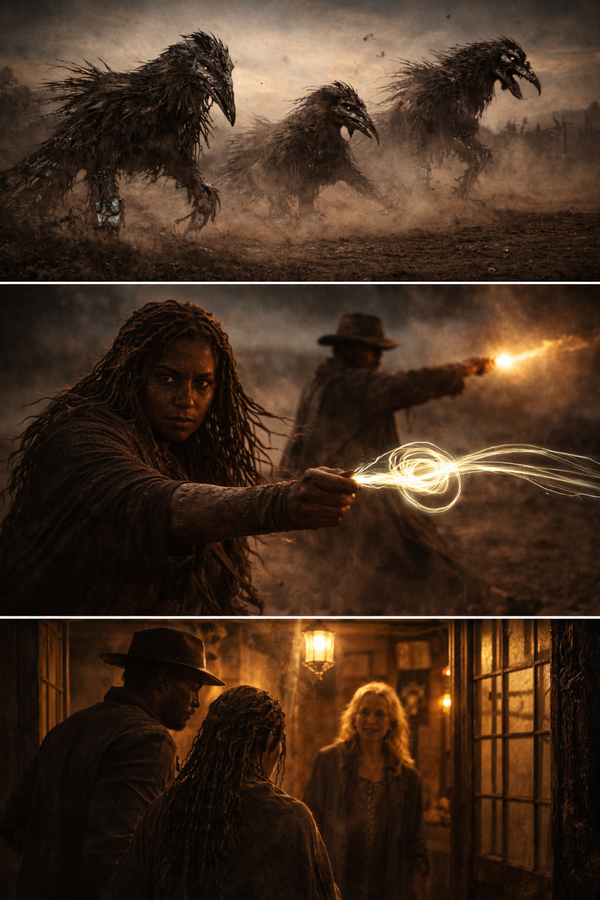
They set out for the field the demon had named and the sky had already chosen, carrying rounds that sang a high thread no ear could boast of hearing, and books that had become tools, and a promise the House had made in light.
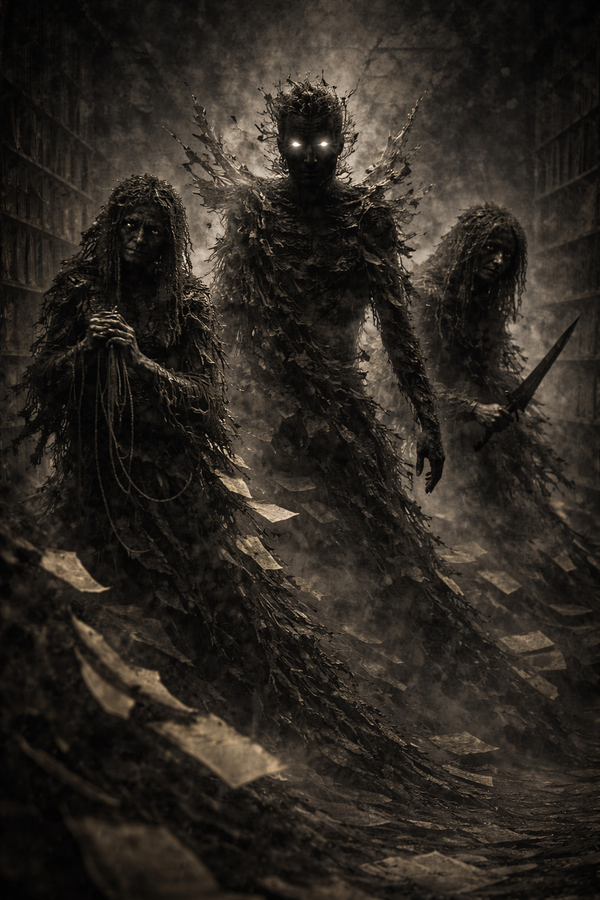
The battle waited in the next hour; this one, at last, had decided on their side.