The Chamber
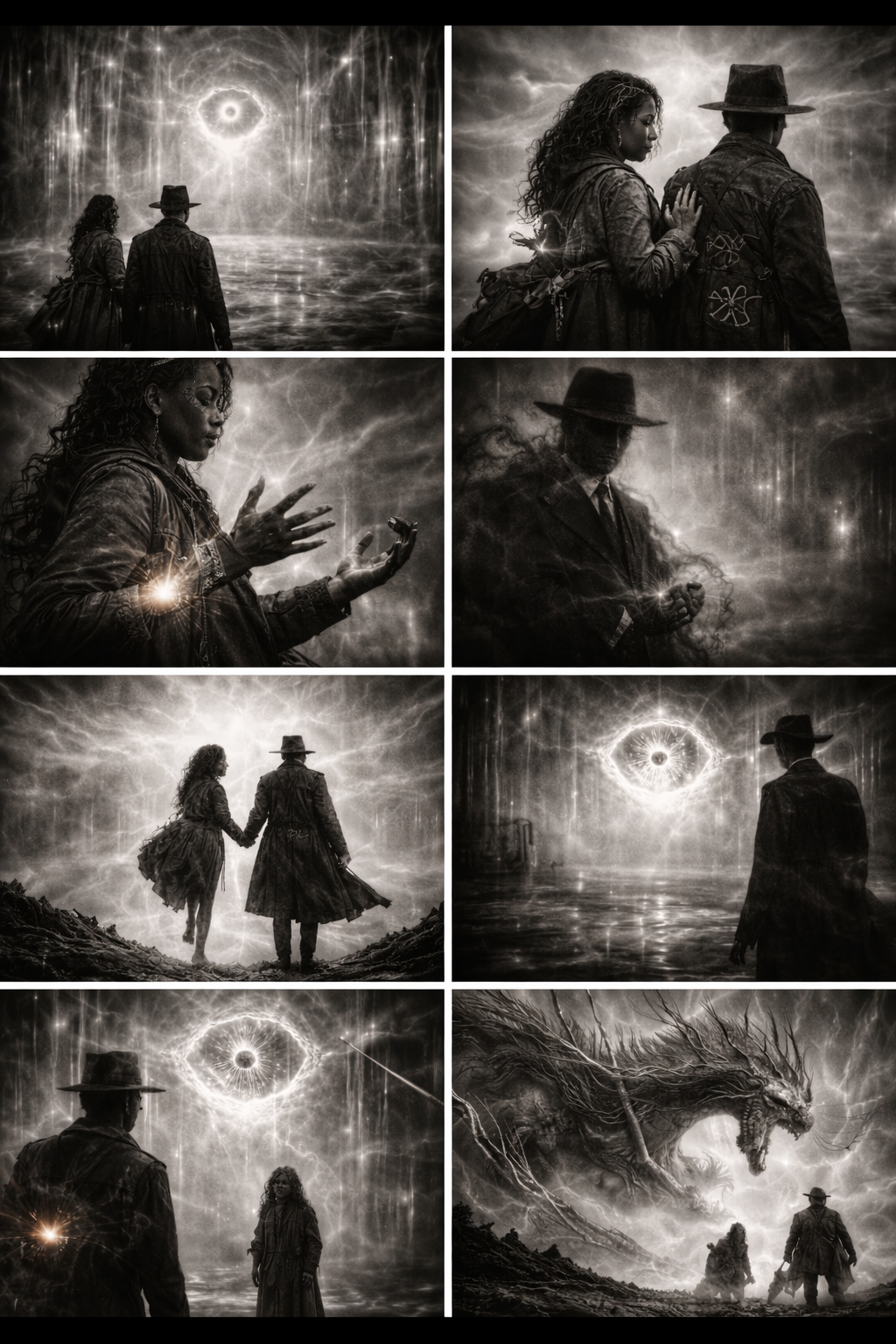
They did not speak at first. The demon stood off to their right—hands folded, eyes reflecting the steady blue-gold—looking for all the world like a man waiting for a meeting to start. The First Fire watched without blinking. The invisible winds kept their cradle, a thousand corrections a second, each one small and absolute.
Hope remembered the witches’ cadence—Share, Count, Wait, Turn—and set her feet to it. The gunslinger remembered the gnomes’ warning—Bring your own rules—and let his ribs ring the second note once, then twice, until his breath took the shape of patience.
They approached not by distance but by manner.
Hope lifted her palms, open as doorways, and spoke in the grammar she trusted. “Share, not swallow,” she said to the Fire, voice paper-soft and unafraid. “We bring work, not wishes.”
The gunslinger did not ask what are you or what can you give. He named the small truths he could swear to. “We mend what’s in arm’s reach. We refuse the easy lie. We’ll pay for answers with hours.”
They avoided riddles. They didn’t bargain. They declared labor and asked for instruction. Trade only labor for life against death, the witches had sung; they kept to the meter.
Silence received them like a ledger that loves careful handwriting. The First Fire offered no speech. It brightened a fraction, then a fraction more, the way a coal glows when you tilt the bellows and stop.
They waited, and in the waiting learned what kind of listener the Fire is. It learned them back.
Heat moved across them not as scorch but as attention. It read the starlight solder in the cartridges at the gunslinger’s hip and found no vanity there, only craft. It ran along Hope’s moon-cords and felt the echo of a laugh that mends, then stopped at the Adinkra stitched under her coat hem—Mpatapo, Epa, Fawohodie, Sankofa, Gye Nyame—and let their small, stubborn meanings seat themselves like honored guests. It nosed the phoenix’s perch in the air and recognized an old colleague. It tasted ash and rosemary and wire and east.
The chamber brightened toward a noon the eye doesn’t have the names for. Arches of probability clarified; the orbiting charges drew their loops as if tracing hymns in ink. Even the demon’s outline sharpened, and for an instant his smile looked like a thing he put on because he couldn’t decide which face to wear instead.
“Good room,” he said into the brightness, but it sounded like a man talking during a benediction, and the winds ignored him.
When the light passed some threshold the body recognizes before the mind can follow, the floor forgot to be floor. Hope felt her weight undo like a consenting knot, and the gunslinger’s hand found hers—not to keep from falling, but to remember who he was while doing it. The brightness did not explode; it unfolded around them like a door that has finally remembered what it was built to do.
The demon’s face clipped with the smallest frown, as if someone had moved his glass one inch to the left at dinner.
Then the two of them were elsewhere.
No cathedral. No hum. A sky like hammered steel hung low over a plain of black glass cleaved into lanes by trenches of white ember. Far to the west stood a range of mountains that had learned to kneel. Far to the east, something like a tower lay on its side, still trying to be vertical by force of habit. The air was hot and honest. Ash lifted and set itself down the way flocks do when they can’t agree which direction is safest.
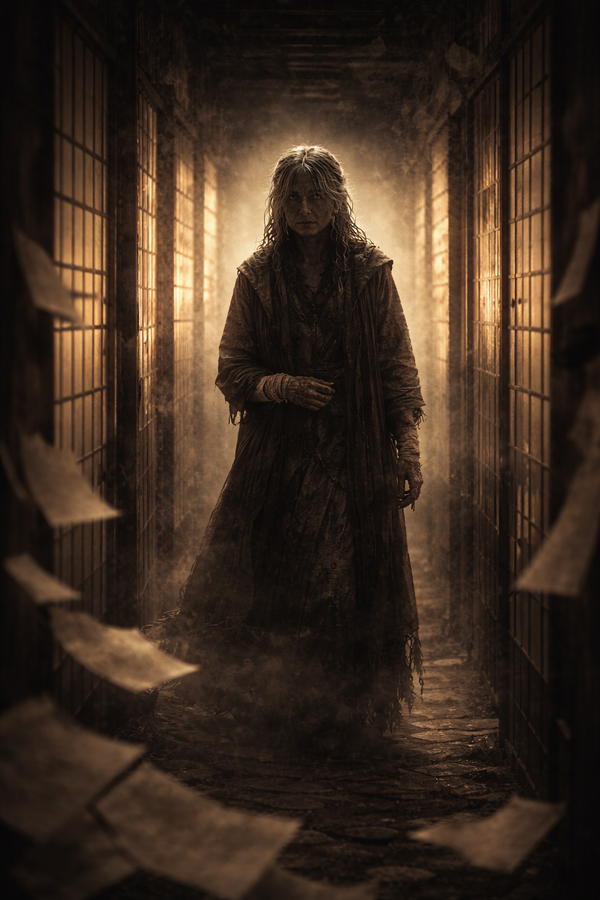
She waited at the edge of the nearest trench—a figure made of endurance and deliberate choices. Her hair had gone to frost without apology; her hands were bandaged not because they were broken, but because they had been asked too often for the same difficult thing. When she turned, recognition arrived like a remembered bell.
“You know me,” she said—voice paper-rough and steady. “I knew you once. I have been waiting.”
Hope’s breath caught. “You’re… her mother,” she said softly. “The Sorceress’s.”
The woman inclined her head. “My daughter lives—without what was taken—home now on Wire Avenue, kept and kept company.” (Inside home Hope heard Mercy’s name.) She looked to the gunslinger as if verifying a map she’d drawn while walking. “And you made it east.”
“Our world,” the woman said without ceremony, gesturing toward a horizon the eye could not forgive, “is on the brink—and needs you to save it from the demon and his army. But it is not the only world. These shadowlands are many, and some are older than honesty. This one has been at war longer than age knows how to count.”
“I am sorry to say,” she went on, each word placed like a stone in a river, “the scales of time are not tipping in our favor. Which is why I cannot return home to fight beside you. I will spend the hour making you dangerous—if you will listen.”
She raised her bandaged hand; the trench breathed light.
“Listen. The winds you met are not moods. They are manners. Share, Count, Wait, Turn. Speak to them in that order. Ask the Fire to witness, not to order. In the between, starve the demon’s cables: insulate copper with wood that has never been furniture; build rooms with no metal and teach your doors to remember. When you must shoot, aim for hinges, not hearts. Hearts recruit; hinges govern.”
She turned to Hope. “To reach him, you must starve his shortcuts. Sugar feeds his choir—teach it to be salt. When he tries to ride kindness as a conductor, make your kindness named and particular. What belongs to everyone can be stolen by anyone.”
Brightness returned like a verdict. The woman thinned to light—but did not diminish.
“Tell Mercy,” she said as the glass plain peeled away, “the ribbon shop’s light held.”
Hope’s answering laugh stitched the distance; then the cathedral returned.
The hum sat where it had been and yet not. The demon stood where they’d left him and yet not. The Fire burned as before and yet—
A crack ran across the eye.
Hair-fine at first, then networked as ice does in spring. The blue-gold ring hiccupped, stuttered, recovered. The orbiting charges hesitated, then resumed their slow hymn, but the harmony had a high false thread in it—nothing you could accuse in court, everything you could feel in bone.
It was not an eye, then. It was a pearl.
Not the neat little prize story-books promise in river mussels. A pearl on a scale you measure with metaphors and lose with numbers: layer upon layer of decision wrapped around a grain so unbearable the world had to learn grace to live with it. And under the first spiderlines of fracture something moved. Something that had never not been waiting.
The demon’s face had changed while they were gone. Surprise had visited him and found nothing to sit on; it had left a hairline smirk instead, the kind men wear when a thing happens they did not plan but will gladly claim. He stood a shade closer to the pearl than manners warrant. His hands were empty, which is how good thieves keep them when they want to be invited back.
“For the first time,” he murmured, tone low as copper wire under snow, “I did not enter on copper.”
Hope heard the word he did not say but meant. Kindness. The nail in her pocket cooled until it told the truth about itself: a gift, yes. And a key, if a hand turns it wrong.
The crack widened with the sound of silk tearing in a quiet house. The winds tightened their cradle until you could have sliced bread with it. The pearl’s surface bulged along one seam. What uncoiled then made language try on smaller clothes.
A ridge, long as a prayer and older, rose and kept rising. Scales that were not scales—plates of rule, overlapping, iridescent with math—slid over one another and threw off sparks of theorem. A coil as fat as Mercy’s bar gathered and then unwound. The cathedral’s arches of probability bowed to let it pass, and still it pressed. Heat went from polite to absolute. The phoenix bristled, every feather a line in a book that refuses editing.
The thing that stepped out of the pearl was too large for “size.” It was a proposition the room accepted under protest. One eyelid opened, and the pupil inside it was an aperture to a night that has never forgiven anyone. Breath, when it came, was not subtraction but choice: to pull, or to spare.
Hope and the gunslinger staggered backward, boots skidding on floor that was idea before it was stone. The winds hissed like a thousand librarians shushing a riot. The demon’s smile—a little wider now, a fraction closer to truth—caught and held the pearl’s ungentled light.
“Workflow,” he said, admiring the catastrophe he’d managed to touch by riding on someone else’s better nature. “At last.”
Hope’s hand found the moon-cord. The gunslinger’s ribs rang the note he had taught them.
The vast answer uncoiled again, and the cathedral learned what room can be made to mean.