Chapter I: The Gunslinger
“Do I know you?”
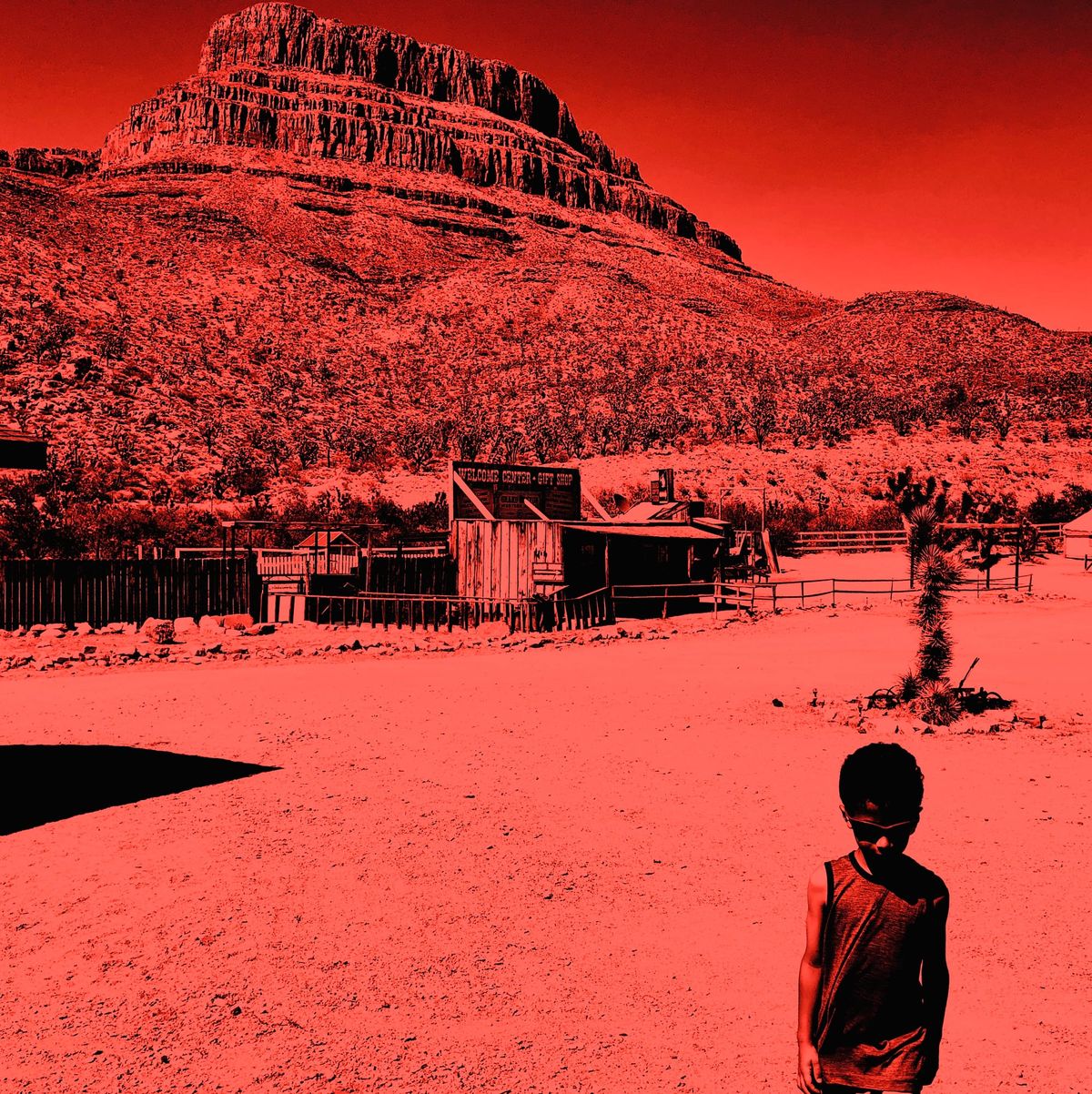
The man wore a hat caked in the dust from the town. A red sand, that over the years changed his clothes so much that he assumed they’d always been that way.
He repeated, “do I know you?”
He had his long-term memory, so it seemed. He knew the city, how to get around, but the people, the people were different. Unrecognizable. Where has he been for so long?
He stood in the middle of Wire Ave as the wind pulled grit from the tracks and the telephone poles sang. You could hear the song if you stopped breathing long enough: a long, silver hum, like a blade tasting air. The wires stitched the town to the horizon, sagging with heat and a thousand memories, some of which belonged to him and most of which didn’t.
The woman he’d addressed smiled without showing teeth. Her eyes were too even in the dust. “Folks come and go,” she said, voice like paper rubbed thin. “Some come back.”
“Do I?” he asked.
“You always do.”
He touched the brim of his hat as if it might introduce him to himself, then let his hand fall to the pistol on his hip. He did not remember buying that pistol any more than he remembered his mother’s name, but the grip had learned his palm and the cylinder held the neat patience of ritual. Someone — him? — had carved a notch in the base plate. Six notches, clustered like a small constellation. The metal was rubbed bright where a thumb might rest when counting.
He turned down Wire Ave, boots finding old grooves in the street the way a tongue finds a gone tooth. He remembered the layout of the city like an old hymn: the depot to the west, the slaughterhouse to the south, the church with the whitewashed bell where the bell never quite fit the tower. He remembered the back way to the water tower, the trick to scaling its ladder, the rope someone had tied at the top that creaked like a ghost. He remembered all the roads that led back to this one.
He did not remember faces. Not hers. Not his.
The bar on the corner had peeled letters in the window: MERCY’S. Inside, the air was warm and smelled of varnish and orange peels. He took a stool. The bartender was a man with a scar that divided his eyebrow into two small wings. “You’re late,” the man said, already reaching for a bottle he kept under the counter, dark glass that sweated like a living thing.
“For what?” he asked.
“For remembering,” the bartender said, setting down a shot. “It happens slower when the wind’s up. The song in the wires ... same as a lullaby.”
“What’s my name?”
“Could be anything today,” Mercy said, and his smile was kind, and hurt. “You gave me a different one last time.”
“Last time what?”
Mercy’s eyes ticked to the door and back. “He’s here.”
A heat rose under the man’s heart and spread down his arms. He didn’t know what he was looking for until he felt the shape of it in his breath ... an absence, a shadow that robbed a room of oxygen. He could feel it like a pressure in the jaw, a tooth gone bad.
The demon was sitting not ten feet away, dressed in a black suit that caught no dust at all, drinking something that did not diminish in its glass. His face was a clean coin. His smile belonged to another century. He did not look at the gunslinger yet, so the gunslinger watched the way the light slid off him, the way dust fell around him and refused to land.
He knew him. Not the name — names are for keeping —but the pattern. He knew the way the air folded around that shape and left a hollow.
Do I know you? he thought, and the wires outside answered with their blade-song.
The demon raised his glass. “Welcome home.” The voice was warm, almost fatherly. “You’ve brought me back to my favorite street.” He glanced at Mercy. “We’ll keep it tidy, won’t we? I am fond of this one.”
“Leave him be,” Mercy said, which was not defiance so much as devotion. “He just sat down.”
“Only one of us is ever sitting,” the demon said, and his smile widened to show nothing at all. “Tell me, how many notches today?”
The gunslinger’s thumb found the bright-worn cluster. “What does it mean?”
“It means you’re a persistent man,” the demon said. “It means we’ve been keeping score.”
Memory came like a whetstone across the edge of his brain. Fast flashes: a hand drawn map on the inside of a jacket, now gone. A voice saying, When you wake, go east. The salt-iron taste of blood and penny-copper wind. A church bell chiming once, always once, even when you counted to twelve. The demon’s face on a different body, a preacher’s collar, a railroad clerk’s visor, a dying boy’s slack grin, a mother’s trembling hands.
“You killed me the first time just there,” the demon said, pointing with his glass to the line in the floorboards where the stools ended. “You were young then. You cried afterward. You apologized to the wood for the blood.”
“I don’t remember,” the gunslinger said.
“You never do,” the demon said, and spread his hands with a gentleness that had broken cities. “That’s the game. I come back, you forget, we dance. We’re old partners, you and I. The town is our music. The wires keep time.”
He stood. The chair legs made a speaking sound across the floor; on Wire Ave the poles shivered. The gunslinger’s hand found the pistol without his permission.
“Out there,” the demon said, tilting his head toward the street. “We keep to our rules. We don’t trouble the bar, or the man with the scar, or the woman with the paper voice. We keep to the middle of the road so the city can watch.”
Mercy’s hand closed around the gunslinger’s wrist. “This time,” he whispered, so quiet the wires had to lean in to hear. “If you win, don’t look at him when he falls. Look up. Remember the way the sky looks. Make that the thing you keep.”
Outside, the dust gathered itself like a congregation. The wires hummed higher, a thin keen that made dogs farther off begin to cry. Faces appeared in doorways, the soft silhouettes of people the gunslinger knew he would not know again.
They took their places in the street. The demon didn’t bother to move his hands from his pockets. The gunslinger took his stance, knees soft, breath inside the breath. It came to him that he had done this enough to wear grooves in the afternoon, that every time he’d stood here he had left a small indentation in the hour that the next him would find with a tender foot.
“How many notches?” the demon asked again, almost curious.
The gunslinger would not give him the courtesy of counting. He pressed his thumb against the metal because that was what he always did, and then except for the wind and the buzz of the wire and the tired bell daring itself to chime, there was quiet.
They drew.
There are moments that belong to the whoever watches. The town took this one: the claw of the demon’s smile cracking, the pitch slid off the wires, the bullet’s round mouth opening into the demon’s chest like a sudden door. The demon looked surprised, as he always looked, as if this were the first ending.
“Again,” the demon whispered, falling without dust ever daring to touch him. “You faithful, forgetful thing.”
The body came apart like burnt paper. The dust refused him. The street exhaled.
The gunslinger stood very still. A weight lifted—a millstone with a thousand names carved on it—and his knees wanted to go. Mercy’s words were in his ear: Look up.
So he did. The sky over Wire Ave was not blue, not anymore. It was a pale, hammered metal, scarred with bright lines that ran to the horizon in four directions, like the world had been tied up and someone tugged the knots until they sang. A single hawk hung above the water tower, wings hardly moving. The sun was a coin with a bite taken out of it. The wires, without their burden, sang low, a song that felt like memory remembering itself.
He kept looking until his eyes watered. He made the sky into a picture he could fold and keep behind his heart. He made a prayer of it, though he didn’t know the words.
When he finally lowered his gaze, Mercy was there, wiping at the place where the demon had been with a rag gone threadbare from such work. “Drink,” the bartender said.
He drank. It tasted like oranges again, and something older than that. He waited for the forgetting, like the tide. It came on slow: a fog at the edge of the city in his head, then the fog stepping in, gentle and absolute.
Before it could take everything, he pulled his pistol and scratched a new mark into the base, careful and slow, a notch to sit with the others, bright as a star. Then he turned the pistol over and over until something else caught his eye: letters rubbed shallow with use, almost gone.
When you wake, go east, someone had etched there, long ago. Someone with his hand and someone else’s hope.
“East,” he said, as if tasting the sound might glue it to his bones.
Mercy nodded, eyes tired. “All right.”
“Who was he?” the gunslinger asked, and even as his mouth made the shape of the question he felt the answer slipping. “The man in the suit.”
“Just a traveler,” Mercy said.
The wires outside took up a different key. The wind moved. Far down the street, at the corner where Wire met the road that led out of town, a shadow stood up slowly, gathering itself from nothing the way a man gathers himself from a bad dream.
The gunslinger felt the old heat kindle and the old chill slip down the ribs of his spine. He set the empty glass down. He wished he could hold the sky in his hand and press it against his tongue like a communion wafer. He wished he remembered the name of the woman with the paper voice. He wished lots of things.
“Do I know you?” he asked Mercy, and Mercy’s mouth twitched.
“Better than most,” Mercy said. “Worse than you should.”
The gunslinger tipped his hat and went back out to the street. The red sand worked at his boots, trying to claim them, but the grooves in the avenue were his and remembered him. The poles waited. The wires pulled taut. The city held its breath. The demon at the corner leaned on the light post like a friend you hadn’t seen in years.
“Welcome back,” the demon said, smiling with someone else’s lips.
The gunslinger’s thumb found the newest notch.
He looked up, once, quick, stealing a bit of sky to tuck behind his eyes. It was still there. It was always there. He didn’t know why it mattered, but it mattered enough to make a shape of him inside the forgetting.
“East,” he whispered, and drew.