The Book No One Opened
She did not die that night. Regardless of what shadows reported by rumor.
But a girl did lose her mother.
When the church roof came down, and the ribbon shop remade itself from ash and stubbornness, the mother stood in the doorway she had taught to be a door and felt the phoenix’s binding hold one more breath than the world had budgeted. It was enough. She gathered her daughter into the lattice and sent her along the alleyways that knew her name, out past the ditch where a boy coughed smoke and stood, past the fence that sang a copper debt. She watched the child vanish into a morning that would one day answer to her. Then she turned toward the ridge.
Grief did what grief always does in the useful. It simplified.
Without the man whose hand had balanced steel and promise, without the village that had learned to count to one, she made herself a thin vow only work could keep: Find the demon. End the lesson. She tuned her laugh down to a tool; she tuned her mercy into edge. Where lesser dragons tested the ruins, she slaughtered them with clean economy—no rage, no spectacle—binding their copper oaths into breath and giving the breath back to the ground. The hyena-laugh in the hedgerows learned her footfall and left. The sugar economy that boiled pain into wealth found its jars turned to sand when she passed.
She hunted by wrong notes. Bells choked at their second: she went there. Roads bent around absences: she rode the angle. In market towns, she bought maps and inked new ones into her coat lining, stitching Sankofa into the seams so the path could fetch her if sleep took away directions. In chapels, she chalked Mpatapo beneath the pews, a quiet truce for any child who needed to rest through the sermon of thunder. In her pockets lived knots and wicks and the smallest of mirrors—the fence kit for a world that kept trying to forget its edges.
It took seasons measured by soot. Rumor toughened into story: a paper-voiced woman whose laugh made fire behave; a healer who set bones and broke bargains; a widow who walked out of subtraction and taught doors their jobs. Lesser dragons left off riddling around her because her answers were nouns: ash, breath, stop.
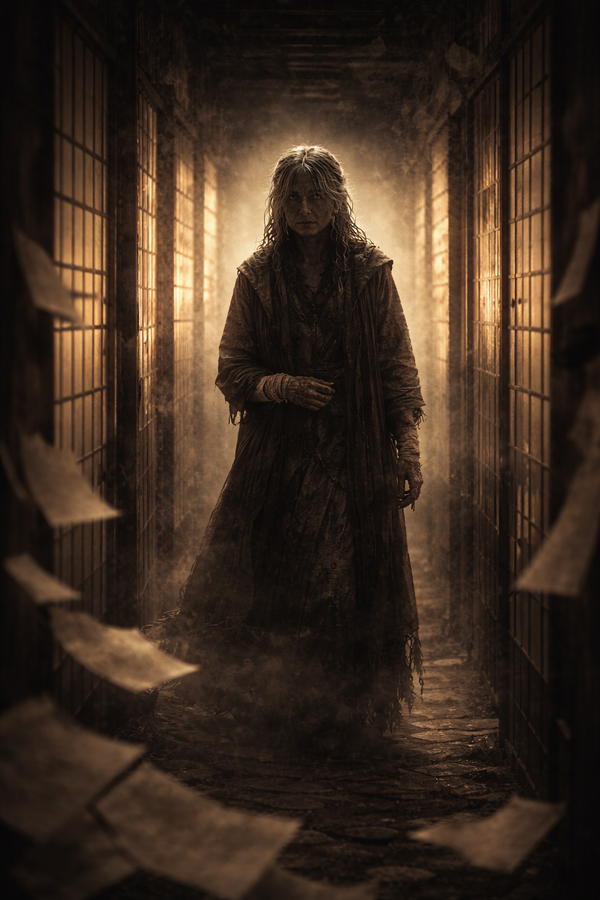
At last, the wrongness ran uphill and stayed there. Bells from a high mountain town rang clean and true and twice, and in the falls between notes, copper hunted the tongue. Books gather where altitude can keep them dry. She found the library on a terrace of stone that trusted itself, a building with good light and better habits.
The old librarian—glasses low, jokes kept in a drawer—saw at once the way war had made her small and exact. He set aside a loans ledger and brought out what passes for sacrament among his kind: tea that doesn’t lie, a table that remembers arguments it survived, and a chair that forgives weary backs.
“Questions?” he asked.
“Locations,” she said. “A ledger of absences. The grammar of his traveling.”
They spoke the day into the lamps. He showed her rail schedules that ran between names. She traced rattling roads on a map and drew thin Xs where bells swallowed themselves. He admitted to doors disguised as bindings and to bindings that behaved as doors. She taught him the sound a dragon makes when it remembers it is only habit and not fate. He told her the only honest thing he knew about evil: that it collects the interest on debts people never meant to sign.
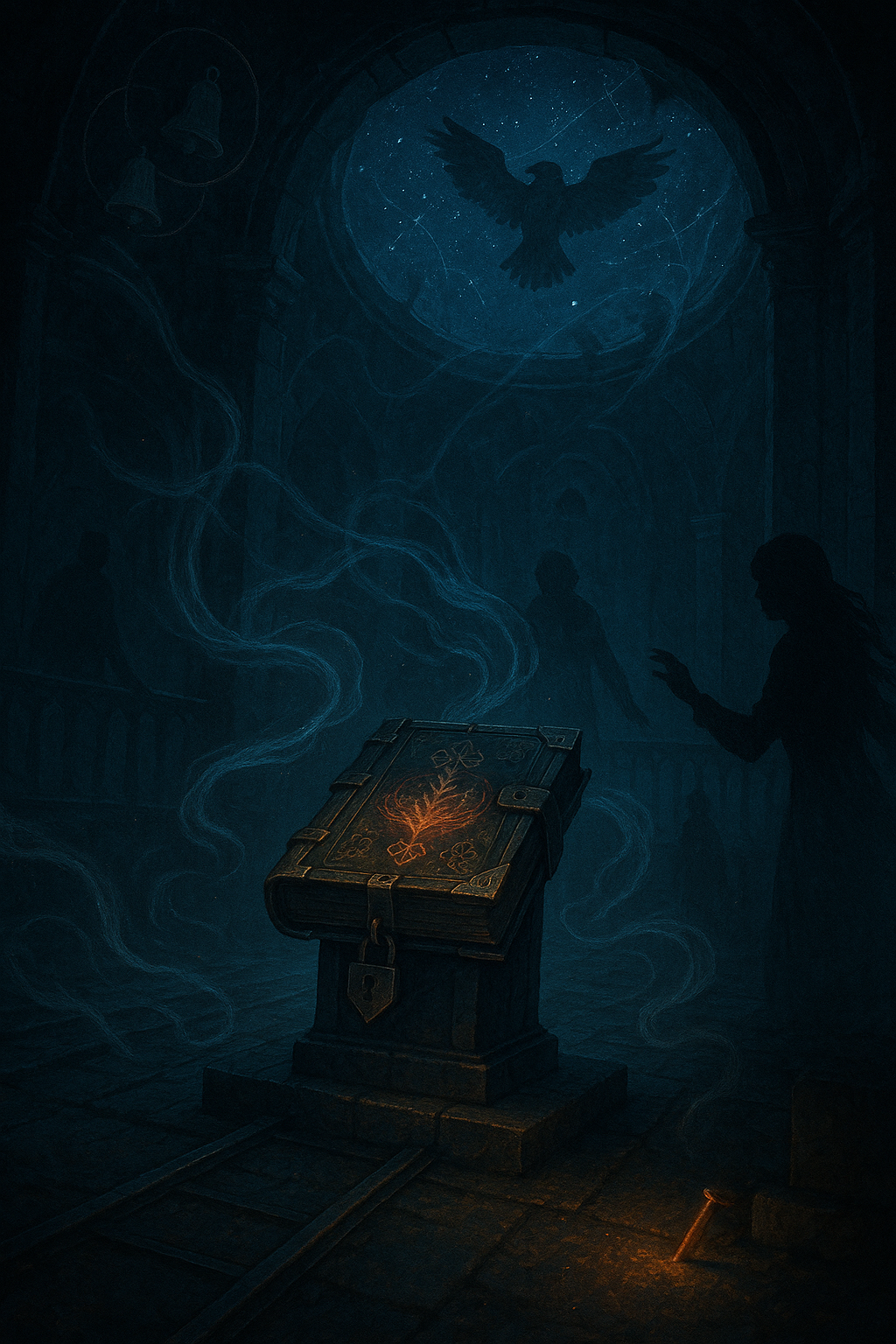
Near evening he walked her to a shelf that had let dust write its name too clearly. A slim, leather-tired volume sat there, unprepossessing, its spine uncracked. The copper foil on the cover showed crossed blades—Akofena, the old sign of courage and statecraft—and, in the corner, a small horn—Akoben, the war call.
“I haven’t opened this one,” he said. “Not out of fear, mind you. Out of policy. There are lands bound in here that demons respect by avoiding and that sorcerers respect by pretending they have never heard of. It is a place made of battles that forgot to end. It keeps its weather sharp.”
“Good,” she said. “He will be there. Or, if not there, then after.”
“The book will open for you,” he warned, “and it may not open back.”
She smiled without humor. “It will. Or what follows won’t need me.”
He brought her to a low room with a coin of sky cut into the ceiling—light honest as a witness. He laid the book on a basalt stand that had waited a decade for this minute and didn’t fidget. She set both hands on the cover and felt, for the first time since the night, her own pulse answer to something other than utility.
“What should I tell anyone who asks?” he said softly.
“Tell them the door did its job,” she said. “Tell them the girl was kept. Tell them I went where pattern fails.”
“And the boy?” he asked, because librarians think in chords.
“If the hour lets me,” she said, “I’ll leave him the phoenix, and with it, a road. There will be other magic in these lands.”
She undid the clasp. Air adjusted. Ink lifted like mist. The room grew the thin, necessary cold of an operating theater. On the first page a single sentence wrote itself and then had the courtesy to underline: ENTER KNOWING YOU WILL NOT LIKE WHAT YOU BECOME.
She laughed once—clean stitch; no miracle—and stepped through.
The librarian stood a long time after the light reshaped itself into nothing. He pretended to dust a clean shelf and failed. That night, under his lamp, he wrote her name in a ledger that kept no fines and closed it with two fingers held longer than usual against the leather.
Days became years that belonged to other people. He shelved wars and returned small mercies to their donors. When boys came up from the low towns with smoke in their lungs and sentences scratched on the plate where a tool would one day ride, he gave them maps that taught east. When women were sent for recipes, he handed them pamphlets that taught doors. He waited the way stone waits for a second bell.
News came by degrees, as it does when the world is deciding who survives to tell it. A gunslinger lost his family and found a direction. A girl with paper in her throat learned to bend moonlight without breaking the sky. In a winter that smelled of beeswax and frost, he led two travelers under the mountain, opened a hawk-bound book, and watched a red-tailed cry teach gravity its manners. Later, in a room cut for meteor, he stood back while feather learned starlight and starlight learned to listen.
He never saw the woman again. He assumed what people assume when a door opens onto a land of war and does not open back. He mourned the way professionals do: by preparing the next reader for the page ahead. In the privacy of an index card he wrote a final cross-reference: If she does not return, help the boy. Years made good on the note.
When at last the library itself went to negative space under a dragon’s patient accounting, he held to a small, disobedient comfort: that somewhere between a book no one opened and a House that remembers patterns, a girl kept by a door and a boy told go east had found the hour where their threads cross.
And though the woman did not die, the ledger of her work was made to continue the way work sometimes does: under other hands, in other voices, carried on a laugh that binds and a bird that arrives without spectacle when called.