The Blank Above
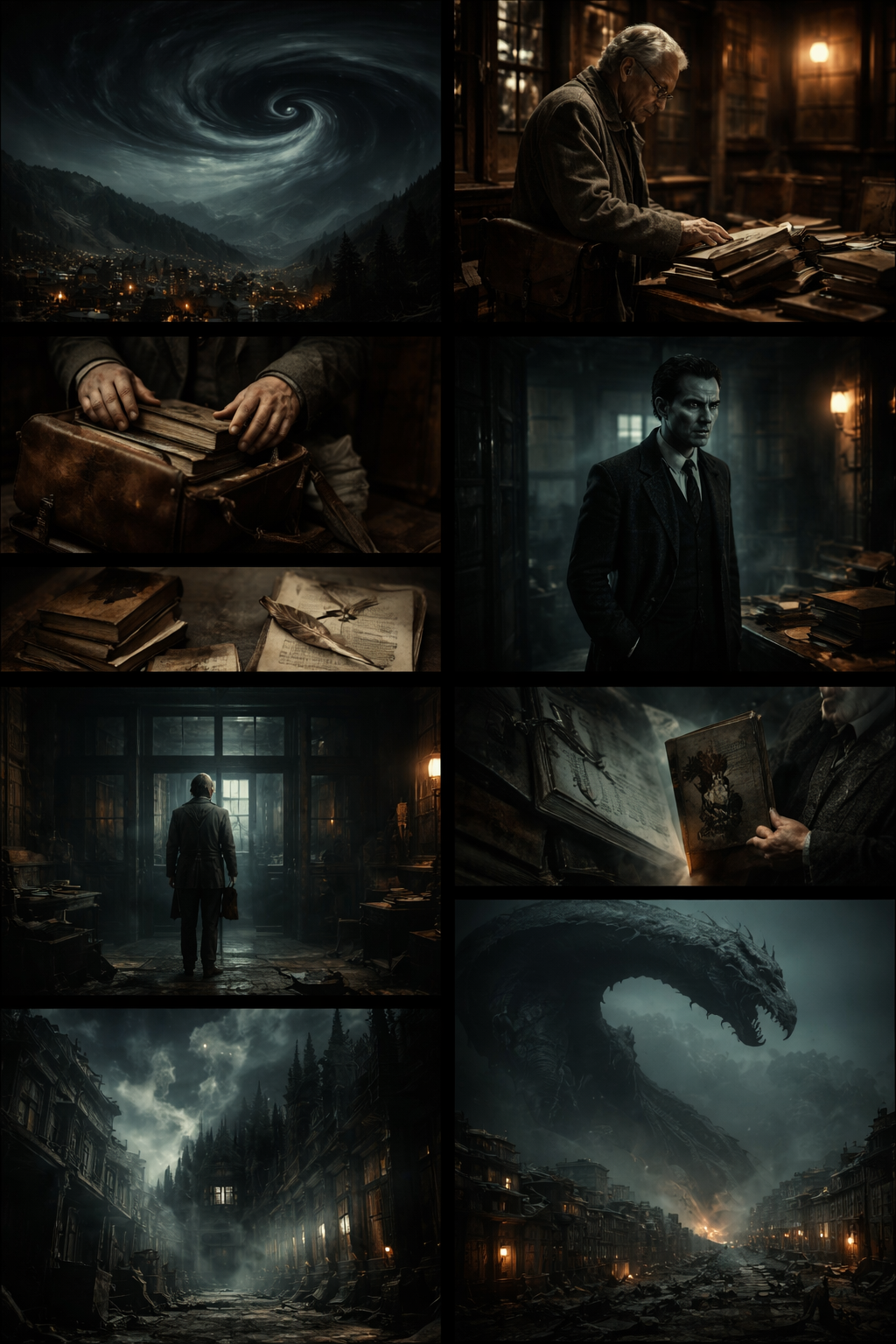
The night did not dim; it erased. One by one the constellations went out, as if a careful hand pinched each star and put it in a pocket. Then the darkness gathered itself into a spiral, hurricane-wide, the sky’s own ink drawing down and down until horizon and heaven were the same unmade thing. The mountain town—its lecture halls, its lintels, its quiet quarrels—stood briefly outlined in that absence and then the outline learned to shrug.
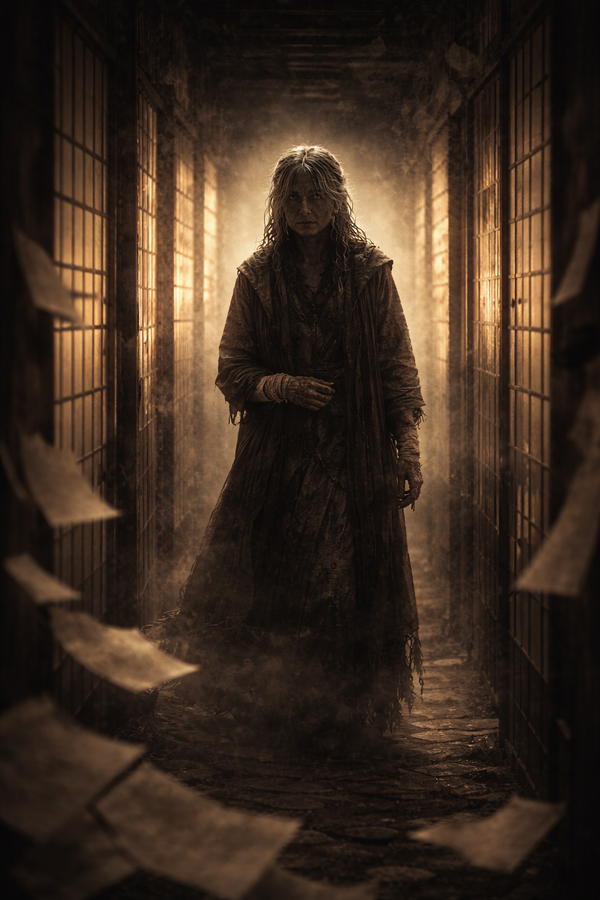
In the library, the old man who liked to be mistaken for a clerk lifted his head before the first shudder. Books speak to their keepers when weather grows unethical. He could feel the bindings tense along the stacks like greyhounds before the bell. On his desk lay the tools of his harmless trade: a stub of pencil, a loans ledger, a single quill molting to dust. He closed the ledger—no one would be fined tomorrow—and reached for the satchel he had carried since a season nobody remodeled. Its leather had learned to be silent.
He walked the aisles as if taking attendance, passing fingers over spines that remembered a thousand hands. He didn’t choose the great showpieces; he chose the sly ones, the links: a map that could be folded into doors, a pamphlet on bells that lied to themselves and how to comfort them, a thin book with a hawk that no longer had to be opened to fly. A slender volume bound in plain cloth gave his wrist a tug. Rail Schedules Between Realms, Revised—he had argued with the author in a rumor once. He slid it in.
On the far side of the glass, the spiral thickened. The air went to thunder without sound. The bell at the tower tried for its two honest notes; it got as far as one and a falsified half and then the second bent backward on itself and snapped shut.
“Education,” he said to the room, tightening the satchel strap. “Mostly refurbished ambushes.”
He took two steps toward the rear stair—the one that trusted him—and the front doors went politely black.
Not night. Shadow. A presence putting itself where architecture had been. The wood forgot its grain; the brass forgot its shine; the glass forgot the street. The shadow did not pour in; it arrived and the room received it like an audit.
The demon came with it in his usual cut of courtesy: coat the color of not-admitting, cuffs that had never learned lint, shoes that didn’t squeak because the dust preferred not to be caught telling the truth about them.
“You always looked older in the stacks,” he said by way of greeting. “I suppose that’s one of their services.”
The librarian took off his spectacles and wiped them with a handkerchief that had been clean in another decade. “You always sounded younger in doorways,” he replied. “That’s one of yours.”
The demon smiled the way a responsible uncle smiles when he’s about to hand a child a geometry problem with no solution. “Your time here is finished,” he said, gentle as a bedtime. He looked up at the ceiling where the copper sconces hummed to themselves and the shadow taught them a new hymn. “Before we go—what did you teach him?”
“The boy?” The librarian re-perched his glasses. “How to speak softly in rooms that want shouting.”
“I’m serious.”
“So am I. But if you mean the things that matter…” He gestured toward the windows where nothing was. “You did most of the teaching. Traps promoted to trials. Syllabi composed of loss. You are a surprisingly thorough adjunct.”
The demon’s eyes warmed a fraction. “Your quips are what pass for courage in this building.”
“And your compliments are what pass for mercy on your side of town,” the librarian said. He set the satchel on his shoulder and felt the books settle themselves to each other the way old friends do. “He has what he needs: a nail in the sky, a door that is choosy, a girl who laughs light. The rest is only hours.”
“And the bird,” the demon said, letting the word land like a spoon in acid. “You gave him a bird.”
“I didn’t give,” the librarian said. “I introduced, lended a good book.”
“Semantics,” the demon said pleasantly. “Semantics are my favorite food. No matter. The bird did not last. Another failure.”
The building shuddered again, deeper. The spiral in the sky found its throat. Through the shadowed glass the old man saw the shape that had learned to be older than mountains: a dragon that wasn’t there until weight needed a body. It did not fly so much as subtract distance from itself. Where it passed, roofs fell upward and landed heavier.
“How tidy,” the demon murmured. “We’ll make a lesson of you, too.”
The librarian looked around his library one last time and found it, as always, more beautiful for being mortal. Chairs that remembered being shoulders under scholars. Tables polished by elbows and indignation. Dust that had tied its life to light.
“We are going,” the demon said. Not to the librarian alone. To the shadow that obediently thickened, to the chief who lowered his head as if bowing to a sacrament that had been redefined to include him. “Take the town. Take the man. Take the light out of the windows and put it somewhere I can account for it.”
“You’ll overreach,” the librarian said mildly. “You always do.”
“Practice makes possible,” the demon said, and the room forgot its corners.
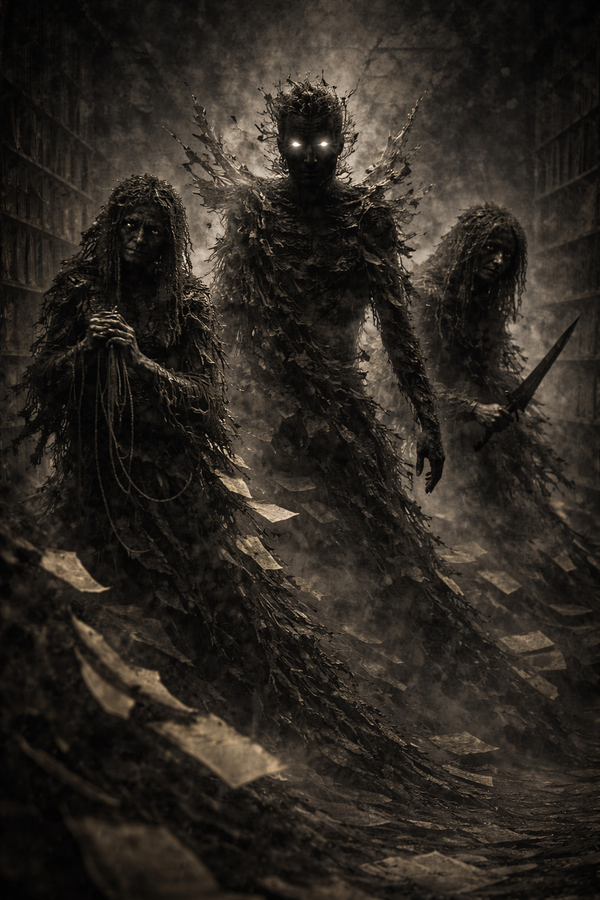
The chief of dragons did not roar. It breathed and the building’s reflections leaned toward it. Books gave their titles up like feathers. The copper lattice in the ceiling—old work, careful work—sang the wrong hymn and then confessed it didn’t know any other. The floorboards remembered they were trees and then forgot that, too. Shelves went to negative space, neat as teeth pulled and laid in a dish.
The librarian had opened a dozen doors in his life that other men would have called walls. He reached for the hawk on the cover out of habit and courtesy, and the book warmed in his hand with the hum of a train that knew which platform to favor. He lifted it. The shadow put two fingers on the spine.
“Indulge me,” the demon said, and his voice was a gloved hand. “Tell me a final thing. What is your favorite sentence?”
The old man thought it over. He had loved many. He had kept more. “Not a sentence,” he said. “A punctuation.”
“Yes?”
“The second bell,” he said. “When it rings.”
The demon’s mouth made something complicated and then decided on a smile. “We don’t ring it here,” he said, and the shadow pressed down.
The town went away by being kept. The bell tower folded into its own silence the way a throat swallows rain. Streets became aisles between aisles and then the aisles became nothings. The chief lowered his head and the mountain obliged. You could not tell when thunder began and buildings finished, only that the horizon had been made irrelevant and kindness impractical.
The librarian did not struggle. He did the only professional thing left: he took inventory until numbers ceased to propose usefulness. Title by title in his head as the stacks flowed into a geometry they had not been bred for. When the count failed, he held to one precise fact: he had not told the demon everything. There is comfort in the partial.
“Traps,” he said into the dark that used to be his air, as the chief’s void wrote him into its ledger. “Refurbished ambushes. Feathers needed for the forge.”
No one in the room laughed. The room forgot how.
The spiral above swallowed the last star and then had nothing to do. The mountain stood with less opinion. The library—its beeswax, its breath, its floor that didn’t squeak—went to negative space.
All was darkness. All was the tidy arithmetic of subtraction. Somewhere far off in a House that had learned to hum, two sleepers breathed evenly, and the chapter paused long enough for the next hour to find them.