Rumors on the Road to Fire
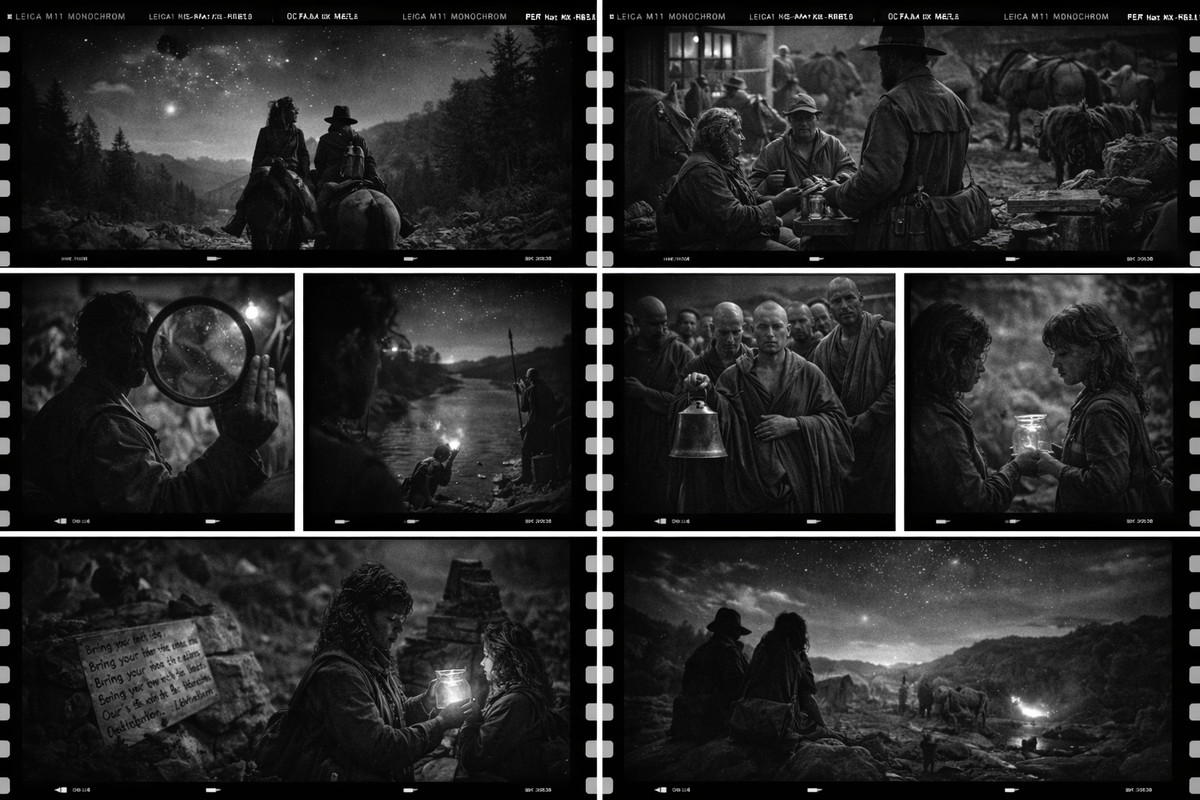
They rode east by the seam in the air that the witches’ rhyme had left, a braid you could feel more than see. The redwoods thinned to black fir and then to a high country scrub that smelled of iron after rain. Their horses had learned the cadence of the Second Bell as a pace: count, breathe, step. Above them Orion kept his nail in the sky; below them the ridges stepped away like a staircase someone had forgotten to finish.
The first tale met them at a waystation where tea was a language and roofs stayed roofs out of habit. A caravan of salt-sellers sat low on their benches, boots white-dusted, eyes bright with the relief of having something that doesn’t lie strapped to their mules. The eldest—cheeks webbed with sun—squinted at Hope’s sling and the gunslinger’s belts and said, “If you’re going to that cathedral, bring questions that can live without answers.”
“Answers are expensive there?” the gunslinger asked.
“Priced by heartbeat, if you believe it,” she said. “We lost a man to curiosity. He heard the hum and walked until the road unstitched under him. When we pulled him back he swore the First Fire was an oracle. Said it spoke in heat and probability. We asked what it told him. He said, ‘It asked me to rephrase.’ Nonsense. It’s all nonsense.”
They traded salt for ribbon-knot charms that kept mules from envying cliffs and moved on.
On a ridge market stitched from tarps and bravery, a lens-maker with cracked spectacles sold the night in fragments. He flipped a lens over for them: a circle of sky where stars seemed to lean inward, listening. “Invisible winds,” he said to Hope’s unasked question, tapping the glass. “Not air. Shear. They say mages name them and the names don’t stick. I call them the Pull and the Maybe. Bring something that remembers share.”
“Like a laugh,” Hope said.
“Like a laugh that mends,” he agreed, not knowing why he knew that was right.
At a river narrowed to a guess, a ferryman let his pole rest and sat studying the current as if it had misplaced a letter. “You heard it?” he asked, and they didn’t need to ask what it was. “Came down the gorge one night. My ferry rope shook like a dog. The hum makes the water think it’s glass. I watched trout hang in it like ideas. Folks say the First Fire is an eye. I say it’s a stack of rules playing cards with one another, and the pot is being.”
They crossed, the phoenix warming the air by an impolite degree, and left him drifting in his philosophy.
On the fourth day a pilgrim band in ash-grey passed them on the narrow, heads shaved, lips chapped from the cold the mountains keep for themselves. The leader carried a bell with no clapper. “We go to hear silence,” he said, voice soft as thaw. “Not peace. Silence. The invisible winds strip speech down to bones. We want to see what stands.”
“What did last time?” Hope asked.
He smiled in a way that made you want to quit lying to yourself. “Regret,” he said. “And hunger. And a woman’s laugh that made both sit down and behave.”
That night they camped under firs that spit resin like the trees were teaching fire to wait its turn. A child wandered in from a shepherding family, holding a jar that flickered faintly blue at the lid. “Caught some thunder,” she said, proud. “Pa says near the First Fire the lightning turns polite. Comes when called. Stays in jars if you tell it please.”
Hope bought the jar with a moon-cord loop and a lesson about doors, then gifted it back. The girl ran off, the jar a small star between her hands.
They learned other, worse rumors. In a town that had taught its bell to ring twice by painting the first note on the wall and shaming the second into joining, they met a clerk with copper under his nails and nerves like wire. “The invisible winds,” he whispered, glancing at his own hands as if they might report him, “they’re made of accounting. They balance everything you bring. Pride gets shaved. Grief gets weighted. Bullets? They become questions. Don’t take anything you’re not willing to have measured.”
“Then we’ll take everything,” the gunslinger said, and the clerk looked relieved without knowing why.
A miner, face scored by years of molten memory, stopped them at a pass where stones clicked underhoof like abacuses. “First Fire burned before bells,” he said. “First Fire will burn after. Don’t ask it to love you. Ask it to share. My brother went begging. Came back with his name spelled different.” He couldn’t spell it either way and wept into his scarf.
In a wind-carved chapel hewn into a cliff, a woman with a charcoal stole and hands smelling of myrrh traced Mpatapo in the dust and said, “People go there to be told the world is smaller than they feared. Some come back believing it. Some come back and plant trees.”
“Which would you recommend?” Hope asked.
“Trees,” she said. “But I tithe to both.”
They passed a watchman’s cairn where old maps flapped on sticks; every path to the “quantum cathedral” blurred at the same distance, ink beading as if the paper had learned to sweat. Someone had scrawled beneath in a steady, courteous hand: Bring your own rules. Ours won’t hold. —Librarian. Hope touched the script like a blessing.
The closer they rode, the stranger the weather’s good manners became. Two clouds argued above a saddle and then agreed to be a halo. Static stroked the horses’ manes the wrong way and left them docile, ears cocked toward a humming that had no direction and all of them. Once, a patch of ground forty paces across forgot gravity for a breath; stones lifted, considered ambition, and put themselves down again, embarrassed. The phoenix rode these moods like a captain riding a sea, wings barely moving, heat tuned to permission instead of hunger.
At a roadside shrine a blind bellfounder ran his palms over bronze he could not see and heard metal with his hands. “Oracle?” he said, laughing. “That’s what men say when they want their wishes to dress as truth. The First Fire doesn’t speak to you; it speaks you. Reflects you in a temperature you can’t stand for long. Invisible winds? They’re not guards. They’re manners. The place insists.”
“What if you don’t?” the gunslinger asked.
“Then it erases you politely,” the bellfounder said, and kissed the bell so it would remember being kissed.
In a meadow where the grass lay down and got up in moving circles as if remembering old dances, a woman with a kite shaped like a spiral stood barefoot and let the line sing through her fingers. “The winds have names,” she told Hope without turning. “Four I can say, three I can’t, one that says itself. None of them translate. But if you must: Share, Count, Wait, Turn. The others are rumors made of math.”
“What does the eye watch?” Hope asked.
“Workflow,” the kite-woman said, tasting the word. “It loves a good process. Hates a shortcut. Beware bargains that offer you a door without a handle.”
By the time the mountains gathered themselves into a ring you could feel in your molars, they had a pouch full of small truths and no answer big enough to risk. The hum was constant now—not loud, but present, like the breath of a sleeping animal you don’t want to wake. The night grew clean in a way that made lying expensive. Their horses set their hooves down as if counting.
They camped one ridge shy of the place everyone agreed they couldn’t describe. The phoenix hung above the pool the creek had carved into the stone and traced a small circle of warmth that nothing else entered. Hope spread a page from Interleavings and copied a diagram with a patience you only get after you’ve run out of hurry. The gunslinger checked his rounds, then checked the sky, then checked his rounds again.
“Oracle?” he said finally, not because he believed it or didn’t, but because he wanted to hear the word in the mouth of someone who still laughed like mending.
“Cathedral?” she countered, same reason.
He nodded toward the dark that felt like light reconsidered. “Invisible winds that guard it?”
“Or teach it manners,” she said. “Or teach us.”
They watched the ridge breathe. The phoenix’s eye held an ethic, not a color. Somewhere beyond, an eye that didn’t blink organized its workflow of madness.
“Questions?” he asked.
“More than answers,” she said.
“Good,” he said, and lay down with his hat over his eyes. “I’d call it a trick if we thought we knew something for once.”
The night obliged them with clarity and no comfort. Above, Orion refused to blink. Below, the hum kept its polite distance. Between, two people and a bird prepared to walk into a place where even rumors wore gloves—carrying knots, belts, and a laugh that could make gravity share—and agreed, without agreeing, that questions would have to be enough for one more hour.