Chapter IV: Fiddler’s Cut
Hope left before the first freight rolled and before the wires woke fully. The air tasted like iron filings and lemon rind, but there was no weight on her chest—no rain in her lungs, no old drowning. The woman with the paper voice had pulled the fever out of her and folded it away in sugar, and now Hope could walk as far as a day could carry her. So she did.
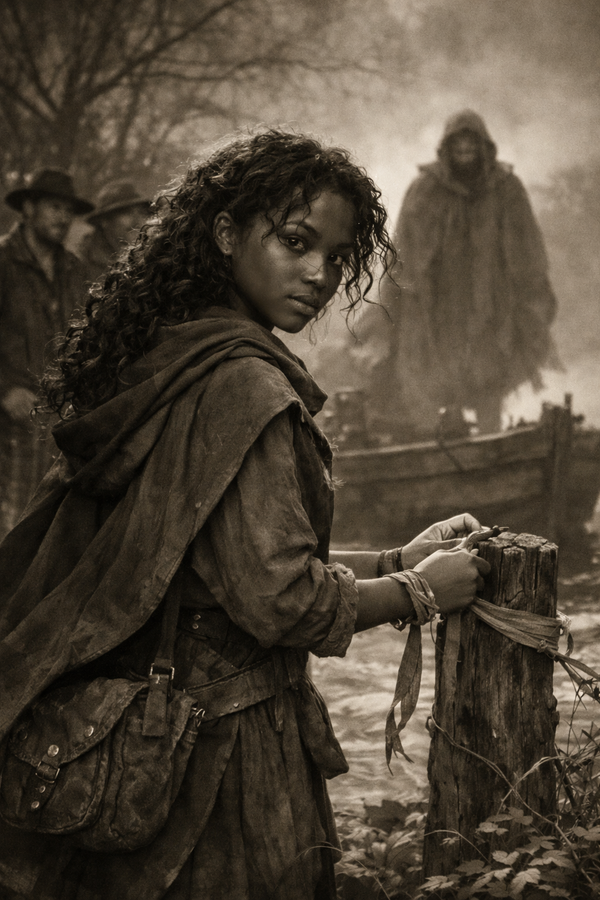
She didn’t take much. A canvas satchel with a length of copper, a pocketknife, a ribbon from a dress she’d outgrown, and the last letter Mercy had written in his tidy, stubborn hand: You’ll do what you will. Write if you can. I’ll keep the floor swept.
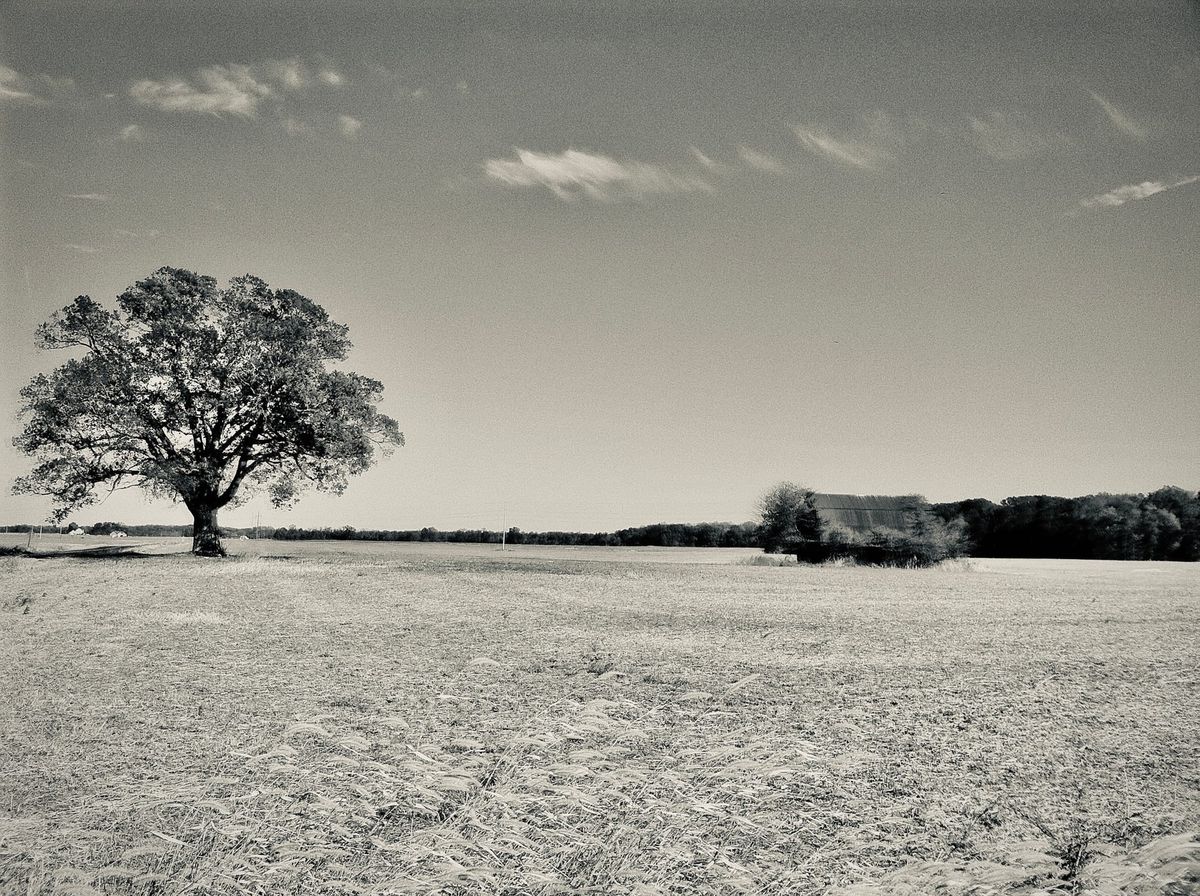
For a long time, the road east was nothing but grass arguing with the wind. In places, the poles marched alongside like thin soldiers, their green-glass mouths sipping sky. Out here the wires hummed their own weather—no hair braided into them, no forgetting tuned into the pitch. Bells in these towns rang twice when the hour asked and sometimes three times to show off. Hope liked that.
The town where things changed was called Fiddler’s Cut, though nobody fiddled that she could see and the cut was a river bent like a question mark. A mill wore the river like a collar and coughed steam into the morning. Three grain silos watched the main street like old saints. The telephone lines came in from three directions and knotted themselves on a pole outside the tavern with a swung sign of a fox and the word LUCK.
Hope felt the shiver as soon as she stepped onto the street: a hollow in the air like a pulled tooth. She could taste the demon the way a person tastes lightning before it arrives. That came from experience. Every town has its own weather; Fiddler’s Cut had a sky that flinched.
Hope arrived just in time to watch.
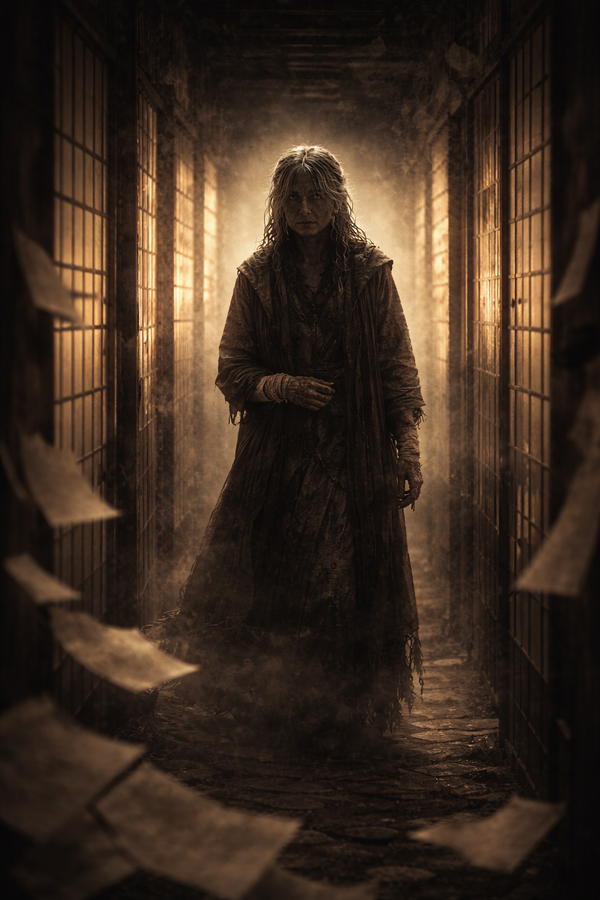
He came the way drought comes: noticed in retrospect, inevitable up close. Hat low, coat the color of old road, boots that had learned how to apologize to dust. The pistol rode his hand docile as a well-taught animal. People near him did that thing you do when you see the contour of a legend—stared without looking, breathed without breathing.
“Gunslinger,” somebody breathed, half prayer, half dare.
The demon stood in a feed-store doorway, dressed in white linen because he had a sense of humor. Dust worked its miracle on everything in town except him. He let the gunslinger come close enough to hear his voice and said it soft: “Welcome, son.”
Hope watched the gunslinger’s body remember what it knew. Knees easy. Breath inside the breath. Thumb to the bright-worn cluster of notches on the pistol’s base plate—a small constellation he didn’t count aloud. The demon did not raise his hands. The town held very still, as if any jostle might spill their lives.
They drew.
It was as old as gravity and just as impersonal. The demon took the bullet in the chest and smiled a surprised boy’s smile as he folded and unstitched into smoke. He would have gathered again—around here demons do—but trouble likes company and today Fiddler’s Cut had an extra trouble.
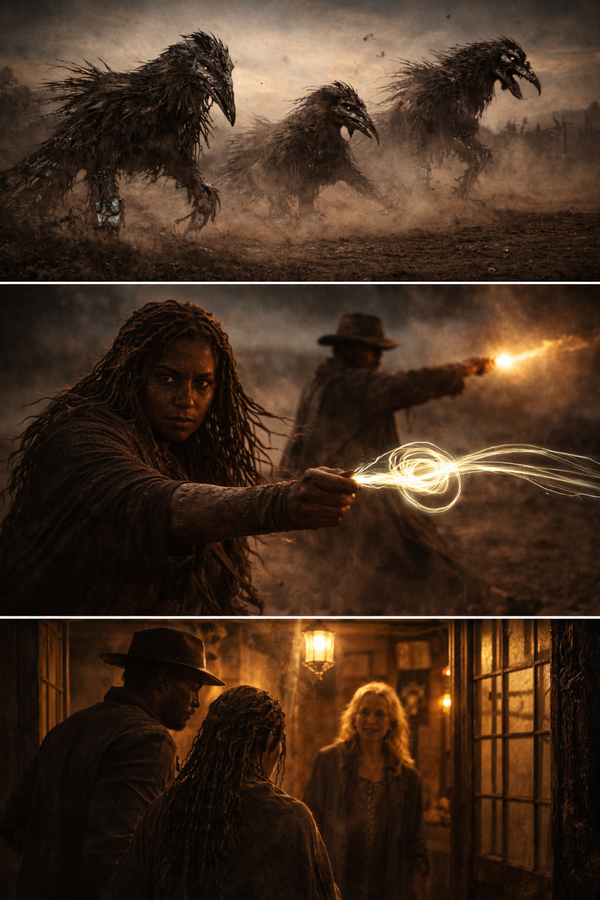
Something huge uncoiled from behind the mill: a shape made of heat and shadow, train-sparks and river steam braided into a spine. The dragon had made a nest of pipes under the boiler house, learned the taste of grain and debt and ledgers. It shouldn’t have flown—nothing that heavy should—but it rose and light bent around it. It said a word with no vowels and a man dropped to his knees with blood pouring from his lips.
Hope’s breath caught; the old lung remembered its habit. She swallowed, found air again, and watched the gunslinger not hesitate. He didn’t try to be brave. He was efficient. This was not his first time. He snapped the clapper chain with a single shot and hit it on the hop; the bell answered with a square blow that made the dragon flinch. He took a pulley that held the sluice gate; the river came in loud, washing steam to nothing. He kicked the boiler door and timed a pressure sigh to the beat of his next round. When the creature opened its mouth to argue, he put a final bullet through the soft black of its eye. The argument ended.
Not pretty. Honest. The dragon collapsed like a sick map. The mill shuddered and stood ashamed. The demon’s smoke tried to reconsider; the wind discouraged it. The bell, having gotten a taste for ringing right, gave them two hard notes that landed in every pocket on the street.
Laughter came first like a mistake and then from the whole body. An apron flew; a boy wore it like a crown. The tavern door broke its own hinge in a hurry to be open. Hope grabbed a bottle and two glasses and met the gunslinger at the end of the bar like a coincidence he might believe.
“Sir,” she said, voice clean as a new page. “Let me buy your drink.”
He looked at her the way a thirsty man looks at water that might still hold a reflection he doesn’t care for. He touched his hat. “Ma’am.”
Up close he was younger and older than she expected. His eyes were the color a sky might try on if it forgave itself. He smelled like dust and oranges; somebody here kept a habit like Mercy’s. He held the glass like it had an opinion.
“You saved this town,” Hope said. “You’re known for it.”
He took a swallow and let it sit before he told it where to go. “Sometimes the town saves itself,” he said. “I just say when.”
Something moved behind his eyes then—sharpening —memory came like a whetstone across the edge of his brain: flash—a hand-drawn map inked onto the lining of a jacket (his own trick, for the forgetting) and then gone, lifted at Rook Station by a railroad clerk in a green visor who smiled too patiently and later burned what he took. Flash—a voice, his voice recorded for himself on bare metal and in the mouth, repeating the same instruction whenever the fog broke: When you wake, go east… He had carved it into the base plate after a woman he couldn’t name told him the bell on the right street rang wrong. Flash—the salt-iron taste of blood and a penny-copper wind: the scent that always rose just before the devil gathered, as if the world itself were nicking its tongue. Flash—a church bell chiming once, always once, even when you stood under its rope and counted to twelve; a sorcerer’s tell, the first wrong note that led him like a string. Flash—the demon’s face on different bodies: in Pine Candle beneath a preacher’s collar with a father’s smile; at Rook Station behind the clerk’s visor counting out exact change; at Ellender’s Ford wearing a dying boy’s slack grin as bait in a fever tent; in Harrow Bend shaking with a mother’s trembling hands, close enough to touch his wrist.
He blinked and let the whetstone pass. “He keeps changing,” he said, almost to himself. “Not just faces. Contracts. Pulpits, ledgers, sickbeds, kitchens. Same hollow where the air should be. Same dust that won’t touch him.”
Hope nodded. “Our town has that hollow,” she said. “But the demon there doesn’t wander. He’s tied to a street. The bell won’t find its second note. The woman who did that to the bell, to the wires—she conjures him. My brother keeps the bar. He won’t leave because he loved her once and maybe still does on tired nights.”
“The map you lost,” she added, cautious now, “it wasn’t the first, was it?”
He smiled without mirth. “No. I draw them for myself when the fog’s kind. Inside linings. Palm, once.” He set the glass down with two careful taps, like measuring the distance to a promise. “The clerk at Rook Station wore his face. I didn’t know until he was ash and I had no jacket.”
Hope watched the ribbon of celebration outside the windows—street filling, street emptying, the tide of relief. “The voice you hear,” she said, “telling you where to go—whose is it?”
“Depends on the day,” he answered. “Mostly mine, left where I can find it. Once it sounded like a woman who spoke like paper. Once like a bartender with a scar that made wings of his eyebrow.” His mouth twitched; it might have been almost a smile. “The bell is the truest voice so far. One chime when there should be two.”
She breathed in, easy, and let the truth sit between them. “There’s a place west of here,” she said. “A long way. The poles run straight to it; the wire hum is…trained. The bell does that sad trick where it chokes before it can be a song. The woman who runs the trick speaks like paper. My brother keeps a debt. In this place, the demon doesn’t come on his own. He’s sent for, shaped, told where to stand.”
He didn’t blink. “What’s it called?”
“Wire Avenue,” she said. “Though the last time I looked, the I was loose.”
“West,” he said, which is a big word when you mean it properly.
“West,” she agreed.
He turned the pistol in his hand. She saw the notches; saw his thumb find them like prayer beads. Beneath the stars, the old scratching was there, rubbed shallow but legible: When you wake, go east.He caught her looking and huffed a breath that might have been a laugh. “It’s a compass that only points when I forget,” he said. “East to remind me where home isn’t. The rest I figure out.”
“If you reach our street and don’t know my name,” she said, “say it twice.”
“Say it now,” he said.
“Hope,” she told him.
“Say it again.”
“Hope.”
“Your brother?”
“Mercy.”
He tasted the names as if they were iron in the water. “Then I know what I’ll need when I arrive,” he said.
She pulled the ribbon from her satchel—blue once, now any color it wanted—and tied it around the strap of his canteen without asking. Sometimes asking is a way of saying no. “So you’ll have a piece of the road you’re riding toward,” she said. “The wind remembers cloth.”
He weighed that without touching it. “All right.” He laid down money he hadn’t counted and left change he hadn’t asked for. The tavern’s air made space around him as he moved. Outside, the town’s relief spilled sunlight in every direction. A child with sticky hands ran into his leg and forgot to be afraid. He set a hand on the boy’s head and then on the father’s shoulder, a benediction without a church.
He stepped into the street and the town stepped back to let the story pass. He swung into the saddle like a man getting back into a sentence. He didn’t look back; men who have to do a thing don’t, not if they want to arrive. He rode west and the road took him without question.
Hope watched until the heat bent him and then let him straighten. She felt the old fear tug her dress hem—fear that men who promise the right thing get pulled apart by the wind—and felt the newer thing rise against it, a habit her lungs could afford now: belief not in heroes or endings, but in work. She would go home. She would climb the tower. She would unmake the song. He would come when the hour had his name in it, and if he forgot, she would say Hope twice.
Back inside, the barkeep was already selling the first version of the tale. Hope took one more sip of the drink she’d bought a famous man and set the glass down. In the ring it left she could almost see the outline of a town with its I missing, a bar that kept oranges under the counter, and a brother rubbing at a knot in the wood as if he could smooth the world there too.
She picked up her satchel, stepped into the sunlight, and started west. The bells of Fiddler’s Cut, pleased with themselves, rang once for luck and once for the road. Above her, the wires hummed nothing but wire—and, if you listened long enough, the faintest promise of a second note.