Chapter X: Laugh, Bind, Slay
Every step taken in a circle is prologue.
This isn’t the kind of story that fits neatly in a ledger.
It begins in a room above a ribbon and pill shop with a window left unlatched for air, with a girl who kept a book her mother told her never to open, and with four words no mouth should carry.
The book did not look like a trap. That was its first defense. Buckram the color of evening. A clasp that remembered iron. Pages made from bark so thin you could see your own breath through them. If you pressed an ear to the spine you could hear nothing—if you were blessed. If you were not, you heard a door breathing.
Her mother kept it on a high shelf and said, in the tone people use for stoves and rivers, “You do not touch this. And you do not say the four.” She herself never said the words aloud. She didn’t have to. She knew the girl was touched—and books tell secrets to those who live under the same roof long enough.
What the girl did not know is that the book wasn’t a book before her mother made it into one. It was a place. And before it was a place, it was a chase.
—
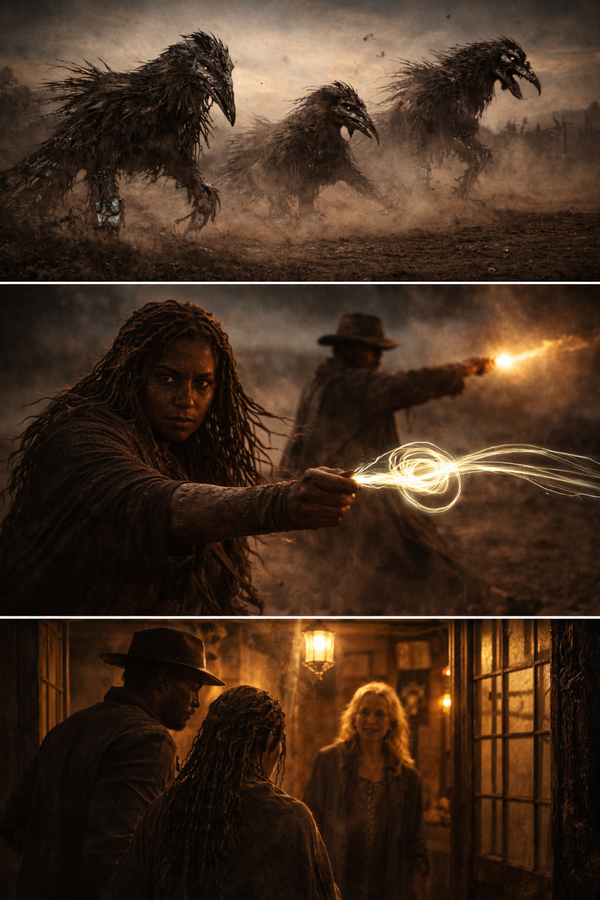
It also began decades earlier, on a salt flat that wore the moon like a bruise, a young gunslinger and a young sorceress followed a wind that tasted like pennies. He had the gait of someone who’d learned to apologize to dust. She had the laugh of someone who’d taught birds to turn in the air at a joke. Between them moved an old problem in a clean suit: the demon that doesn’t take dust, the one that prefers other people’s faces.
He’d driven the dragon back to earth twice already that week—boiler shattered, sluice loosed; he knew how to turn a town’s machinery against its myths. She had mapped the thing’s contracts in chalk and whiskey, finding copper at every corner, oaths fastened with nail and silence. It was her idea to bring fire that knows names.
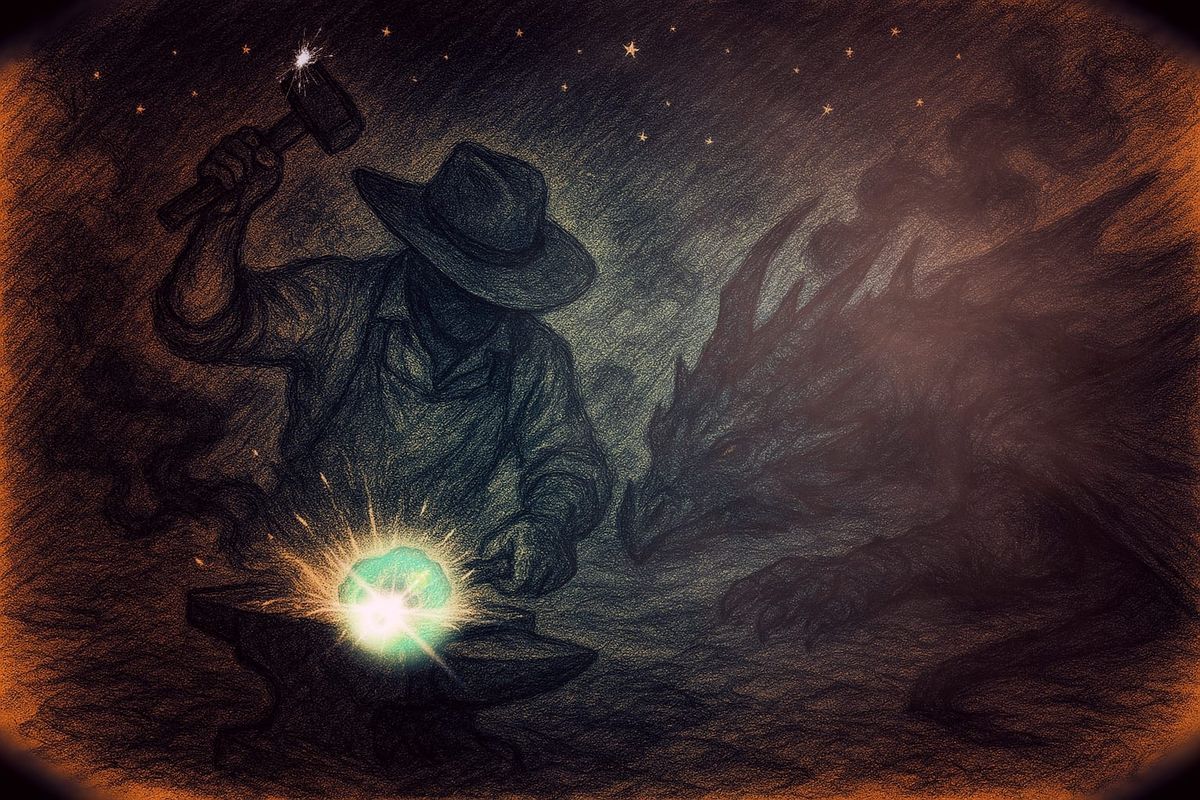
“Laugh,” he said, when the thing stood in the door of a church and smiled with a father’s mouth.
She laughed. The sound climbed the rafters and escaped, and the air above the salt brightened and broke. A phoenix arrived the way a hymn arrives—first as a thought, then as heat. It circled, slow as the tick of a second hand, and every shadow on the flat remembered where it belonged.
“Bind,” she told it, voice steady.
“Slay,” he told himself, and when the dragon came through the demon like a second thought, he put the last round where it needed to go and turned heat against itself. The phoenix dropped, folded its wings over what was left of the demon’s shape, and for a breath they had it—pinioned, quiet, possible.
“Not forever,” the phoenix warned, speaking in the way light speaks: by being.
“Long enough,” she said, and unlatched the satchel that held a sheaf of bark-sheets and a spool of copper thread. She sewed a door on the flat ground with quick fingers, each stitch a syllable, each knot a rule: no gathering in corners; no wearing of mothers; no bells taught to lie. She stitched a spine of phoenix quill through the middle so the page would remember how to be fire without turning into it. When she tugged the last knot with her teeth, the bound thing tried to wring itself into smoke. The copper sang, the phoenix pressed down, and the demon went into the place she’d made for it—a shadowland shaped like a book.
He lifted the finished object the way a man carries a newborn he hasn’t decided he deserves. It was heavier than paper and lighter than iron and exactly as serious as both. He looked at the sorceress and saw a life that didn’t end at the road. She looked at him and saw the same.
“What now?” he asked.
“We find a town with manners,” she said. “One whose bell rings twice. We grow quiet. We let people call it luck. We grow old.”
So they did. They found the town whose crops came up even and whose river remembered its job. He put his gun in a box and slid it where no one would trip on it. She opened a shop that smelled like cinnamon and camphor and clean bandage. She laughed often and softly, and sometimes the air got warmer for a second, the way a body does when a fever breaks.
He married a woman whose hands could turn a plank into a table without measuring, because a person like that needs someone who knows what a home looks like.
She married a man who could knead good bread and better apologies, because a woman like that needs someone who will ask her to rest.
The two old hunters crossed each other in the market on Tuesdays and said nothing important out loud. They had given the town a luck it didn’t have a purse for; they let the town think it had found it under a cushion.
The book they hid in plain sight—wrapped, shelved high, a notch in the spine where her finger had found its way every time she’d checked the stitches. She told herself she would never need it again. She told herself she would teach a daughter to keep away from ladders.
—
The children grew the way children do in such towns—quick and sharp, poor and bright—and the thing in the book did what prisoners do when the jailer lives upstairs: it listened. When you keep something that wants the dark in a bright room long enough, the dark learns to make its own weather.
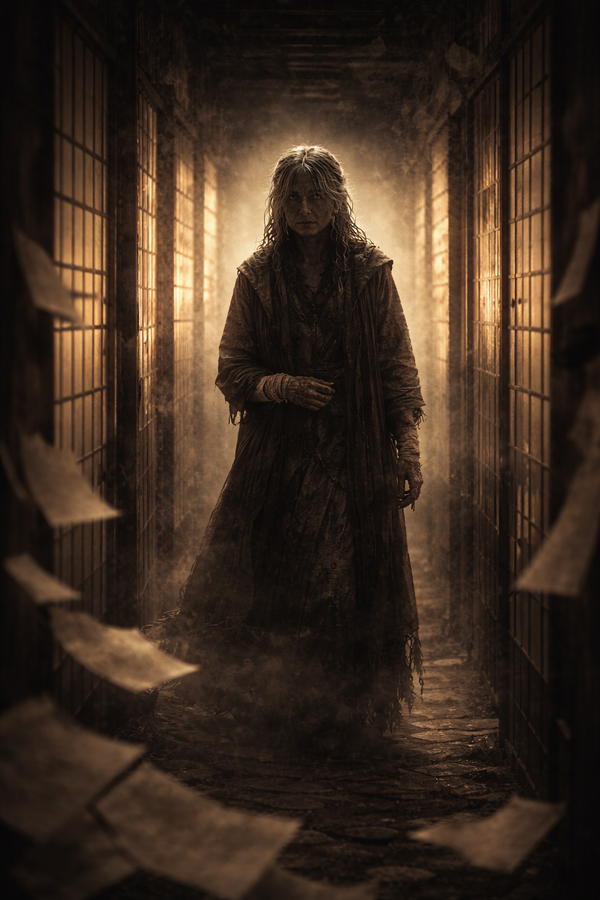
The night the two men came with a hook made from a spoon and a thirst that would not be argued with, the book had already woken. It had been waking for years. It liked the way the window was left unlatched for air. It liked the way the girl read other books by lamplight and mouthed the letters. It liked the way a throat is simpler to solve than a lock.
...
One man kicked a chair by accident. The other cursed in a whisper, which is louder than shouting if you’ve ever broken into a room. The girl sat up. The nearest hand—impatient, practiced—closed around her voice. She saw stars and then only four letters, bright as nails.
Her mother had told her there were words in the world that feel like stepping into a river in winter: they will take your breath and tell you it’s a gift. “You do not touch the book,” she’d said. “And you do not say the four.”
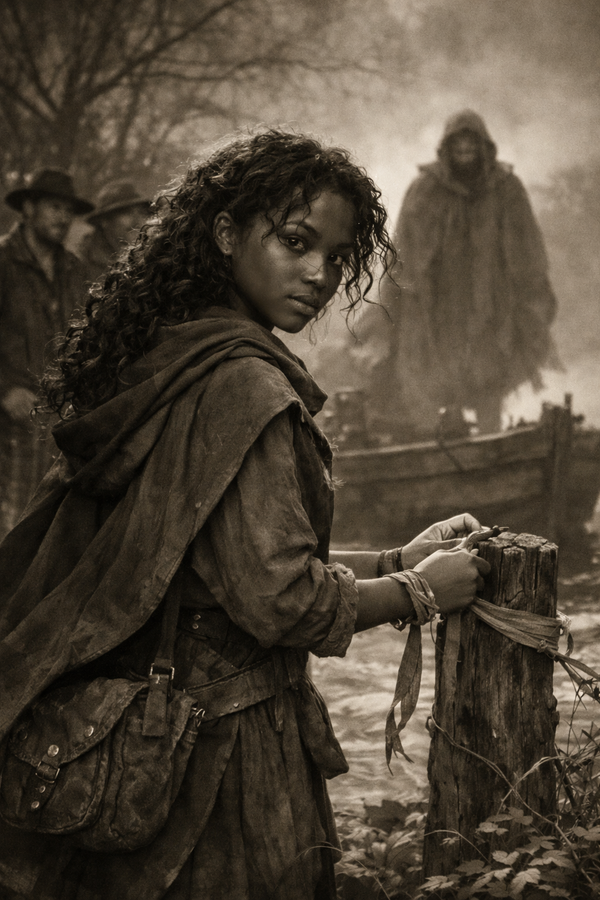
The book whispered at the exact speed of panic. It laid the four out like a trail of breadcrumbs. The girl, small and human and afraid to die, followed the trail with her mouth.
She said them.
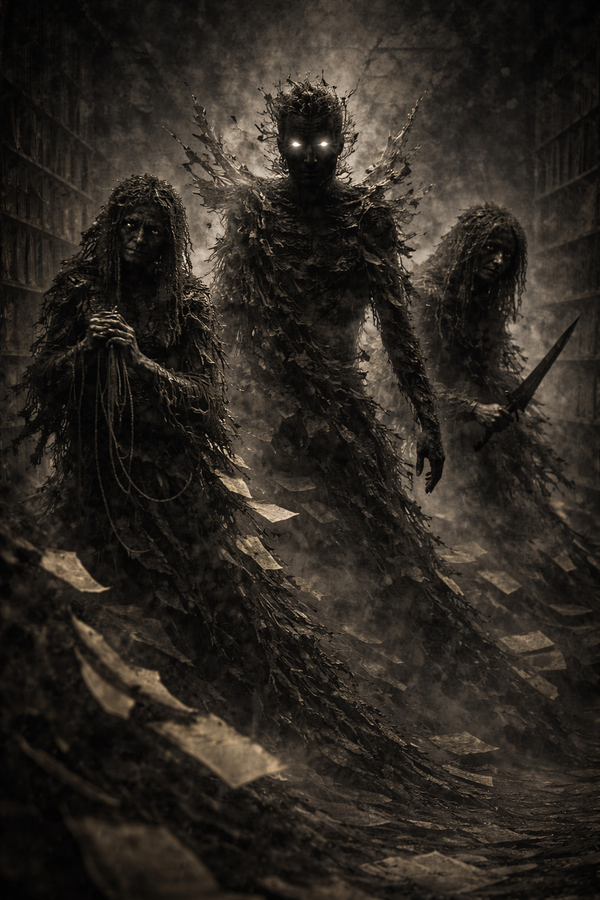
The clasp forgot iron. The copper thread remembered it could be wire. The phoenix feather in the spine burned without light, a poor, loyal thing trying to hold the door closed. The words unstitched what had been stitched. The thing inside sat up and smiled with every mouth it had ever borrowed.
It reached first for where it had been happiest: a preacher’s collar; a clerk’s visor; a mother’s tremor. Finding none in that room, it took the nearest compromise—the dark under the bed—and poured itself through the cracks in the floor into the lane. Outside, something larger uncoiled from behind the tannery with a machinery sigh. Once you remove a lid, the pot remembers its boil.
The girl tried to shout sorry, or stop, or take the coins in the tin, and found her voice was paper now, forever. That was the demon’s parting gift: the sound of pages turning. Paper holds ink. Ink holds contracts. It was a joke told to no one but himself.
Her mother reached the stairs three heartbeats too late. She knew the smell of copper and lye and old rain that meant a boundary had been turned into suggestion. She knew what the absence meant: her laugh would not call the phoenix while the warrior slept two doors down with a baby’s foot over his wrist and a life he had promised to keep. Binding darkness requires two. She had one.
She put her hand against the book—hot, then cold, then nothing—and did not weep because repairs require dry hands. She straightened the chair the men had kicked. She set her daughter’s chin in her fingers and said, “Breathe.” She would fix lungs later, in jars of sugar and hours of sleep and rules that would keep the child alive. She would never fix the voice. That, she knew—and with it laughter—belonged to the night now.
Across town, the bell tried to ring twice for the hour and choked on its second note, as if a hand had found its throat too. No one paid attention to such small falseness in a town with crops to count and a river to manage. The old gunslinger—no longer a boy, not yet a legend—woke with the feeling you get when the wind changes flavor. He put his hand to a cedar lid and did not lift it, because the life he had chosen was holding him by the shirt. Sometimes goodness arrives in the form of staying.
He would lift it later. He would teach his son the sentence that sounds like weather: “This isn’t for men. It’s for arrangements.” He would not say “I thought we had ended it,” because ending is a word that pretends it doesn’t know about doors, shadowlands and the warnings from a phoenix.
In the morning, the girl’s mother moved the book to a shelf no ladder reached and wrote a list that began with copper and ended with mercy. She kept healing. She took payments that were not coins. She reduced fevers into sweetness and stored them away because no poison should be left loose. She wore her new silence like a shawl and laughed with her eyes when she could, because the world, stubbornly, prefers to live.
Far away, on higher plane, the phoenix wheeled and wheeled and did not find the call that binds. It is a law older than bells that some work cannot be done alone. The demon, remembering the fit of a book like a man remembers a coat, defied it and stretched himself out across the wires and the rails and the mouths of bells, and made himself useful to every person who needed a reason not to be the villain in their own story.
This is how a town forgets on purpose. This is how a girl learns to speak in paper. This is how a man puts a gun in a box and tells himself it is a box for keeping, not for opening. This is how the book that once held a door became only a rectangle of quiet in a shop that smelled of cinnamon and camphor and clean bandage—until the hour came round again and someone, somewhere, mistook a second note for a luxury and did without it.
Four words are all it takes to loose a thing that never sleeps. Four stitches, tugged out, and a binding turns into a ribbon.
And still, somewhere, a bell is practicing ringing twice—and the gunslinger is unhitching his steed with a sidearm of starlight and Hope at his side.
Again.