Kettle & the Boy
I left Hope at the split where the cottonwoods lean like old men arguing about weather. We traded easy lies—be quick, be careful—and the Phoenix clicked once under her cloak like a coal agreeing. Then I turned my horse toward the next smoke that wasn’t weather and put the brim down to keep my face plain. Sometimes the only prayer a man has is to look like work.
The wolf-dragon announces itself two ways: the penny taste and the quiet that isn’t. Copper hum rides the nails in fences, the wire in the line, the fillings in your teeth. You can hear it if you quit pretending wind is wind. I quit. The hum led me to a town I didn’t know and would not learn; there wasn’t much left of it to deserve a name and too much ash to carry one.
On the road in I passed a wagon with one wheel and three people who had run out of words. A man walked beside the trace, leading the mule because the mule had seen enough. A woman held a child like a ledger she refused to close. “Find the sheriff,” the man said without stopping. “The one with the bird. Raven named Kettle. He keeps the south side. If anyone lived, he’ll know.” Then the wagon moved on and the road kept its dust.
Porches held their teeth up to a sky that wouldn’t look back. The schoolhouse leaned, then gave up. Wagon wheels asked their questions and were told to lie down. I stepped over what used to be rooms and listened for the thing I had come to hear. It wasn’t a roar. It was the sound a story makes when it’s sure you’ll take it home anyway.
The raven found me.
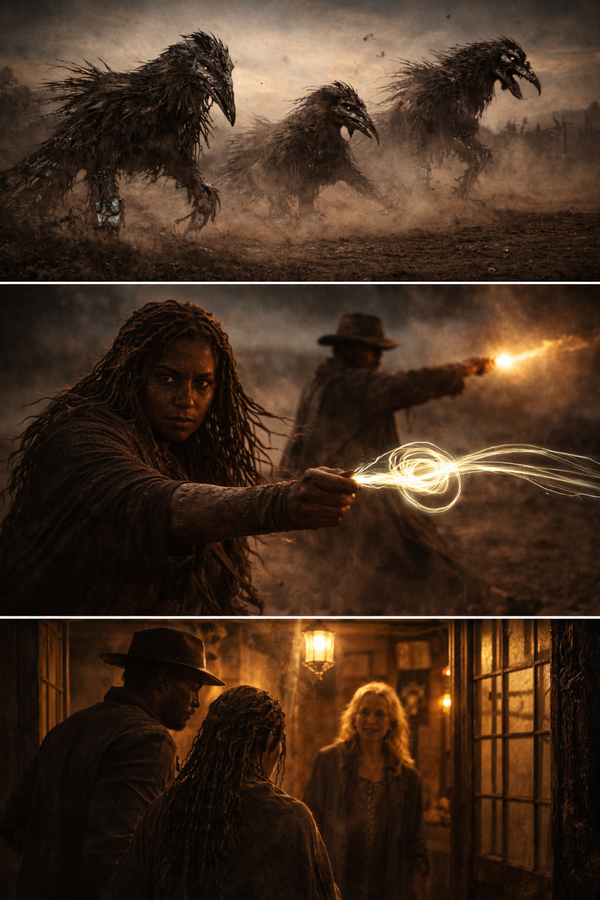
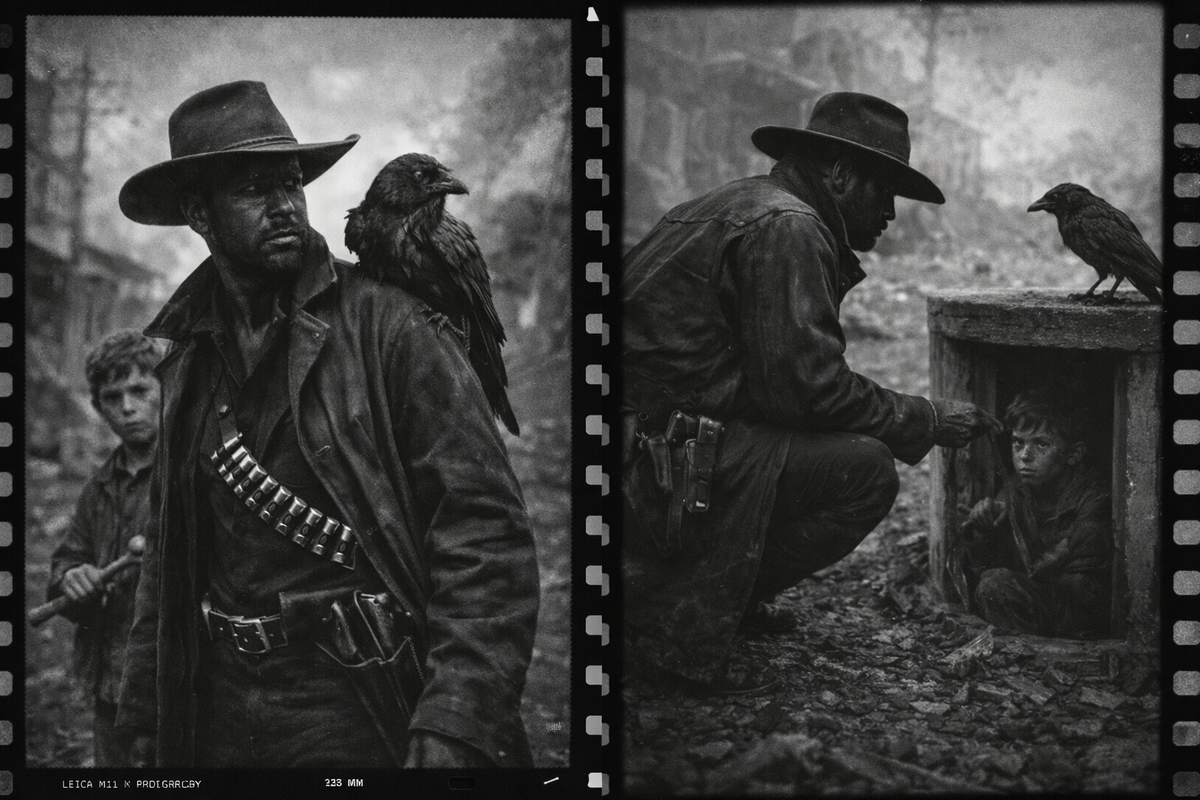
It hit the light like a thrown hat, bounced once off a stovepipe, and landed on the rail of what used to be a store with windows and now was a warning. The bird’s feathers were wrong at the edges, curled like paper that had tried to keep a secret in a fire. One eye filmed, the other steady. It pecked the rail twice, hard, then cocked its head as if to say you’ll do.
“Easy,” I said, and offered two fingers.
It hopped to them the way a soldier takes a hand he didn’t ask for. There was a strip of raw skin along the neck. A bit of cord tied to one leg. The cord was notched with someone’s habit—counting, maybe. Duty.
“You’re Kettle,” I said, because sometimes a name is just sitting there waiting for you to pick it up.
The bird blinked slow, a yes that didn’t want to be sentimental, and stabbed my glove twice, urgent. Then it left the hand and scissored low across the street, over glass that had been sugar in a jar last night and had turned itself to knives by morning.
“Fine,” I said. “Lead.”
It brought me to a door that was trying to be a door. The lintel had cracked and remembered tree; the knob had puddled into a lesson. There was a cellar behind it because parents who wear stars make strong cellars for children. I called first, with the kind of voice a boy can choose to trust if he’s run out of other choices.
“Sheriff’s boy,” I said. “I’m here to carry you somewhere the air isn’t mean.”
No answer. Kettle rapped the wood like a debtor. The hum in the nails made my molars itch. I put a shoulder to the jamb and told the hinge it was time to be helpful. Hinges like to be told the truth with a little weight behind it. It let go. Heat breathed out. The cellar smelled like apples that wanted to keep living.
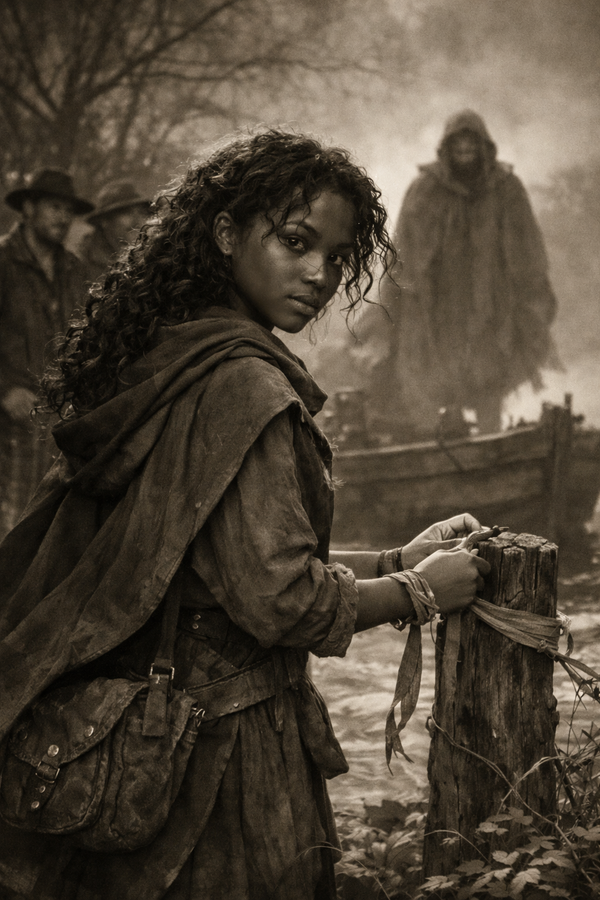
He was under the stairs, with a dish and a canteen and a rope he’d tied to the latch so he could pull it closed without showing himself. Smart. The rope had burned along the top without breaking; that’s how you win small on a night like this. He watched me with his father’s eyes and a fist locked around a slingshot that wouldn’t stop anything bigger than a story.
“I’m not him,” I said. “I’m the kind you call when him won’t do.”
“The dragon,” he said, and the word came out like a cough that had learned grammar. His throat was smoke-burned raw. He didn’t cry. Children don’t in the hour that has too many facts in it.
“Right,” I said. “We go now.”
He looked at Kettle. The bird hopped to his knee like it had a chair there. It pecked the boy’s knuckles once, a precise inspection, as if to count that they were still his.
I carried him up because stairs aren’t work for boys who did everything else right. Outside, the world was ugly and true. He squinted into it like it had to be tamed again and that was his job. I put him in the shade of a wall that remembered being a wall and made him drink slow.
“Your name,” I said.
He said it. It was the kind of name that can hammer into a bell without the bell complaining. I told him mine. Names are a trade you do without receipts.
He looked at my belt next. Not the gun. The bright rounds. Children know where the hope sits. He didn’t ask to touch. He didn’t ask anything. He watched my hands and waited for the part where I’d forget to lie.
“Tell me where it came from,” I said. “Tell me like a map.”
He breathed once through the hurt and nodded, the kind of nod a little man makes when he sees you’ll listen the first time and save the second for the running. “Kettle came back wrong,” he said. “Dad said ‘cellar.’ Mom… we went below. The bell hit once. It should have—” He swallowed. “Once. Then it walked between the buildings so the porches would have to move. It looked at the door. Dad stood where the door is. He told it ‘fine.’ He was good with necks.”
He stopped. You don’t make a child say the part that stole the house out of the word home. I let the quiet be more useful than speech and waited. He wiped his nose with two knuckles and kept going because that’s the job we give to children and then say out loud we didn’t.
“It breathed. The copper sang. The badge got hot on Dad and then it went black. Kettle went for the eye. Kettle fell. The dragon laughed without—” He lifted a hand and opened it. The gesture meant afterwards, the kind the Demon bills.
“You saw anything tied to it?” I asked. “String. Ring. Anything that didn’t look like it grew there.”
He frowned, good. He was doing the kind of thinking that makes a life out of ash. “Ribbon,” he said. “On the ankle. Bright. Shiny like… like a mirror that forgot to make you pretty. And… nails in the tracks, like the ground spit them up, and the dirt made a glass of itself where it stepped. The stepping was… slow. It wasn’t running. It had us.”
“Direction?”
He pointed without looking at his hand. West by south. Toward broken chaparral and a section of telegraph line that was still humming route even though it had nothing left to say.
“It goes where copper puts its nets,” I said. “It rides wire and taste. It likes a pump, a bell, a chain, a hinge.”
“Dad said that,” he answered. “About hinges.”
“He taught you right,” I said.
He looked at me then like a plate trusts a table. “Is he—”
“Yes,” I said, and the word didn’t spill. “He stood where the door is. It kept. That’s the math we keep.”
He nodded. Some children age clean from a single sentence. He was one. He put a hand on Kettle and didn’t ask the bird if it was hurt. The bird didn’t ask either.
“Shelter first,” I said. “Then dragon.”
“There’s a cistern halfway to the ridge,” he said. “Stone. The door sticks. The inside is cool and the inside has a bucket and a nail that squeaks. We used to hide there when we played dead-man’s-cliff.”
“Good,” I said. “You’re going to hide there now and do it better.”
We made for it down the back of the street where the wind had been lazy. I put him in the shadow when the world remembered it had a sun. Kettle flew low like a sentence underlined. Twice we stepped on nails the fire had convinced to come back naked. Twice I carried him. He did not complain, which is a skill.
The cistern door did stick. Doors that save lives often do. I put my shoulder to it and the hinge decided to be helpful. Cool came like someone had told the room a joke and it took the right amount of time to laugh. I sat him and let him drink until the cup stopped shaking in his hands. I tore a strip off my shirt and made a bandage that would fail later, but worked good enough.
“You’ll stay,” I said. “You’ll keep that bucket full and this door unlatched. If you hear the bell once, you wait. If you hear it twice, you wait again because I don’t trust bells much anymore. If Kettle pecks your ear three times, you don’t argue. You run to a place called Wire Avenue and you find a bar with a towel hanging in the window. The man with the towel will make a table out of any mess you bring him.”
He nodded. “What about you?”
“I’m the kind you call when him won’t do,” I said again. “I’m going to find where it stepped wrong and give it a reason to count today as a problem.”
Kettle left the bucket handle and hopped to my shoulder. The eye that still worked was mean in a helpful way. It pecked my hat brim once, a correction to the map only birds know, then took the air and made an arrow of itself.
I stepped back out into the heat that used to be houses and put my boot in the first footprint that had glass at the bottom of it. You can learn a gait by standing where it stood. Weight forward. Not a runner. Certain of the hour. It liked the line where the telegraph posts went because copper sings the same song everywhere and monsters like a chorus.
The boy’s voice followed me once, small but plain. “The ribbon,” he said. “If you find it. Don’t touch the shiny. Dad said not to touch shiny things that want you.”
“I’ll have the good manners to ignore it,” I said.
The tracks took me past the pump, past the church whose bell had struck once and swallowed its echo, past a field of glass that used to be bottles in a backroom, and down into a wash that would become a throat if a man refused to stop walking. Kettle circled high where the heat couldn’t lay him out; he dropped when the trail fuzzed and hovered when it was clear, the way a scout and a friend negotiates a job.
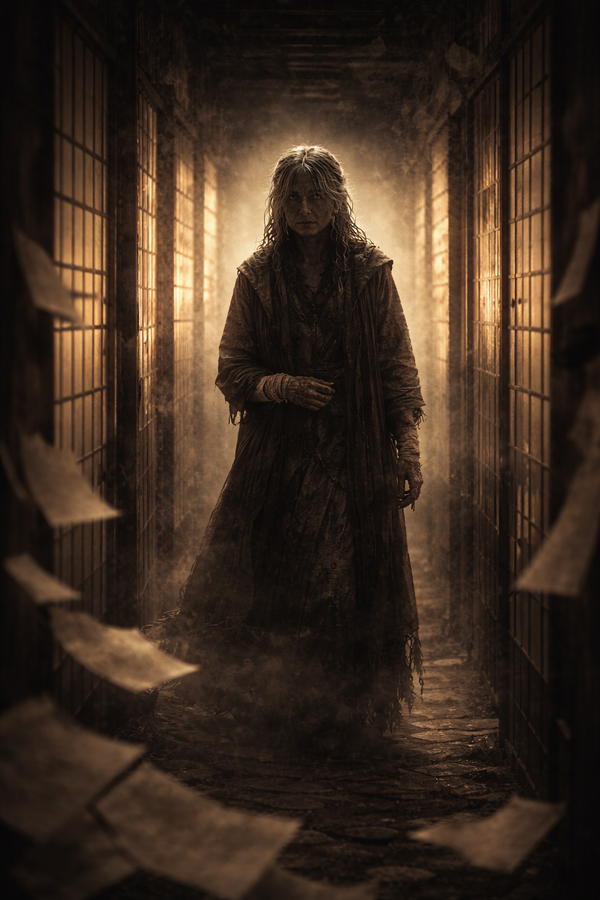
Half a mile out I found what the boy had seen. A ribbon, blackened at the edges where fire had had its say, and a mirror tile sewn crooked with wire. It was humming, the little bastard—listening, naming, trying to bill me for seeing myself. I gave it a shadow with my hat and it quieted enough to let me look without having an opinion. There was a smear of something on the wire. Not blood. Not grease. Taste of battery. A handle.
“Wrong lever,” I told it, and put it in my pocket with the care you give a snake in a sack.
When you’re lucky, a hunt is just walking until the world admits it left tracks. When you’re honest, it’s the same. I walked. The wash narrowed. The hum grew sure of itself. The prints turned from glass back to dirt because the ground had run out of patience to show off. Ahead, rock lifted close and dark and I could hear a breath a house would fear. The kind of breath that wants to know how big you feel inside your own name.
I stopped where a man stops if he wants to choose the hour and not have it chosen for him. I turned once, so the boy would see from the cistern mouth which way I’d gone. He was a dark coin in the doorway, not moving, which is how you keep doors open. Kettle hung over the wash like a thought that wasn’t ready to land.
“All right,” I said to the rocks and the copper and the memory of the sheriff standing where a door had been. “Let’s write this part neat.”
I thumbed a bright round where it could feel my heat and think with me. Hawk-cry for the hinge. Meteor for the pact. I breathed in the penny wind until it quit pretending to be weather and showed me the throat. Then I went toward the place where a wolf wants to be a dragon and a dragon wants to be a law, walking like a gunslinger who intends to get his second bell.