Chapter V: How to build a gunslinger
He was seventeen when the wind changed taste.
It happened the week the heat came early and stayed, the week his mother kept a basin by the door because people walked in dizzy, asking for water and a place to sit while their hearts remembered how. The air turned sharp, salt-iron with a penny-copper afterbite, and the dogs along the fence line laid their jaws on their paws and would not be called. He learned that taste before he learned its name. He learned it meant something was coming that didn’t belong to the town and didn’t owe it respect.
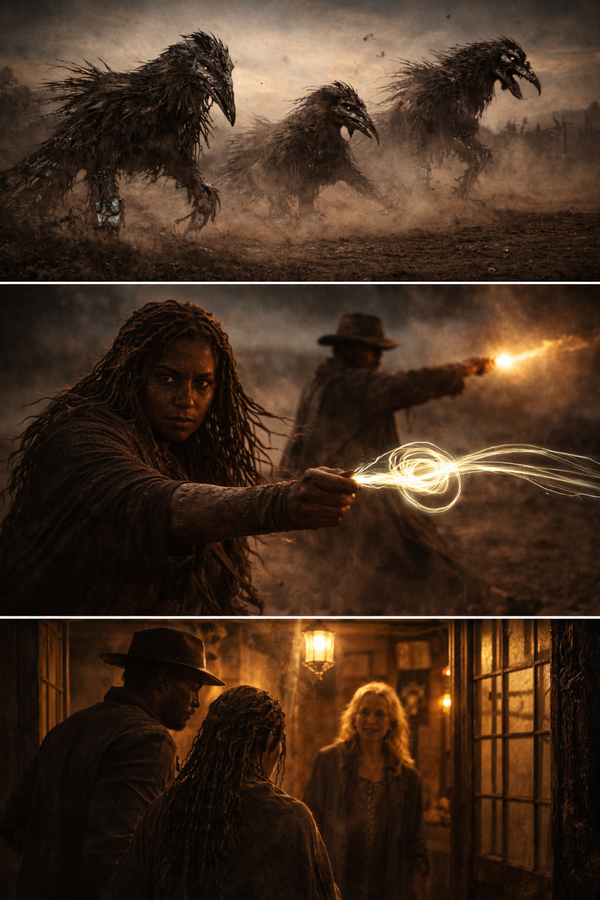
The dragon arrived at dusk, heavy as a verdict.
It came out of the old slag pit beyond the tannery, a long shadow braided from heat and smoke, too big to fly and flying anyway. It said a word with no vowels and the bell in the church—poor thing, hung slightly wrong since they’d raised it—answered only once and then choked, even when you could swear you heard the air count up to twelve. That was the first time the gunslinger understood bells could lie.
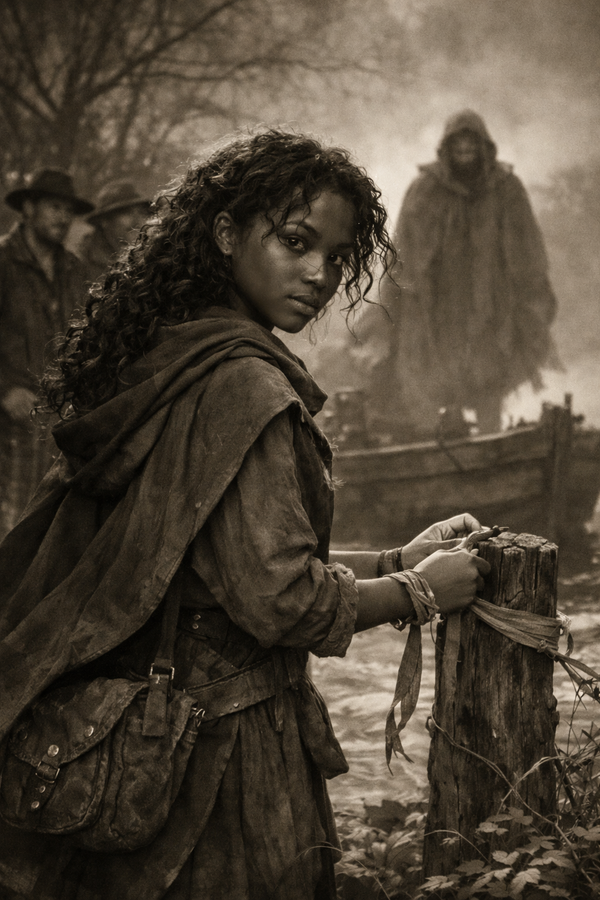
He ran toward the fire because home was toward the fire. By the time he reached Main, the east side was already a line of lanterns falling into themselves. He saw his father on the roof with a wet blanket, saw his mother at the pump, saw the dragon draw a breath that would eat them. He didn’t have much then: a pistol his uncle had said was lucky because it was heavy enough to remember your hand, and the habit of doing what was needed without waiting for your fear to take a seat—despite his father’s promise that they were finished with shooting.
He didn’t kill the dragon that night. He made it turn its head. He climbed the pump house ladder and put a shot through the pulley that held the river gate, and the river came angry enough to make steam cry. He hit the clapper chain on the first try and made the bell give them one honest note—just one, but it tore a slice in the roar. He shot the tar barrel instead of the man under it, and flame bent away long enough for his mother to pull his father down and run.
The dragon didn’t forget them. When it finally went down—boiler house collapsed, steam turned against heat, iron giving up its hoarded pain—it was still big enough to roll and crush. He was knocked off the roof and didn’t see the moment the house went. The sound came through him like a decision. After, the town stood in a ring around what used to be his street. People said words like “sorry” and meant them and also meant: you will not be the same as us anymore. He wasn’t.
They buried in the morning and he went out at noon, because there was nothing left for him to do that would be welcome. Past the rail yard, at the edge of the slag pit, heat made a mirage of the air, and there, like someone waiting for a late train, stood a man in a black suit that would not take ash. The wind had the taste again. The bell, still wounded, tried to ring and could not find a second note. The man smiled the way fathers smile when they want you to try harder.
“Welcome,” the man said. “You’ll want answers. You’ll want someone you can shoot.”
“What are you?” he asked, because he could ask or he could shoot, and he wanted to hear what a thing like this called itself.
“Depends who’s asking,” the man said. He opened his hands. The heat did not touch him. “Sometimes I’m a hunger. Sometimes a debt collector. Sometimes I’m that familiar face you can’t quite name. Today I am what sent the dragon.”
The boy did not talk about his father or mother; he had not learned yet that grief is a story some people shop as currency, or others ask you to retell to make sense of their own. He lifted the pistol and aimed at the place where the suit’s buttons met the mirage. The man did not move.
“You want to see my main face,” the man prompted. “It won’t help. I have so many faces because I am a thing people make when they need an excuse for the harm they ordered. I wear whatever makes them feel clean.”
“Take this one off,” the boy said.
He shot him cleanly. The bullet went in like a word going home. The suited man smiled a child’s surprised smile and came unwound into smoke.
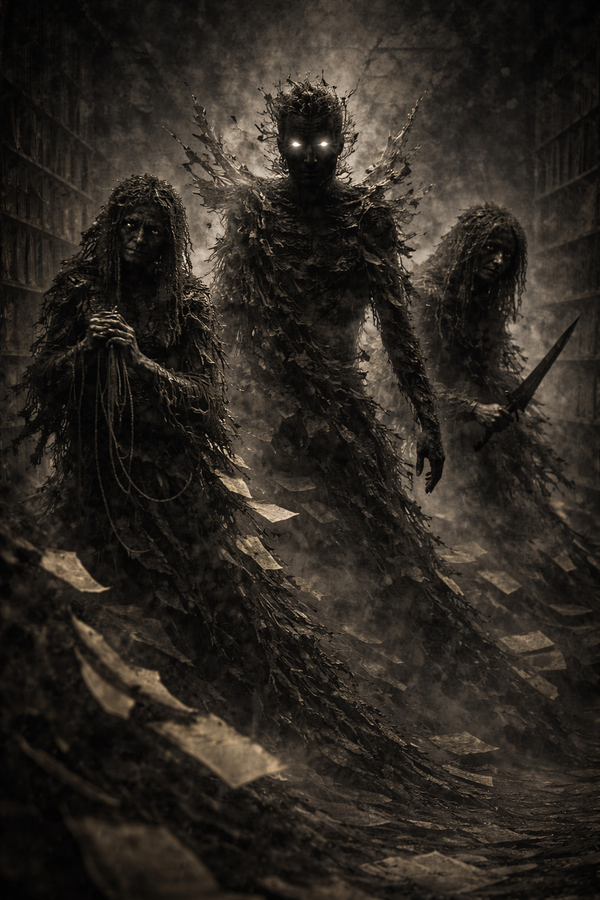
Which should have helped. It didn’t. The smoke gathered again a dozen paces away and someone else stood there: the preacher from Pine Candle, collar askew; then the railroad clerk from Rook Station, visor green and eyes patient; then a woman with mother’s hands shaking; then a boy whose mouth slacked wrong. The faces flickered like a deck of cards thumbed fast for a trick.
“I’m all of them,” the demon said, all the mouths speaking the same warm voice. “When one breaks, I carry on as the next. When you hurt me, I am someone else you will have to hurt later. When you try to name me, I put on another name that will fit inside your teeth.”
The boy fired again because boys do that, because men do that. He hit what stood in front of him and it went down and became smoke that went away and didn’t quite go. When the air settled, the slag pit was just a pit and he was alone with his breath and his pistol and a bell that could not ring properly to save its life.
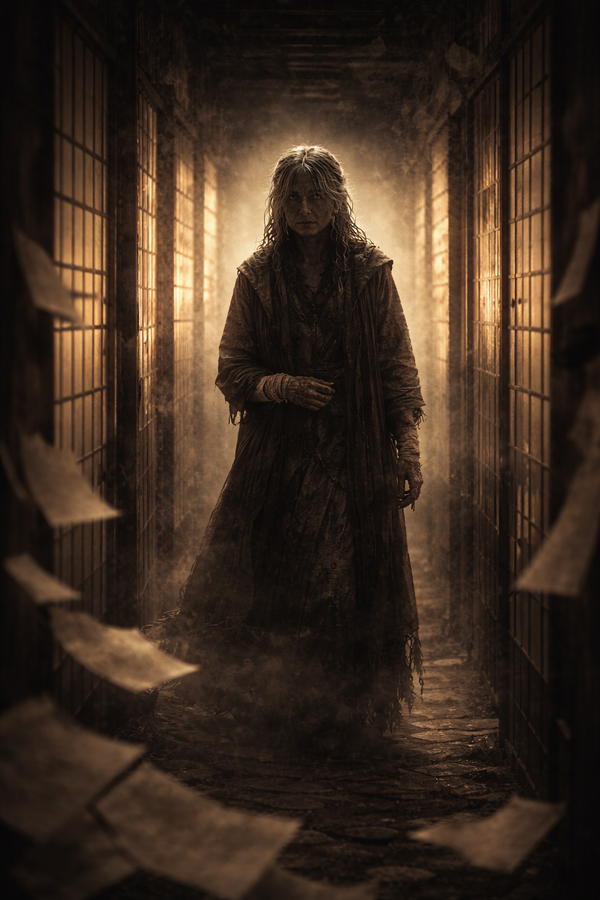
He should have been free to mourn. He was not. That night, he dreamed a face that was also a courtroom, and in the morning he woke with a mouth full of iron and words he hadn’t meant to say: When you wake, go east. He didn’t know where it came from until a week later, when an old woman with hands like paper paid for his coffee and told him that wherever the bell only chimes once when it should chime twice, a sorcerer has laid a hand on the town’s neck. “Follow the wrong note,” she said. “It will take you to the right street.”
He kept her advice in a place where forgetting could not bite it. He unclipped the base plate of his pistol and scratched the words with a file he borrowed and never returned: WHEN YOU WAKE, GO EAST. He began to leave himself messages like that. He had learned that grief could turn to fog; he was learning it might be given a path.
The thing that called itself all demons did not let him go, not really. It jumped faces. In Pine Candle, it wore the preacher’s collar and a fatherly smile and told the town that what they’d lost was a lesson about purity; then it accepted a box of coins to pray at the edge of the fields and called the storm on schedule. The boy shot him behind the vestry, and the organ played the wrong hymn the next Sunday because the woman who pumped the bellows swore she saw an angel and couldn’t get her hands to do what she was told.
At Rook Station, a clerk in a green visor smiled too patiently and counted out exact change with a little flourish at the end. The boy felt the iron taste and the world’s tongue nicking itself. He wore a jacket with his maps inked on the lining—towns and roads and the particular kind of wrong you could hear in their bells. He knew he would need it. He felt a hand brush his elbow and heard, in a voice like warm milk, “Sir, your ticket,” and when he looked up, the visor’s eyes were empty as a ledger that had never had to be honest. The mouth smiled. He put a bullet through the visor and the body fell neatly backward. Someone screamed. Someone else laughed. By the time he fought his way to the back office, the burning had already started. The map—his map—went up with the receipts. He watched his own ink turn into smoke and felt the first true despair of a man trying to outrun what learns his habits faster than he can.
At Ellender’s Ford, the demon wore a boy’s slack grin in a fever tent, and that was the worst of it because the boy looked like his own brother would have if he’d had the chance to get sick instead of burned. The whole tent stank of penny-copper and fear. The preacher—the same one from Pine Candle, or a cousin made by the same hunger—held the boy’s hand and told the town it was God’s work to watch him die. The gunslinger put a round where it needed to go, and the tent came apart like ashamed laundry. The mothers there forgave him and didn’t forgive themselves. He understood why the demon liked to wear that face: it made every person in the room complicit for a minute.
At Harrow Bend, it shook with a mother’s trembling hands, so close he could have touched its wrist, and asked him, very softly, if he would carry a basket across the road because her legs had gotten stubborn. He smelled the iron and the copper and the sweet rot under it and knew. He did carry the basket. He set it down on the far side and watched the mother’s face relax and something behind it open its mouth to bite. He shot it through the smile. It died like smoke does, without the courtesy of a thud.
After each killing, he learned the same lesson again: the body on the ground was not the account in the ledger. The debt collected itself elsewhere. He hadn’t owed anything except the truth that he wanted the killing to matter, and the demon took that anyway and wrote his name under “Due.”
He finally saw the main face again in the culvert behind a freight yard, the night before he turned eighteen. The wind shifted to that old taste and the bell in the freight office chimed once of its own accord and then refused to announce any other hours. The suited man stood without dust on him, same as the first day by the slag pit. He looked proud.
“You’ve been keeping me busy,” he said, like a tutor praising a student who had finally done his homework with his own pen. “You’ve been learning where to aim.”
“I want you,” the gunslinger said, and the words felt like pulling a blade up to his own throat, not to cut but to test the edge.
“You have me,” the demon said. “And I have you.”
They drew in the dark with the smell of creosote and hot iron in the air. The bullet took the suited man as it had before. He folded with the surprised child’s smile. The smoke did not gather the way smoke should; it pulled tight around him instead and the night itself leaned in. The demon spoke from inside the folding. “A tax,” it said, kindly. “Not a debt you owe. A debt I take.”
“What?” the boy asked, because he had not yet learned that when a monster tells you the price, it’s already counting.
“Faces,” the demon said. “You keep the maps, boy. You keep the tricks with bells and gates and chains and pressure, because those are the tools you use to hurt me and I want you to have them. But faces? Names? How your mother said your name when you came in late? How your father laughed when he lied about his fishing? The way a woman with paper in her voice will look at you and show you the street that’s wrong? Those I will collect. Not because you owe me. Because I can.”
He felt something pull loose from behind his eyes. It wasn’t a forgetting like sleep. It was like someone had taken all the names he had taped to the inside of his head, peeled them up, and kept the tack for later. He could see his mother’s hands and not attach them to his name. He could draw a map of the town in the dirt with a stick and not find the door he’d been born through. He could stand under a bell and count to twelve with his mouth and hear only one note fall.
He didn’t whimper. He learned then that he had that kind of pride, for good or for ill. He shot the smoke again because that is what he knew, and the smoke did what smoke does. He stood in the culvert and waited for his breath to make it back to him.
After that, he became the boy who wrote to himself. He carved WHEN YOU WAKE, GO EAST into the base plate because he would need to be told and who else would tell him in a voice he trusted. He started drawing maps on the inside of his jacket because paper gets lost and leather takes ink like a promise. He learned the tell of the bell that chimed once when it should chime twice and he followed that wrong note, because somewhere far off there was a street where the bell would refuse him in exactly the right way.
He carried the iron taste like a weather forecast. He learned that sometimes a preacher’s collar is a mask, sometimes a clerk’s visor, sometimes a sick boy’s mouth, sometimes a mother’s shaking hands. He learned that demons are an idea people hire to do the work no one wants to admit ordering. He learned he could hurt the idea only by hurting the body it borrowed, which is the same as saying he could never win clean.
He left at dawn on the day he turned eighteen. He didn’t say goodbye to anyone because he didn’t remember who to find to say it to. At the edge of town, a woman with thin hands he would later think of as paper told him the thing about bells, and he scratched her advice into his gun before the fog could make a meal of it. He walked toward the wrong chimes.
Before he ever found Wire Ave, he hunted the demon across towns that kept their hours and towns that had forgotten them. He was already a gunslinger then: what else do you call a boy who has lost his house to a dragon sent by a face that cannot keep still, who fights the main form and loses his faces and keeps walking anyway?
By the time Hope found him years later in a town called Fiddler’s Cut, he had a leather dust jacket lined in ink because of Rook Station and a base plate scratched with east because of a woman he couldn’t name and a nose that could taste a devil gathering before anyone else could see the shadow.
He had the habit of looking up after he killed something, because sometimes the sky is the only face you can keep.