Feathers for the Forge
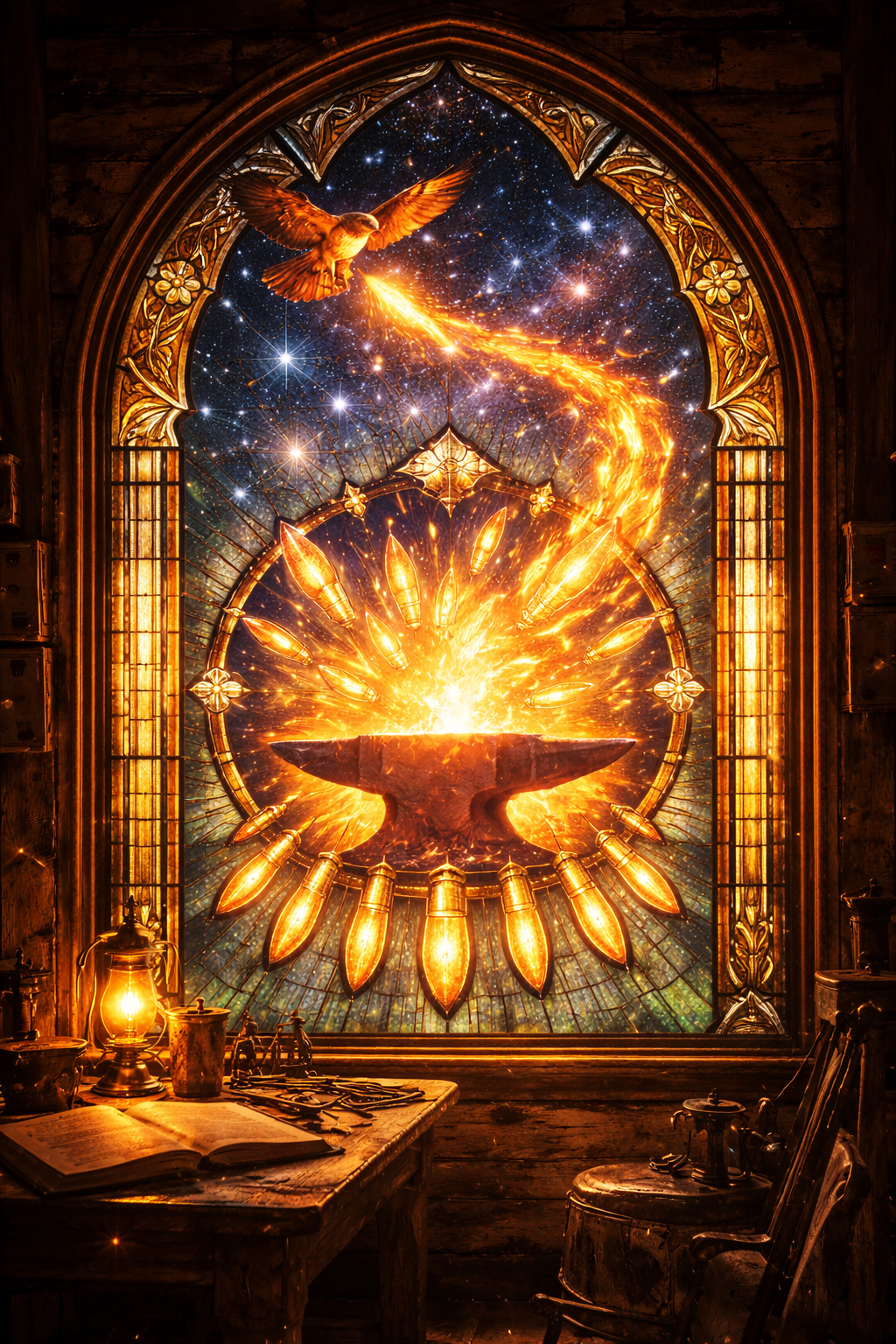
Hope laid the three red tail feathers on the basalt bench as if setting down tools that were also names. The gunslinger unrolled his traveling kit—press, molds, white-brass jackets, rain-glass tears, primed cases, a thumb of lead—and then paused. They both looked to the House.
The Adinkra answered without words. Sankofa brightened on the frieze—fetch what you must from the past to live the present rightly. Gye Nyame spun slow in the center stone—except for God. The meteor’s note rose a degree, not in protest but permission. They were allowed to finish what others had begun.
He went to work and she made it possible.
Hope cupped her hands beneath the lattice windows and gathered light into her palms the way a healer gathers fever—drawing, reversing, persuading. She breathed into the beam until it warmed and held. When she exhaled, the moonlight thickened to a steady radiance you could temper steel in. Her left hand spoke tiny, practical stitches—bind, blend, remember—and the light learned them without fuss.
The gunslinger set the first spoon to the meteor. This time there was no restraint. Star-iron softened under House-light rather than fire, the surface going from stone to bread without smoke. He fed a curl of lead through that shine and poured cores—small suns settling into shape—then folded the last shavings of meteor into the batch until nothing of it remained but purpose.
The recipe changed because the road had changed. In the capillaries he cut into each ogive, he pressed a new paste Hope mixed by vigil: lamp oil from a name-room lamp, river salt from the drought year, verdigris reversed with a breath of two-bell water—and, ground finer than flour, a whisper of quill-shaft from the hawk’s rachis. Feather turned to dust carried not flight but instruction: the habit of up. Into the hollow under each nose he set a rain-glass tear filled with separation—clear, patient—and over the mouth of that vial he laid a single vanishing filament teased from the feather vane, a wick for the light of the laugh.
They jacketed the cores in white brass—never copper against copper—then cut twin spirals down each nose to match the barrel’s pitch. Where the spirals crossed the feather-dust paste, the channels picked up a faint red-gold sheen. Each round took quench not in water, not in oil, but by being lifted slow through a crossing of the lattice beams—a Mpatapo bar and an Epa bar—counting two honest heartbeats, like two honest bells.
He seated primers while she whispered sound into metal. Not words—sound. The remembered cry of the red-tailed hawk passed from her throat into her wrists and down through her fingers into each cartridge until, when he held one to his ear, he thought he could hear a high thread of agreement hiding in the brass.
Time unhooked its usual habits. They worked as if inside a clause the world would not diagram. When they stopped, the bench carried the weight of more than a hundred bright decisions. He counted belts, then rows; she counted breaths. In the end they admitted a number only because containers require it.
“A gross and a dozen,” he said—one hundred and fifty-six—twelve belts of twelve and a spare row that made the lattice smile.
She smiled back, but her eyes were wet. “Enough to write on the dark.”
They tested without spending. He loaded six and cocked the hammer to feel the cylinder’s truth. The rounds did not weigh more, yet the frame remembered them. The barrel seemed to sigh through the rifling. When he eased the hammer down, the gun kept a small, new note—like a bird breathing on metal.
“These are not only for copper,” he said.
“No,” Hope said. “For gravity that forgets to share. For mouths that mistake light for food. For doors that need a pattern to stay doors.”
They packed the belts where fingers would find them without thought. They left no star-iron in the House. The meteor hung lighter, transformed entirely into grammar for the work ahead. Even so, the hum in the room did not empty; it moved—into belts and bandoliers, into the seam where the silver line in the floor met the threshold, into the Adinkra cut through stone. The House did not resent being less; it approved of being finished.
Only then did they look out.
Beyond the lattice windows, the mountains held still. No peak reconsidered its address. No ridge took a step. The thin place stayed thin, but the stitches held—Mpatapo and Epa shining steady, Fawohodie a crown, Sankofa at the roof, Gye Nyame in the middle like a truth you don’t waste.
“Rest,” the House seemed to say, which is rare for houses.
They made beds on the warm stone near the silver line. The belts lay coiled like tame serpents at his side; the book-less sling lay at hers, empty but not hopeless. He set the pistol on his chest and let its small new note be a lullaby he’d never admit to needing. She lay beneath the door’s freedom mark and watched the lattice throw rectangles of light on the ceiling until her breath matched the House’s hum.
Somewhere far off—perhaps WIRE Avenue where Mercy still called home, Hope thought—a bell still rang twice. Outside, the mountains kept their manners. Inside, sleep came decently, like a friend who knocks.
They would wake to the work—the demon’s room where light is taught to fail, the chief with a ledger in its ribs, the black mouth widening with every wrong word. For now, there were rounds made of starlight and feather, a House that held, and a night that agreed to be only night.