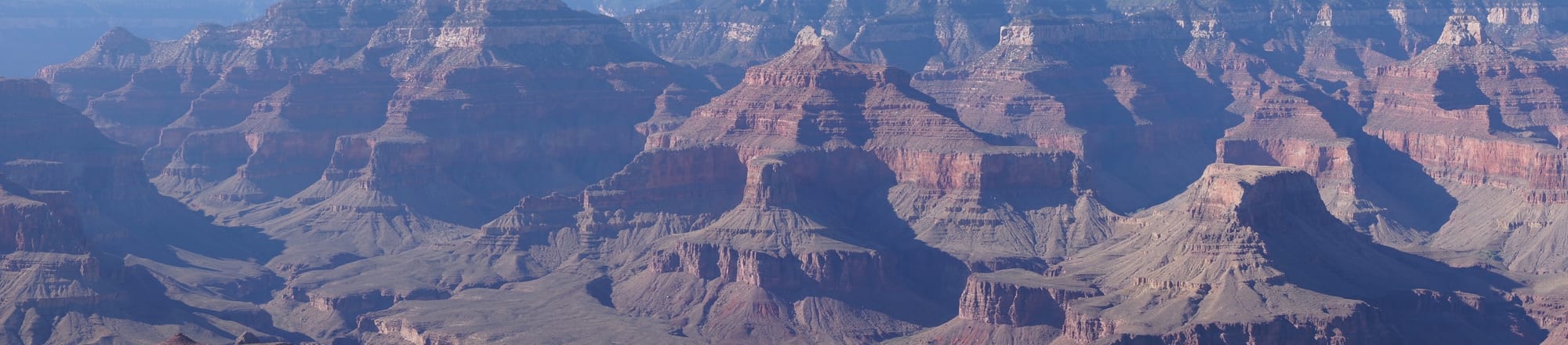
Before the Wolf
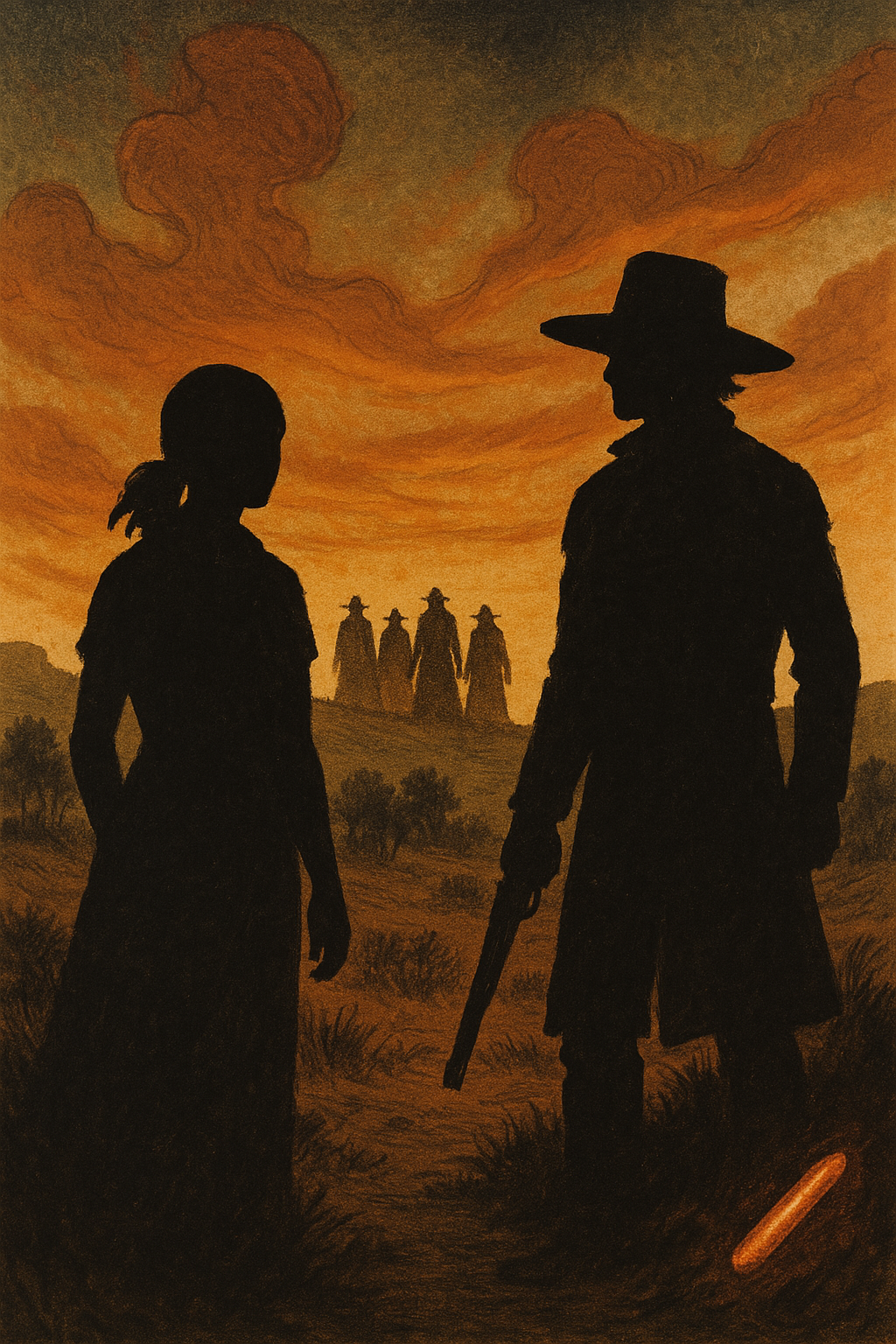
By the time the constellations learned their new routes again, a year had gone strange and thin. Word carried farther than hooves, and everywhere their names arrived first—Hope and the gunslinger—and everywhere the news ran ahead of them in two directions at once: They saved a city from a void that learned to breathe and the demon slipped the noose and is learning to sing in darker keys.
They rode through places that had relearned how to be places. In some towns the bells had finally taught themselves to ring twice without supervision. In others, copper still hummed at night like a pane that wants to be a door. Jars were rarer on the back bars, and when foam gathered, a shy hand salted it by habit and couldn’t say why. Where the ground had remembered lava and then chosen earth, green pushed up without apology. Where the demon had passed, wolves cried in voices too large for wolves, and the wind came back tasting like old batteries.
The phoenix flew with them as an ember the color of decisions, resting above Hope’s shoulder when the air turned cruel, tucking itself into the book when the world needed them small. The hawk was gone, feathers long since melted into star-metal rounds and song, but on cold evenings a thread of sound ran high in the dark, like the memory of a scream you survived.
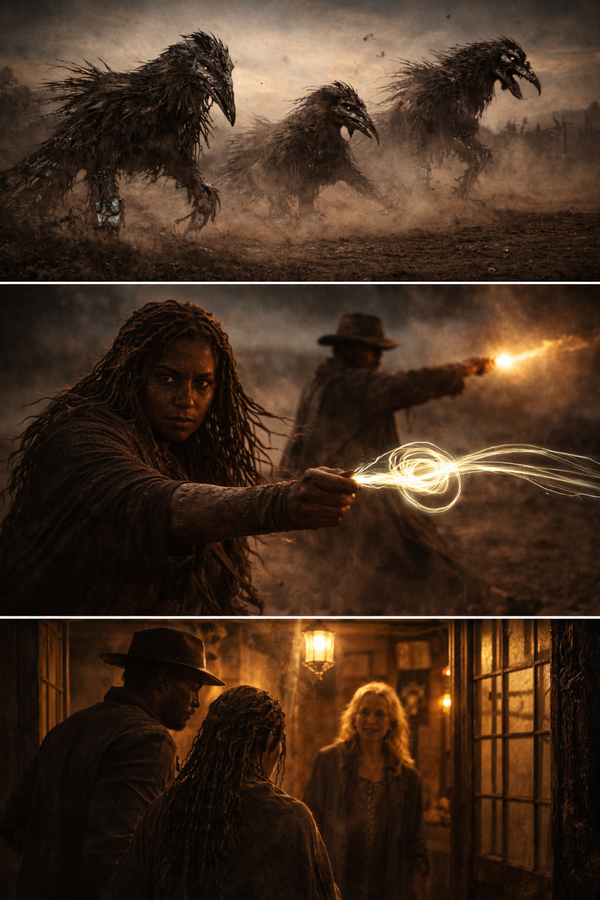
They were hunting. Not a mark on a poster, not a bounty in coin; hunting the vacancy a peace leaves when it doesn’t stay. The demon had learned the landscapes of afterwards in other books and hired new bodies to speak his appetite: serpent-dragons in red salt gulches, a mantled thing that walked tide-lines and made fishermen forget their own names, and in the north—a shadow that ran on four and then six and then four again, eyes like coals in a mouth that lied about how many teeth it had. The wolf-dragon learned to wait in ravines the world had given up on.
They never found the demon.
They found where he had been—the copper kiss on a doorknob, the wrong note in a coach bell, the little island of dust that refused to sit on a pair of shoes. They found markets for sorrow whose prices had stopped climbing. They found rooms without metal where laughter had left its thumbprint in the plaster like a maker’s mark. They found a professor in a glass tower who swore the winds have seven names and can only be translated into stories. They found a librarian in a rice terrace city who recognized the phoenix by the way the air behaved and showed them a shelf labeled Doors That Think They Are Walls. They met witches who did not mind being called that because their work was to make people harder to price.
And they met a shopkeeper in a lattice shop.
——————————
The Lattice Shop
The bell over the door rang once and then thought better of ringing again. The shop smelled of camphor and beeswax and old paper. A fan turned slow. It clicked at the same spot each time. The room was long and narrow. Squares of linen hung on pegs—dark thread crossing white, blue ribbon knotted at the corners. The tags were written in pencil. HEALING LATTICE. Each price written twice, as if the first might lie.
Hope set her palm on the book at her hip and stepped in. The gunslinger came after. Dust on his boots. Hat low. He looked at the hinges and the bell rope and the wire that ran along the joists. He had the look of a man listening to things that were not supposed to talk.
“Afternoon,” the shopkeeper said. He was long in the arms, narrow in the face. A white whisker had lived through three shaves. His green apron had a clean chest and a gray hem. Chalk dust on the cuffs. “Door sticks,” he said. “I scrubbed the rope. Twice.”
Hope smiled a little. The room warmed a notch. The bell gave a second sound, soft, like a throat clearing. The shopkeeper let out breath.
“You sell those?” the gunslinger asked, nodding at the squares.
“I do,” the man said. He touched one. “Linen soaked in salt water from the west marsh. Horsehair inside for backbone. Flax thread, crossed right. Blue at the corners. Some things answer blue. Put one on a cut and skin remembers how to close. Tack one across a sill and the window remembers it lets air pass, not swallow it. On a hinge it keeps the swing honest. Not a trick. A pattern that teaches.”
Hope took a square down. It had give and it held its shape. “What’s the old name?” she said.
“Cross-and-Keep,” he said. He watched her. His eyes went north though a wall stood there. “Old folks call it the witch’s fence when they trust you. You two headed for the trees?”
“What trees?” the gunslinger said. His voice was dry.
“The three at the end of the north track,” the shopkeeper said. “Most don’t go. Dogs turn off. I’m not telling you to go.” He wiped his hands on the apron. “You look like people who don’t wait on permission. You want the rumor or the church version?”
“Both,” Hope said.
He put both hands on the counter. His knuckles were square and pale. The fan clicked. Outside, a wagon wheel hit a bad plank and thumped. The room waited.
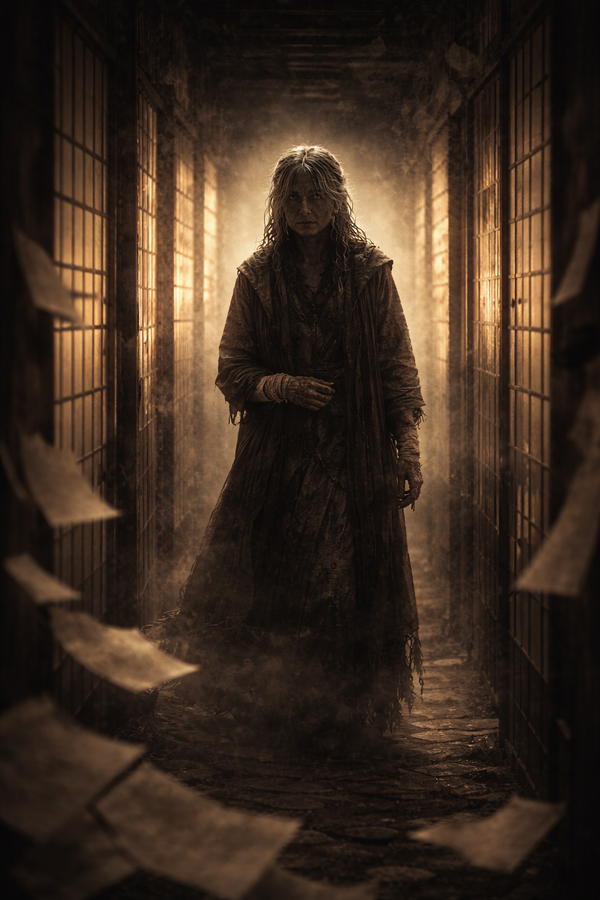
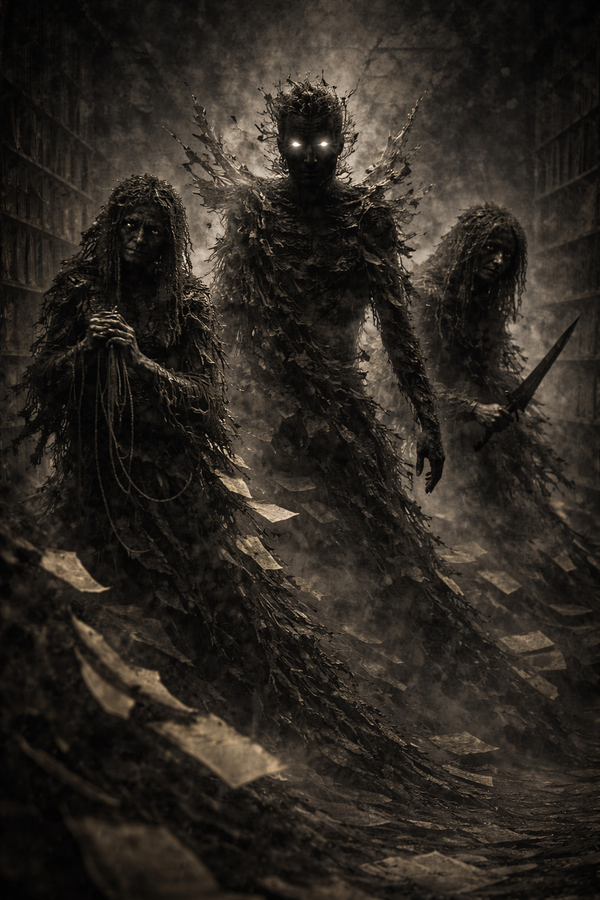
“Long time back,” he said, “when this was a ford and an oak with a bell tied to it, a witch stood in the river and faced the Triad. Not a beast. Not one thing. Three shadows in the shape of women. Thin like hunger. Faces almost there and then not. Hair like smoke that never settles. If you’ve seen the Thin Men in old stories, picture that—but clothed in night, and with voices like the kind of mothers who don’t raise their voices because they don’t have to.”
He looked past them now. The words were coming whether he wanted them to or not.
“They came out of the bend where the water goes dark,” he said. “They did not make ripples. The air got cold enough to ache in the teeth. The birds stopped. Even the flies learned manners.”
He lifted a finger. “You need to know what the town was doing first. At the mill they had the boys lined up. They chalked numbers on their sleeves and called them by number. They sold the boys’ hours before the boys worked them. They fined them for eating. For talking. For being late. They shaved a piece off each pay and called it a fee. The foreman said it was efficient. He used that word like a clean shirt.”
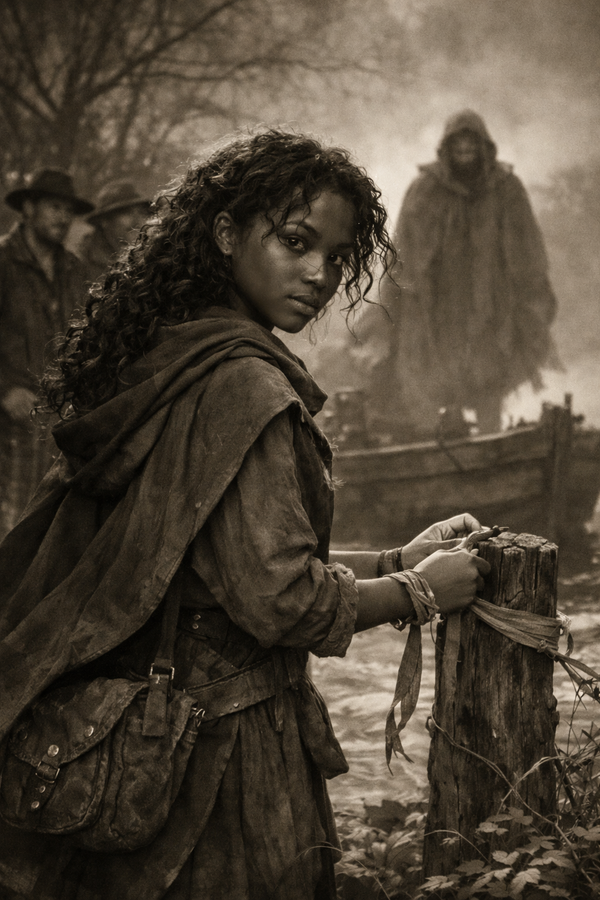
He touched the hanging lattice with two fingers. “The witch walked into the ford at dusk. She had a roll of lattice under her arm. The bell rope tied around her waist. People watched from brush—as people do for any spectacle you know you shouldn’t watch.”
He swallowed. The whisker on his jaw shined white when the light hit it.
“The first shadow stepped close,” he said. “We called her Mirror, after. She looked like the witch, and then like every woman who wanted to be seen. Her face changed to fit the need. She said: make your laugh a show. Make your grief a stage. We’ll make it big enough to see from twenty towns. All she had to do was give the laugh to Mirror, and Mirror would carry it and change it and sell it back to her.”
He shook his head. “The witch looked at the river, saw an awkward step of the beast slip off a rock like a man who trips and pretends he meant it. She laughed small and human at that. Not at anybody. Just at the clumsy place in the day. Mirror flinched. The shadow’s mouth tried to smile and could not. It can’t hold a laugh that isn’t for show. The air warmed a hair.”
He went on. “The second shadow put her hands on a book and lifted it out of the deacon’s palms without touching him. The book was blue. Pages too white. The letters moved at the edges like gnats that bite. We called her Ledger. She said: sign this. We will smooth the town. We will write rules so good you never have to say a name again. She sounded kind. She sounded tired of trouble. That is the way it gets you.”
He nodded toward the floor as if he could still see water there. “The witch dragged a table into the ford. She opened the book. She read the first line out loud—the boy’s name and the hours beside it. She said the name again, slow, like she was putting it back where it belongs. She asked the crowd: is this right? Men nodded or shook their heads. The foreman went pale. The witch crossed out the fines that weren’t earned. She wrote the true hours. She said: pay him now. The paymaster tried to turn away. She took his wrist and turned him back and made him count the coins into the boy’s palm, in the open, where water cleaned the metal. She did it again for the next line. And the next. The moving letters went still where the sun touched them. Ledger’s voice changed. It got thin and sharp. She smiled like a knife with lips.”
He rubbed his jaw and looked down at his hands. They were shaking. He set them flat so they’d stop.
“The third shadow stayed back,” he said. “Her voice came cold. We called her Knife. She said: cut what takes too long to heal. Be kind. Be quick. Make it clean and be done. She spoke through a boy she took by the wrist. His hand came up with a blade. It was fast. The witch rang the rope—short, short—before steel met bone. The boy stopped like waking from a bad dream. He cried. Knife hates crying. Knife wants a cut and silence after.”
He blew out a breath. The fan clicked. A jar on the shelf made a small sound like a mouse behind a wall. The room felt one degree colder.
“It should have ended there,” he said. “It didn’t. Mirror breathed out and the light around the witch turned false. Ledger slid a thin line under her shadow where no one could see. Knife nicked her heel so she couldn’t run. They spoke together then, and it sounded like a choir that never learned mercy.”
He said the words flat, the way a man says the thing he doesn’t want to shape with his mouth. “They said: stand in the ground that will outlast you. Be split. Be three. Speak leaf and wind and the bell forever starting now.”
He lifted his eyes to Hope’s. “She went straight down in the ford like a nail hammered true. The river frothed. When it cleared there were three saplings in the shallows—ash, thorn, oak if you ask my side of the family. Some say yew, ash, oak. Old men will fight you about that part in winter. People tied blue ribbon on the branches. They said their names under the leaves. Sometimes the leaves answered. Mostly the leaves answered when the town bell rang twice without shame.”
Hope’s fingers tightened on the lattice square. “And those shadows?” she said.
“They took their time,” he said. “They learned patience. They stepped thinner. They put a little of Mirror into bar glass and spectacles. They put a little of Ledger into the back room where men write numbers that don’t see daylight. They put a sliver of Knife into the way a person tells himself he is being kind when he is only being fast. Most nights you won’t see them. You’ll just feel a room get cold and quiet in the wrong way. But when folks stop saying names in the square, when the bell forgets the second note, when boys get called by numbers at work again, you see the shadows gather at the edge of your eye. If you turn your head they’re gone. If you keep working in the open, they starve.”
He wrapped two lattices in brown paper. He tied them with string that had a little grit in it. He set down a tin of salt and a short length of blue ribbon. His hands had steadied.
“If you go—and I’m not sending you—take two,” he said. “One for where you stand. One for where you plan to come back. Bring water. Ring twice. Say your names plain, like a bird would understand. Don’t lay copper on them. Copper listens. It will try to make the lattice into more than it should be. That turns a fence into a snare.”
“How do we know which tree to ask?” the gunslinger said.
“You don’t,” he said. “They’re three and one. If you’re meant to hear, you will. If not, the wind will be wind and you can try again when pride isn’t driving.”
Silence held. The fan clicked. The bell over the door found its second ring without help, quiet and firm. A shadow passed across the window though no one walked by. Hope felt the hair lift on her arms. The telegraph wire outside hummed once in a wind that wasn’t there.
“What happened to her after?” Hope asked. Her voice had gone small.
“Ten answers and none you can prove,” he said. “I like the one where she keeps watch and dreams the town true, one leaf at a time. Some say the shadows come to bargain every so often and leave angry. Some say she’ll be a woman again when we don’t have to teach the bell the second note because the first one calls its own answer. I’d like to see that day.”
Hope paid. Palm to palm. No jar. No tab. The gunslinger paid for salt and ribbon and didn’t take his change until the man counted the coins where all three could see. The shopkeeper looked less tired around the eyes.
At the door the gunslinger put his hand on the frame and said, “Door.” It was plain talk, but the wood seemed to ease. “If anyone asks where we heard this?”
“Tell them a man who sells fences you can fold told you,” the shopkeeper said. “Tell them the room remembered its job when you walked in.”
“What’s your name?” Hope asked.
“Cal Dugan,” he said. He paused. “My grandmother was a Rowan. Like the tree. She said that kept her honest.”
“Thank you, Cal,” Hope said. She let out a small, plain laugh. It wasn’t for show. The jars settled square for it. The air lost its ache by a finger’s width. Cal observed and smiled.
They stepped out. The lane ran north between gray fences. The sky over that way had the flat, wrong look it gets when stars plan to leave early. The horses shook their heads and blew. Hope slid the wrapped lattices into her satchel beside the book. The bell above the door rang its second note again, stronger. The telegraph wire hummed once more, like a line plucked by a cold finger.
They rode north at an easy walk. Dust rose and fell. A hawk made one slow circle and went on. Behind them the shop door settled. The little fan clicked. The bell rope hung still and ready. Far off, where the track bent toward the ford, the air looked thinner, as if something old were standing there in the daylight trying to remember its shape.
————————
From there, lead after lead turned to a direction: north, tracking shadow and breath that frost could not own.
At a pass where the granite remembered being ocean and kept the memory in ripples you could trip on, the gunslinger reined in and set his hat back on the wind’s terms. Hope did not dismount. She held the book closed with her hand and felt the phoenix stir once like a coal deciding not to go out.
“We won’t catch him by riding at his back,” the gunslinger said. “He’s too fond of afterwards. He’ll move to the next room while we’re mopping this one.”
“We can try the next room first,” Hope said, but she didn’t make it a joke.
He nodded. He had learned to agree in degrees. “I’ll hunt the thing he hired—the wolf the size of an argument. It leaves a shadow that I can make limp. It makes copper sound like singing teeth. I can follow that.”
“And I’ll go where copper keeps receipts,” Hope said. “Home.”
Wire Avenue had learned to sleep with both eyes half-open in ways that didn’t ruin sleep. Mercy kept a bar where jars had become windows, and a woman with paper in her voice had learned to knit badly and be content. If any place had learned how to make kindness particular, it was that block of town. If the demon had found a way to ride the general love of strangers again, some creak in that street’s bones might tell her.
They had spent months braiding roads and rumors together: high steppe towns where bells rang in threes because two had been a luxury once; a university built into the ribs of a fossilized storm where a professor told them winds can teach patience; a witch-market that sold knots pre-tied to mend what anger does to chairs—warps the grain and loosens pegs, lifting old nails. They had learned and learned until their saddlebags knew the weight of books and their horses knew the smell of chalk. They had asked the phoenix for heat when heat was grammar and for quiet when quiet was the law.
But the demon stood between—copper to copper, a rumor with boots—and each time they neared him the world sprouted waiting rooms.
Hope looked north. The far ridges wore the same expression as trouble when it decides to pretend it’s tired. “You’ll need a place to stand,” she said. “He likes corners. He’ll talk if he thinks you hate silence.”
“I like corners,” the gunslinger said. He smiled the way a door smiles when it knows which way it opens.
“Take the rounds with the feather and star,” she said. “He might not be real enough to care, but he’ll be real enough to flinch.”
He touched the cylinder at his hip like a reliquary. It had learned his name without letters. “I’ll leave you the moon-cord with the thin place knot,” he said. “If a door forgets its manners, remind it.”
They made small camp because small camp is easy to bless. The pass kept wind like a secret and let them borrow it. They ate what food they had left, and when they drank, the cups didn’t make sugar. The phoenix dozed between covers and warmth. They slept with second-bell breaths.
In the morning they verified their names to each other without asking: Hope checked his belts, and he let her; he checked the book’s clasp, and she let him. They did not rehearse the promises because an hour is louder than a vow when you know how to use it.
“I’ll listen,” he said.
“I’ll ring,” she said.
He saddled up, the leather making the soft complaint leather makes when it is honest. He was a line text would rather be than read: left shoulder a fraction low from nights spent in arguments with stone; hat brim bent where winds had inspected his resolve and found it pliable but not weak. His horse shook its mane as if to remind the sun what glitter is for.
“Wire Avenue is not a refuge,” Hope said. “It’s a hinge. The right kind. If he tries to ride a kindness there, I’ll name it until he can’t.”
“Name Mercy twice,” the gunslinger said. “Once for the man, once for the word.”
She smiled. “I always do.”
They said no goodbye because goodbye makes the air think it has to keep a record. The phoenix decided with a flick of heat that it would ride with Hope, not because the gunslinger did not need it but because Wire Avenue liked birds that arrive when called and the streets knew how to carry fire without burning their feet.
The gunslinger’s horse turned north and took the slope like an express letter addressed correctly. He rode the grammar of empty places: uphill where they narrow the world, down where they reveal how large a room can be when it has nothing in it but work. He found prints where a shadow should not have weight, and in one of them—older than most—he found a coin hammered thin by thought and left as a joke by someone who had learned to walk on all fours. He kept the coin because clues are doors with bad posture.
Hope turned east a little, then south, then east again—the way a road decides you when you pretend to decide it. She passed through a town where the bell had learned to prebend the clapper so the second note arrives without waiting for the first to get tired. She passed a school where children had drawn the Adinkra for Mpatapo on the floor in chalk and dared one another to step on it and feel their anger go out like a candle. She bought ribbon in a shop where the sorceress used to breathe and still did, and the shopkeeper wrapped the ribbon in paper that had been saved for weddings and wars. Everywhere she went she asked people to name their kindness out loud and tie it to doors; everywhere she went, doors remembered their jobs sooner.
Wire Avenue was three turns and a long exhale away. Mercy’s window sat in its frame with the confidence of a healed bone. Light lay along the sill as if paid to. A jar stood in the corner with wildflowers that do not solicit permission from catalogues. Inside, Hope knew, a woman with a paper voice was learning a new stitch that looked like a mistake until you finished the row.
Before the hill hid her from the pass, she looked back. A figure, smaller and already claimed by distance, stood for a moment where granite thinks about sky. He touched his brim—the gesture that covers everything words would spoil—and then the ridge kept him.
She touched the book. The phoenix woke like a hush and then a promise. “We’ll look for thin places,” she told it. “Where the bell rings once and calls that enough.” The bird warmed her hand in answer, and the heat was the temperature of a sentence about to be true.
North, a wolf with too many thoughts left prints in snow that did not quite admit to being snow. East, a street held its breath politely and did not crumble. Between them lay continents that had remembered stories are work. They were not following the demon anymore. They were arranging the world so that, when he arrives to price it, the price refuses to be written.
The hunt had not narrowed; it had widened into what hunts truly are: not the finding of a body but the proving of a pattern. And so they split the pattern in two and each took a side—one for corners and teeth, one for doors and names—both for the second note the hour is owed.
Hope turned her horse downhill and let Wire Avenue rise to meet her. The gunslinger rode north toward the cave where a voice like gravel would soon practice its sermon. The book shut its eye and kept its ember.
Somewhere behind them a bell rehearsed, and somewhere ahead of them another learned not to apologize.