A Knock at the Lattice
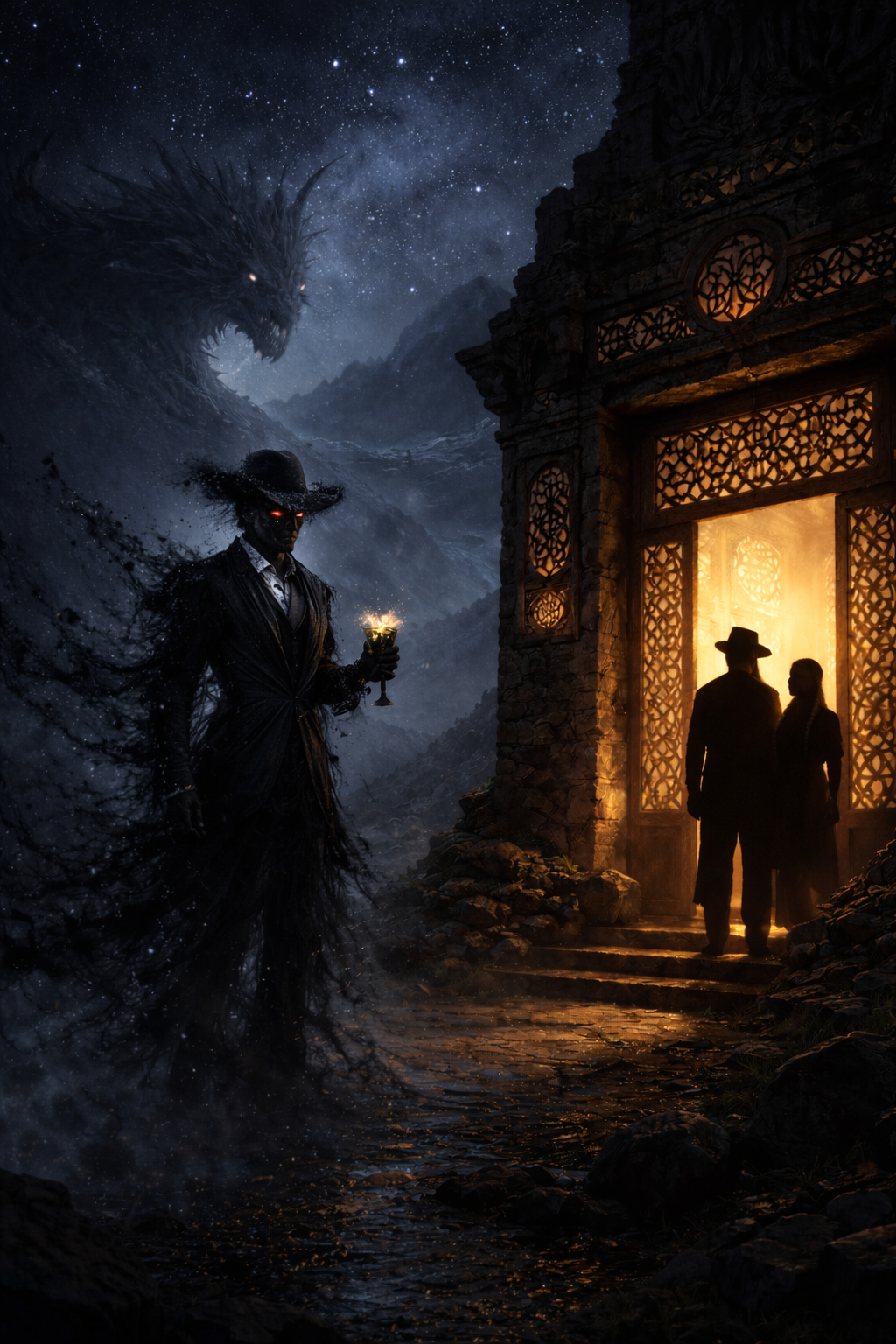
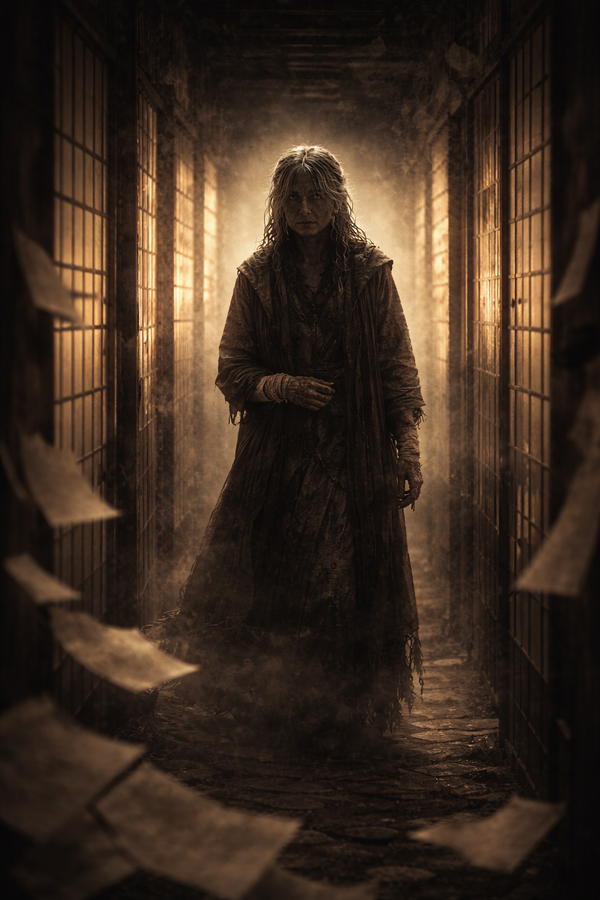
The Demon Shadow rode the void the way a storm rides wind—without effort, without apology. Beneath him the Chief of Dragons moved like a continent making up its mind. With each city emptied, each bell taught to swallow its second note, the Chief grew more exact. Night bent around their passage, constellations curving toward absence as iron filings lean to a magnet. From that high unraveled sky, the demon looked down and saw the House of Light holding its square of law against the dark.
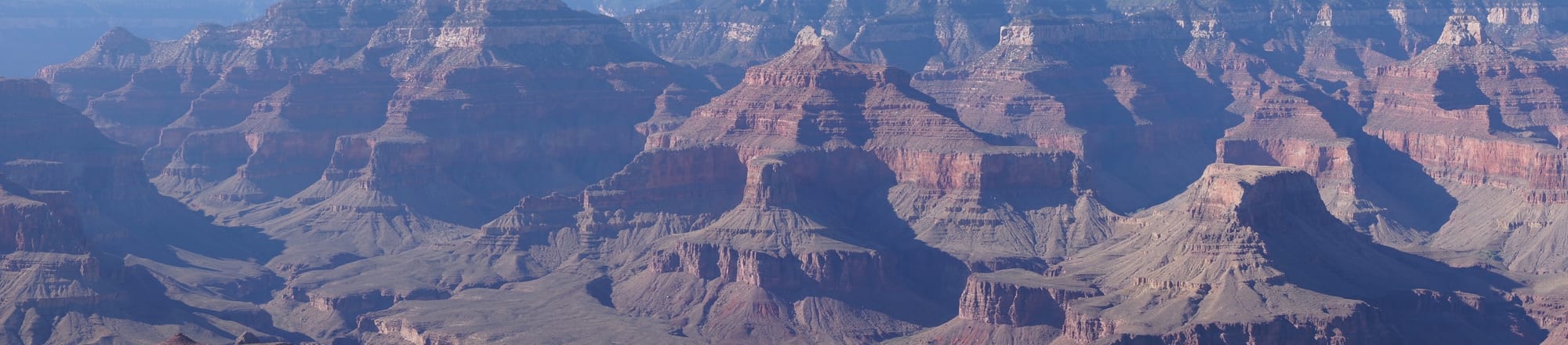
They descended. The Chief settled along the ridge as a mountain settles into a map—ribs of night, hollows where seasons would be, a horizon erased and redrawn in one breath. The demon dismounted like lightning finding a home in a dead tree: sudden, precise, satisfied with the ruin it could make from stillness.
He conjured a glass from the air, and sugar rose obediently, frothing to the lip, head bright as sin. He crossed the moonlit apron and knocked.
The House refused the knuckles of shadow. His fist smoked, then froze—the instant sting of dry ice on skin, a cold that announced itself in the bones and left fingerprints of pain. He stepped back, smiling with all the teeth a courteous man is permitted to show.
“Borders,” he said to the door, admiring the Adinkra set through cedar and iron. “I respect a line that remembers itself. We shall converse, then.”
The lattice let voices through and nothing else.
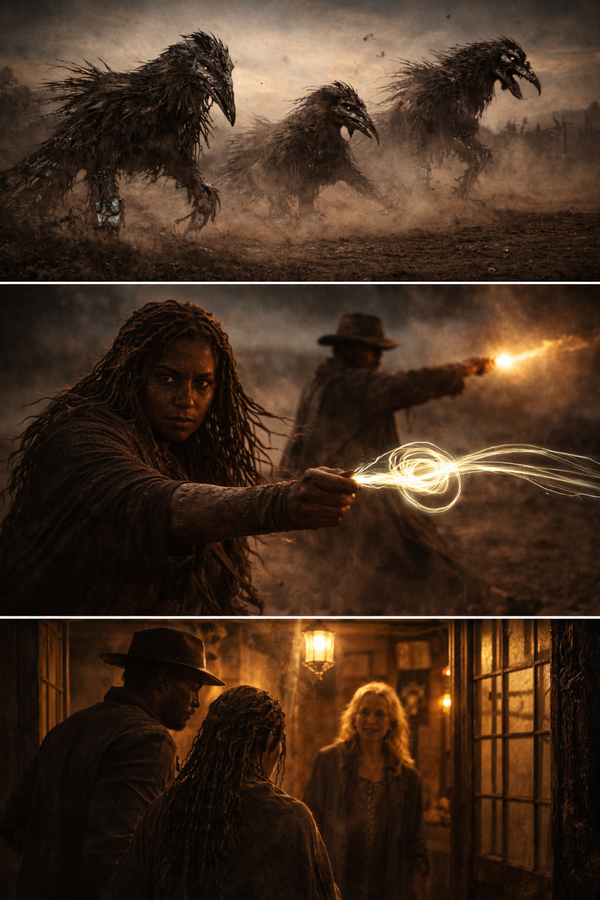
Inside, Hope and the gunslinger woke to the demon’s words, braided through the House’s hum like barbed wire through a hymn. They rose without hurry that could be mistaken for fear. The belts of fresh rounds lay coiled like tame serpents. The meteor’s absence sang its small, approving note.
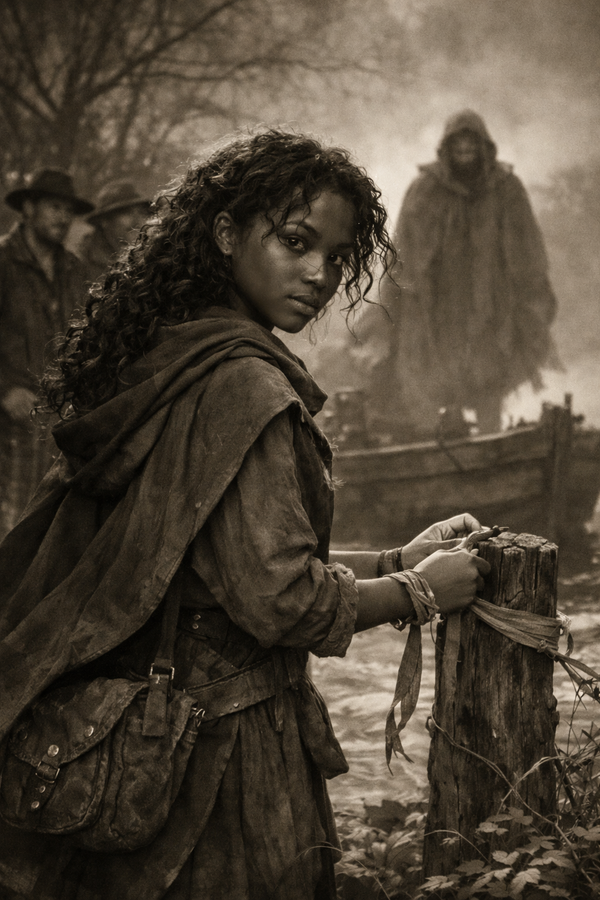
The gunslinger went to the door and set his hand against Fawohodie without crossing the sill. Hope stood just behind his shoulder, paper voice unspent, the empty sling tied close as a rule.
“Good evening,” the demon called, standing in the moon that used the House as a lens. “Long road, gentlefolk. You must be parched.”
He lifted the glass. The sugar head held like foam that had learned to be a crown.
“Drink?” he asked, genial as a host. “Sweetness for the ache.”
“I’ve had my fill,” the gunslinger said. “Unless you’re pouring birds now. Got a phoenix on tap?”
The demon’s smile thinned with pleasure. “We both know I won’t do that.”
“Worth asking,” the gunslinger said.
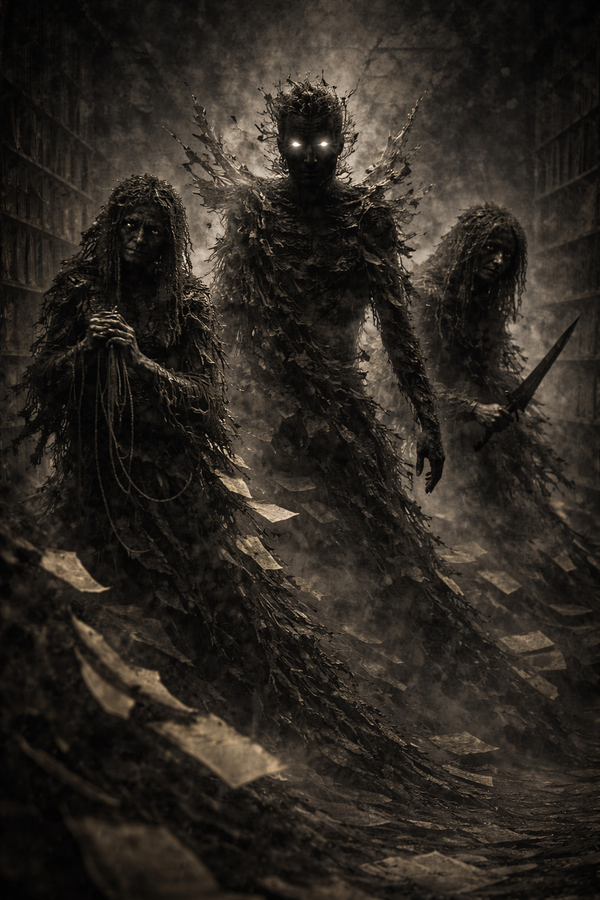
Behind the demon, the Chief of Dragons watched, a mountain of mountains. It wore the constellations like a coat it had stolen and made fit; its breath subtracted distance. Where its body should have ended, the void continued, and where the void should have ended, the earth complied. To look at it was to learn how horizons lie.
“You’ve been busy,” Hope said, and the House warmed a degree at the sound of her not-laugh.
“Education,” the demon replied. “Mostly refurbished ambushes.” He tipped the glass, let a bright rope of sugar spill onto stone, where the lattice-light refused to let it be sticky. “And now: commencement.”
He glanced up at the Adinkra cut into the doorframe—Mpatapo and Epa in their patient braids, Sankofa at the frieze, Gye Nyame turning slow where only meaning can bear weight.
“You have made yourself dangerous,” he said to the gunslinger. “Starlight taught to bite, feather taught to instruct gravity. A neat syllabus. I propose a practicum.”
The gunslinger did not blink. “Say it.”
“A face-off,” said the demon pleasantly. “You and yours against the Chief of Dragons—my elder, my ledger, my mountain that does not apologize. No riddles to bind your tongues. No bartenders to tilt the floor. The plateau will serve as arena; the sky will audit. If you win, you win. If you lose, there will be no need to discuss outcomes.”
“And you?” Hope asked. “What do you risk, aside from the pleasure of your own voice?”
“Visibility,” he said, and the word tasted like copper in the air. “The bird, if you force my hand. The map I drew of this land’s thin places, which I would rather not have you read aloud. Risk is not a stranger to me, girl. I introduced him to half your towns.”
The House thrummed under their feet—a warning, a permission, both. The gunslinger felt the belts at his hip the way a man feels his name fit in his mouth: true, and costly to misuse. Hope angled her palm against the door’s inner beam and felt the lattice answer with the smallest nod a house can give the people it likes best.
“Terms,” the gunslinger said. “Ground. Hour.”
The demon looked to the Chief; the Chief looked at nothing at all and the canyon behind the ridge obligingly deepened. “When the second bell rings from the last honest tower you have left,” the demon said. “And on the field where molten rock remembers how to be river. There is room enough for instruction.”
“You ring the first,” Hope said.
“I don’t ring anything,” the demon replied. “I arrive, and bells remember their manners poorly.”
Silence stood up between the door and the moon. The demon drained the glass; the sugar went nowhere a stomach could use. He set the cup on the threshold. It frosted at once and then cracked down the middle with a sound like a thin lie ending.
“Come out and meet your hour,” he said softly. “Or stay and wake to find every book you’ve ever loved speaking my grammar.”
The gunslinger rested his knuckles on the wood, the way a man tips his hat when he promises to keep a promise. He did not cross.
“We’ll meet you,” he said. “On the field that remembers river. When the second bell rings.”
“And not before,” Hope added.
The demon inclined his head. “Students who keep office hours. Delightful.”
He stepped backward into his own weather. The House’s light refused his shadow a perch. Behind him, the Chief shifted and the night rode higher on its spine. For a moment, the world was an equation with too many terms and then, as equations do when watched by people who intend to survive them, it simplified.
“Rest well,” the demon said. “You will want a steady hand. Star-iron punishes tremors.”
He mounted the void the way a storm reconsiders a coastline and rose, taking half the horizon with him. The House exhaled, small and clean. The cracked cup skated itself to the edge of the threshold and fell, shattering into a frost so fine it looked like dust and then was not.
They did not speak for a count of ten. Then Hope set her palm to Fawohodie and felt the door speak freedom in a grammar that refuses panic.
“He wants us visible,” she said.
“He wants us spent,” the gunslinger said. “We’ll oblige him by being precise.”
She looked up through the lattice windows. Orion held steady; the middle belt star refused to blink.
“Second bell,” she said.
“Second bell,” he agreed.
They stepped back from the door. The House settled its light on them like a shawl that belongs to the whole family. Outside, the mountain of mountains wrapped the night tighter around itself and moved away just far enough to be courteous.
Inside, two people laid out belts bright as decisions and closed their eyes, not to sleep, but to learn the shape of the hour they had agreed to meet. The chapter kept its breath, and beyond the ridge the first bell began looking for its nerve.