Chapter VI: The girl and the boy
They still called it a town in those days, though it was mostly a street with ideas. The water tower hadn’t learned to sing yet, and the bell in the church hung new and bright and true. The boy who would grow up to be the gunslinger slept under a window that stuck in summer. He could find his way to the pump in the dark without thinking and was just learning the trick of breathing dust without tasting it.
The girl who would grow up to be the sorceress lived three doors down over a shop that sold needles and notions and the kind of ribbon people bought when they felt luck coming. She was small and sharp and poor and quicker than her body looked. Nights she read by lamplight with the window cracked, mouthing the letters as if they might bite back. Sometimes they did.
The night it happened, the girl's mother had left after midnight with a shawl and a ribbon and a copper nail in her pocket, telling no one, not even the man whose sleep had turned shallow since the fields began to sing his name. For years she’d watched his fingers worry the fence wire as if taking the pulse of a patient, seen the small round scar in his palm where a nail’s head had once pressed—sign enough that a crossroads had listened. But the bell in town rang its honest two notes as she walked, and she timed her steps between them, following the old ditch to where four roads make a hinge in the world. There she knelt, set a penny under her tongue, and spoke to the dirt in the quiet grammar of people who fix what can’t be admitted out loud: show me what he traded; show me how to pay it back.
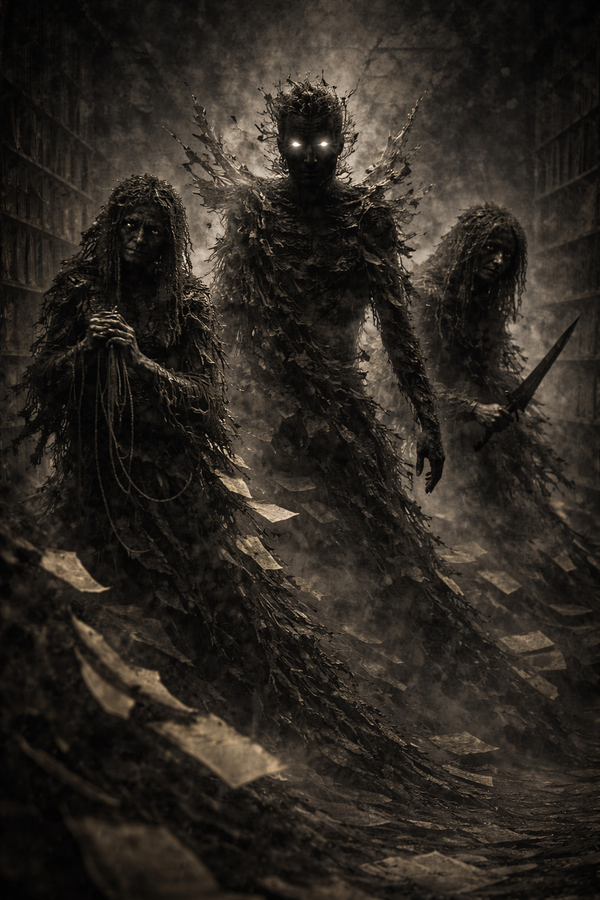
The ghostly remnant of a thing that answers such questions came wearing a patient smile and the kind of coat dust won’t keep—trying on a memory. It recited the terms like a notary reading a will: the husband’s breath bound to the harvest, copper for corners, name in the wire; the town to prosper while he lasted, to hunger when he did; release only through another binding of equal weight. “A bell that lies,” he mused, “or a voice that won’t heal right, or fire borrowed from a bird that knows your laugh—choose wisely.” And the memory smirked. She did not give him the pleasure of recognition. She stood very still and weighed the terrible arithmetic, the way a surgeon weighs a necessary cut. Then—she felt it: wind gone metallic on her tongue, the home bell reaching for its second note and failing. Something had opened where she had left a door.
She ran the ditches home and found the proofs waiting: the book’s clasp warm-cold-warm, stitches slackened where phoenix quill had once held a shape; dragon heat wavering over the tannery; her husband at the fence with both hands on the wire, humming pain he could not hide; her daughter upright and struggling for breath, voice turned to paper.
That night, late and windless, two men lifted the shop latch with a hook made from a spoon and moved upstairs with their hands under their coats. The girl had left the window open for the book’s sake, and the men came in by that soft door. There wasn’t much to take—some thread, a tin with buttons and a few coins—but men like that always think there’s more in a poor room if you look with a hard enough want.
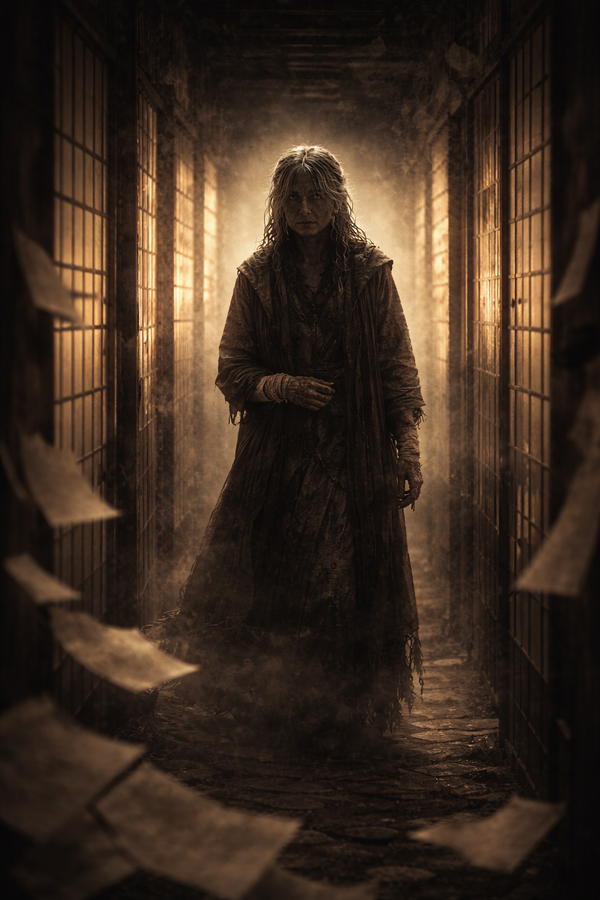
She woke to one of them pointing toward the cupboard where she kept the book with the old words in it, the one that smelled like damp wool and lightning. Maybe they’d seen her reading. Maybe they only knew that thin purses sometimes hide fat luck. She tried to shout and the nearer man set his hand to her throat to hush the air at the source. He squeezed fast and hard and the world went black to a small point where a handful of letters sat and stared back at her: four words she wasn’t supposed to say aloud.
She said them anyway.
The words broke across the dark like a match. The men yelped and staggered back, because the room went cold and then hot and then both, and something climbed through the window without touching the sill. It was not a man, not quite—only the shape a fear takes when it’s been given a mouth. It took the room’s light for a coat and smiled, and one of the men dropped his hook and the other his courage. They ran. The girl tried to call after them—stop, or sorry, or take the money, please—but what came out was a papery rasp, a rustle like a page turning: the new sound her throat would make forever.
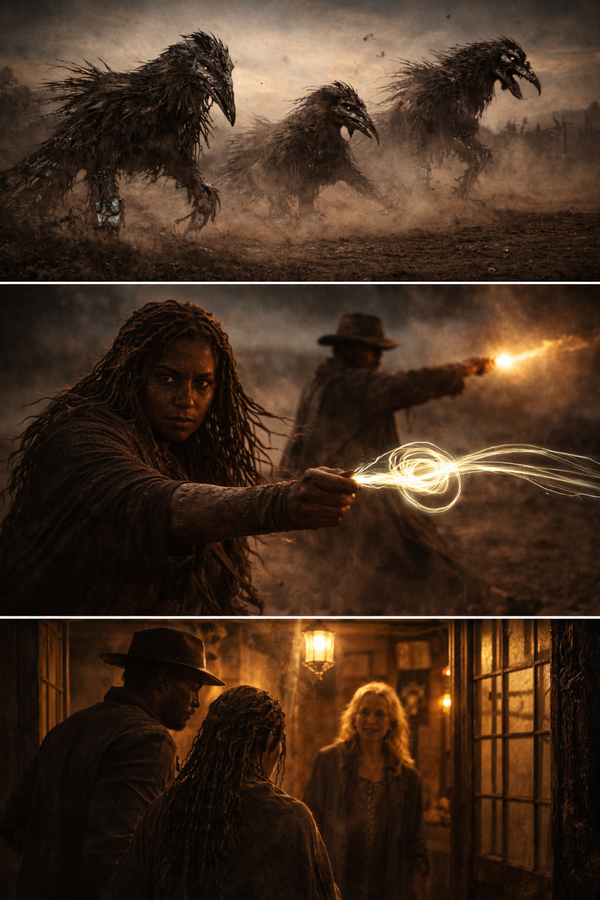
The thing that had come leaned down as if to listen better. Behind it, out in the lane, something bigger uncoiled with a machinery sigh: a dragon, heat braided with darkness, called by accident out of the part of the world that has no use for crops. It stalked along the fence behind the tannery, leaving no prints and a trail of dry in the grass. The thing in the room smiled with a hundred borrowed smiles and left the way it had arrived. The dragon followed as if on a leash of thought. In the morning, people blamed boys for the footprints they could understand and looked away from what their eyes tried to turn into weather.
She could have run away that night. Her voice was a broken page and her hands wouldn’t stop shaking, and running is the first miracle the body believes in. She didn’t. In the morning aftermath she took bread and thread to the neighbor with the wet cough and pulled the fever into a jar of sugar with three turns of a spoon and a word that felt like swallowing a coin. It left the boy panting and pink and hungry. It left the jar heavy and sweet. When the boy’s mother cried, the sound made the girl’s throat ache, but the girl only nodded and took back the spoon. “There will be a cost,” she said, because the book had been clear and the thing in the room had been clearer.
“What cost?” the mother asked.
“Not today,” the girl said, and that was the first debt she wrote on the town without ink.
She learned as her body lengthened and her hands steadied. She learned which salts belong in which corners, how iron likes to sit at the four extremities of a circle, how to sew a stitch into a hem that will not let a knife remember its edge. She learned to draw a fever out and put a heartbeat back. Babies were born who might not have; old men sat up and asked for soup just to argue. The girl’s voice never recovered. It sounded like paper rubbed thin. People leaned in to hear her; the wind did too.
When she asked for payment, it was not always coins. Some mornings she took a day from a man who had too many the way some men have too much wheat; some nights she took a memory that would only hurt the one who kept it; some afternoons she asked for a name to be put away for a week while a wound remembered how to close. She kept a ledger she never showed anyone, a list of givings and takings. The town kept one too, with her name on every other line. Half the people counted blessings; the other half counted the ways a blessing might be a trick.
Then the fields went yellow the wrong week and stayed. The river peeled back from its banks and licked its teeth. Children came home with stories about a shadow walking through the corn that never broke a leaf and never cast shade the way a good shadow should. When the wind shifted, there was that taste in it: salt-iron and a copper penny pressed to the tongue. The bell in the church rang right in the mornings and wrong at noon. A man said he saw heat bending over the far pasture, like a stovetop had raised its hand.
Some people went to the girl and asked for rain. She made a promise shaped like a circle in flour on a table. It brought a cloud and the cloud passed like a polite stranger. Some people went to the preacher and asked for forgiveness. He gave them words that cost too little. Some people stood up at the meeting under the water tower and said the words fear likes to wear when it leaves home: witch, trouble, bringer.
The night before the vote, the dragon walked the bottoms and the crops crisped in their jackets. You could pinch a stalk and it would shatter like a thin bone. Men went out with shovels as if you could dig for water inside a fire. Women stood with buckets and did not cry, because crying is what you do when loss is done, and this loss was still working.
In the morning, the town agreed with itself to cast the girl out and then argued about the posture. Some wanted a rope and a tree because ropes and trees make men feel like they’ve stood up. Some wanted merely to add her name to the list of things not talked about: a quieter kind of killing. When the moment came, the only two people who moved with decision were the boy’s mother and father—the boy who would someday be the gunslinger, though at the time he was just a child with ink under his nails from tracing floorboards.
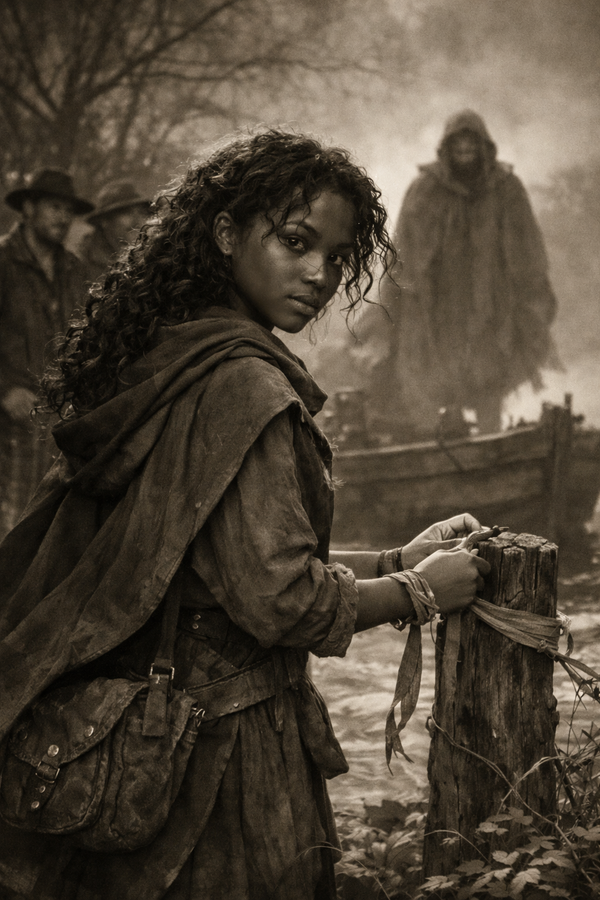
They took the girl by the elbow and did not ask permission, because permission would have been a kind of betrayal. They led her out through the back of the meeting hall where the paint never dried right and through the lot behind the livery and into the stand of cottonwoods that remembered every promise ever told under them. The father lifted the rail at the old fence; the mother pushed the girl through and put bread in her hands and a ribbon in her pocket and said, “Go before any of us change into someone we won’t know later.”
The girl tried to answer. Her paper voice made a sound like wind sorting letters on a porch. She looked down at the child by the mother’s skirt and the child looked back with the kind of seeing that sometimes happens once in a lifetime and sometimes never. She put her hand on his head and felt a heat there—not fever, but the part of a person that will not be tricked forever. It scared and comforted her in the same breath.
“Wait,” the father said, and he ran back and came out with a shawl and a small book and a look that lived halfway between pride and apology. He lifted his hands as if to bless her and let them fall because blessing is a thing you say with a throat that makes more than rustle.
She walked. She did not look back because back was a kind of hanging. At the edge of the cottonwoods, she stopped. Anger kept pace with her; gratitude sat down to rest. She knew the town would make a story of her whether she had one left in her or not. She knew stories sharpen quickly when they are afraid.
So she turned and—out of gratitude, out of spite, out of the knowledge that a thrown wish can do harm long after the hand has forgotten the throw—she spoke another spell, this one shaped like a blanket. Forgetting fell over the town the way ash settles after the fire moves on: thin and equal and inescapable. It softened the edges of the girl’s name and blurred the details of the night in the upstairs room and the vote under the tower. People woke the next day with the relief you feel when you can’t recall the bad dream that made you get out of bed. They set their shoulders and fetched their water and didn’t know why the sight of a certain house made their jaw ache.
But she remembered everything—she knew that would be her curse.
Still, magic, even the kind meant as mercy, leaves a remainder. When you pull out memory, the hole it makes still wants filling. The town filled it with the nearest thing that would hold a nail. They decided, without deciding and without knowing, that the family who had lifted the rail at the fence had done something wrong. They didn’t remember what. They didn’t have to. Hatred doesn’t need names to cling; it only needs a shape.
In the weeks that followed, men spit near the father’s boots and smiled like it was weather. The mother reached for sugar on the mercantile shelf and found her hand moved aside by a hand that pretended it hadn’t meant to. The boy heard his name said in the tone that means somebody ought to do something and did not yet know how to put that tone down without breaking something else in the process.
Worse: a wish said in heat will sometimes sprout in cold. The night after the girl left, standing in the ring of the failed crops, the town said its wish out loud without listening to itself. “Let the evil we fear find its true home,” someone said, and others nodded and made the sound men make when they think they have solved the part that hurt. The air heard and did what air does with a thrown nail: it carried it where it was pointed. The wish learned the shape of the street and the house and the boy who slept under the sticky window.
Years later, when the dragon came heavy and flying and the bell choked on the second note as if strangled by a familiar hand, some of the old men swore they recognized the smell on the wind. They did not know why. Memory is a ledger with more pages than sense. The girl, grown into a woman who healed and measured and made rules the way a careful person makes bread, would return to the edge of the town she had blessed into forgetting and take stock and make mistakes and lay down more rails for fate to follow—she longed for a life she could control.
But before all that, there was the boy at the pump learning how to draw water clean without splashing, hearing men say a name they didn’t know in a tone that said a rope would be useful, and there was the girl walking east with a paper voice and a ledger with no place yet for mercy, and there was a wish hurrying along the fence line like a small clever animal that knew the path by heart.
The town would call what came after “justice” in some seasons and “accident” in others, because people need their words to match the weather. The boy would grow up under both those skies. He would learn the taste of the wind when it has copper in it, and he would learn the sound a bell makes when it has been taught to lie. And somewhere beyond the cottonwoods, the girl would teach herself to speak loudly enough for the wires to carry, and softly enough for a man to believe what wasn’t good for him.